Ahsan Javaid
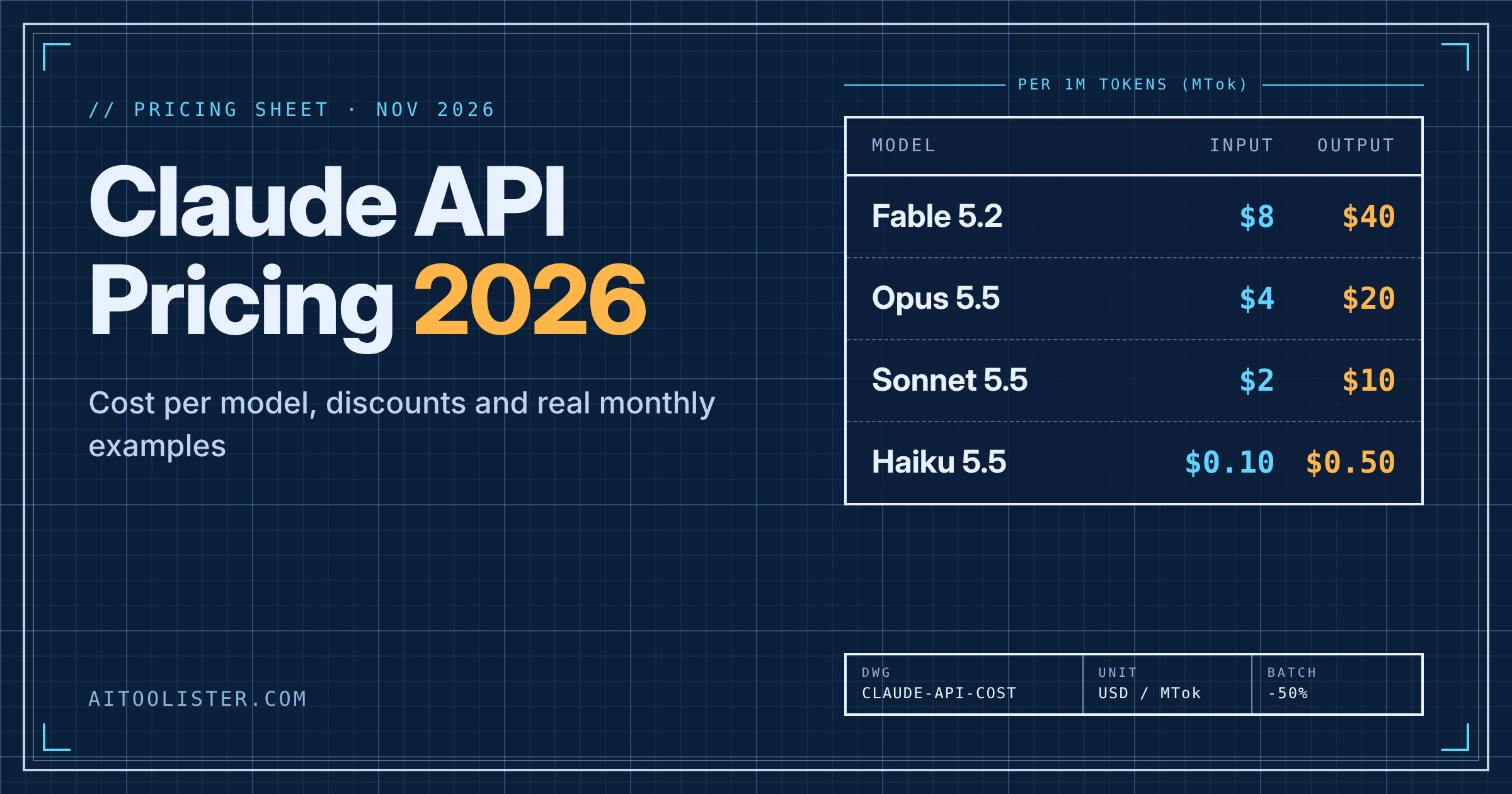
Claude API pricing is pay-as-you-go, billed per million tokens (MTok). On the current models it runs from $0.10 per MTok of input and $0.50 per MTok of output on Claude Haiku 5.5, up to $8 input and $40 output on Claude Fable 5.2. Output costs five times as much as input on every current model, so long answers drive most bills. Batch processing halves the price, and prompt caching can cut repeated input by 90% or more.
This guide covers the price of each model, what the units mean, the extra charges that sit on top of tokens, worked cost examples, and when a Claude subscription is cheaper than the API.
How we checked: all prices come from Anthropic’s and OpenAI’s official pricing pages and documentation, reviewed on 7 November 2026, and updated for Claude Fable 5.2 on 12 November 2026. Prices are in USD and exclude tax.
Claude API pricing at a glance
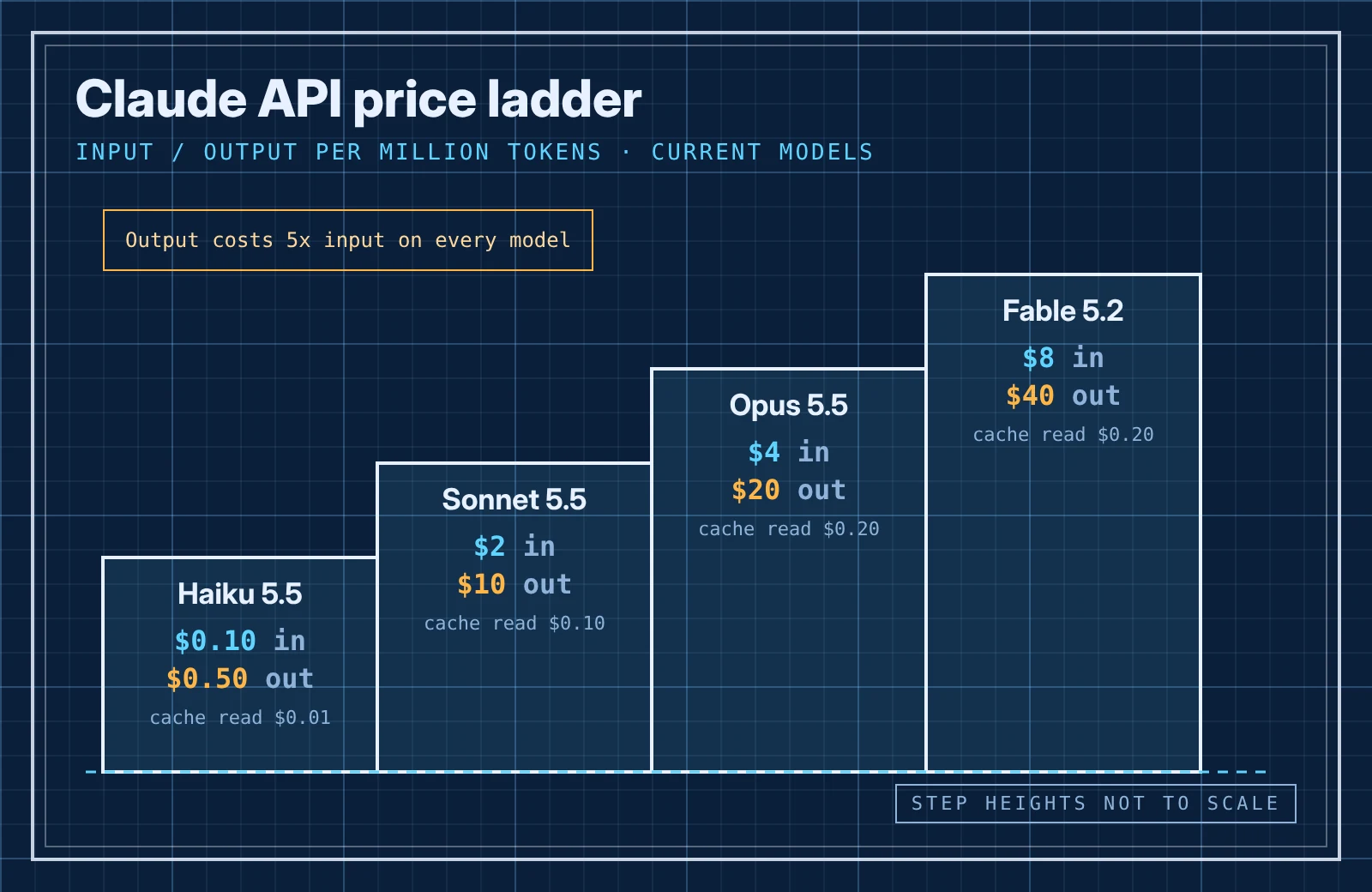
| Model | Best for | Input / MTok | Output / MTok | Cache read / MTok |
|---|---|---|---|---|
| Claude Fable 5.2 | Hardest reasoning and long-running agents | $8 | $40 | $0.20 |
| Claude Opus 5.5 | Agentic coding and complex knowledge work | $4 | $20 | $0.20 |
| Claude Sonnet 5.5 | Most production apps: speed plus intelligence | $2 | $10 | $0.10 |
| Claude Haiku 5.5 (prompts up to 100K tokens) | High-volume classification, extraction, routing | $0.10 | $0.50 | $0.01 |
| Claude Haiku 5.5 (prompts over 100K tokens) | Same, with long prompts | $0.50 | $2.50 | $0.05 |
Source: Anthropic’s pricing documentation.
Sonnet 5.5 is a sensible starting point for cost-conscious production applications, while Anthropic recommends Opus 5.5 as the starting point for most workloads. Benchmark both against your quality, latency and token-cost requirements. Move simple, high-volume tasks to Haiku 5.5, and reserve Opus 5.5 or Fable 5.2 for work where a cheaper model’s mistakes cost more than the token difference. Our latest Claude model guide compares what each model is best at.
What MTok means and how Claude counts tokens
MTok stands for one million tokens. A token is a chunk of text, often part of a word. The API bills two types of tokens:
- Input tokens: everything you send, including the system prompt, the conversation history, documents, tool definitions and tool results.
- Output tokens: everything Claude writes back. Thinking tokens also bill as output, even when the thinking text isn’t returned to you.
So the Claude API cost per token is the MTok price divided by one million. On Sonnet 5.5, one input token costs $0.000002 and one output token costs $0.00001.
Why output costs more
Output is priced at 5x input on all four current models. For a chatbot that sends a long system prompt and gets short replies, input dominates. For report writing, code generation or extended thinking, output dominates. Capping max_tokens and asking for concise answers are the cheapest savings available.
The newer tokenizer changes the math
Claude 4.7 and later models, which include every current 5.x model, use a newer tokenizer. Anthropic says it produces approximately 30% more tokens for the same text than earlier models, and that the exact increase depends on the content and workload.
That matters when you compare generations. Sonnet 5.5’s $2 input price is a third lower than Sonnet 4.6’s $3. If your text produces 30% more tokens, though, the effective input cost works out to roughly $2.60 for the same text, about 13% cheaper rather than 33%. Treat that as a rough illustration, not a fixed rule. To get your real number, run a sample of your own prompts through Anthropic’s token counting endpoint with each model ID.
Tools add tokens too. Declaring any tool adds a hidden tool-use system prompt of a few hundred tokens per request, and heavier toolsets such as browser use add several thousand.
Claude API price by model
Claude Fable 5.2
Fable 5.2, released November 9, 2026, costs $8 per MTok of input and $40 per MTok of output, down from Fable 5.1’s $10 / $50. It is Anthropic’s most capable widely released model, built for demanding reasoning and long-horizon agent work. Its standout pricing detail is caching: a cache read costs $0.20 per MTok, just 2.5% of the input price. That makes it far cheaper than it looks for agents that reread the same large context many times.
The trade-off is plain: at twice Opus 5.5’s per-token price, Fable 5.2 only makes sense when the extra capability changes the result.
Claude Opus 5.5
Claude Opus API pricing is now $4 input and $20 output per MTok, 20% below Opus 5’s $5/$25. Anthropic also states that Opus 5.5 uses fewer tokens per task and estimates typical token-billed workloads cost about 40% less than on Opus 5. That 40% is Anthropic’s own estimate, so check it against your workload.
Cache reads cost $0.20 per MTok, 5% of the input price. Opus 5.5 is also the only current model with fast mode, a faster output option at $8 input and $40 output per MTok.
Claude Sonnet 5.5
Sonnet 5.5 costs $2 input and $10 output per MTok, with cache reads at $0.10. Anthropic positions it as the best combination of speed and intelligence, and it is the sensible default for chat products, coding assistants and most agent workflows. At half of Opus 5.5’s price, it is worth testing Sonnet first and only moving up when quality falls short.
Claude Haiku 5.5
Haiku 5.5 is the cheapest current model and the only one priced by prompt length:
- Prompts up to 100,000 tokens: $0.10 input and $0.50 output per MTok.
- Prompts over 100,000 tokens: $0.50 input and $2.50 output per MTok.
The threshold counts every input token in a request, including cache reads and writes. A request that crosses 100,000 tokens pays the higher rate on the whole request, not just the excess. Haiku 5.5 is therefore excellent for short, frequent jobs like classification, extraction and routing. For long documents, compare it with Sonnet 5.5, since a 150K-token Haiku request costs a quarter of Sonnet’s input price rather than a twentieth.
Older Claude models and recent price changes
Older models stay available at their own rates, which is why some articles still quote different numbers.
| Model | Input / MTok | Output / MTok |
|---|---|---|
| Claude Fable 5.1 and Fable 5 | $10 | $50 |
| Claude Opus 5, 4.8, 4.7, 4.6, 4.5 | $5 | $25 |
| Claude Opus 4.1 and Opus 4 | $15 | $75 |
| Claude Sonnet 5 | $2 | $10 |
| Claude Sonnet 4.6, 4.5 and Sonnet 4 | $3 | $15 |
| Claude Haiku 4.5 | $1 | $5 |
Two changes explain most of the confusion. First, Sonnet 5 launched at an introductory $2/$10, with $3/$15 originally scheduled to follow. Anthropic later made the $2/$10 price permanent and dropped the increase. Second, Opus 5.5 arrived below Opus 5. If a page quotes $15 input for “Claude,” it is describing Opus 4 or 4.1, not the current lineup.
Cache reads differ between generations too. Fable 5 charges $1 per MTok for a cache hit, while Fable 5.1 charges $0.25, even though their input and output prices match.
How batch processing and prompt caching lower your bill
Batch API: 50% off
The Batch API processes requests asynchronously at half price on both input and output. Sonnet 5.5 drops to $1/$5 per MTok and Haiku 5.5 to $0.05/$0.25 for short prompts. It suits anything that doesn’t need an instant reply: document summaries, data labeling, evaluations and overnight reports. Fast mode can’t be combined with the Batch API.
Prompt caching
Caching stores a repeated block of input, such as a long system prompt or a reference document, so later requests read it cheaply instead of paying full price again.
| Cache operation | Price vs base input | How long it lasts |
|---|---|---|
| 5-minute cache write | 1.25x | 5 minutes |
| 1-hour cache write | 2x | 1 hour |
| Cache read | 0.1x by default; 0.05x on Opus 5.5 and Sonnet 5.5; 0.025x on Fable 5.2 and 5.1 | Same as the write |
A 5-minute cache pays for itself after one cache read, and a 1-hour cache after two. If your app sends the same instructions every few seconds, caching them is close to free money.
Stacking discounts
Batch and caching discounts multiply together. Data residency also stacks: pinning inference to the US adds 1.1x on top of everything else.
| Sonnet 5.5, per MTok | Input | Output |
|---|---|---|
| Standard | $2.00 | $10.00 |
| Batch API | $1.00 | $5.00 |
| Cache read | $0.10 | n/a |
Extra costs beyond tokens
Most Claude API bills are almost entirely tokens, but these items can add to them:
- Fast mode (Opus 5.5): $8 input and $40 output per MTok, double the standard rate, for up to 2.5x faster output.
- US-only inference: a 1.1x multiplier on all token prices when you set the
inference_geoparameter to US. - Web search: $10 per 1,000 searches, plus the tokens from the search results.
- Web fetch: no extra charge beyond the tokens of the fetched content.
- Code execution: free when used alongside web search or web fetch. Otherwise each organization gets 1,550 free hours a month, then $0.05 per container-hour, with a 5-minute minimum per execution.
- Claude Managed Agents: $0.08 per session-hour of active runtime, on top of tokens.
Long context isn’t an extra cost on most models. Every current model except Haiku 5.5 bills the full 1M-token context window at standard rates, so a 900K-token request pays the same per token as a 9K-token one.
Claude API cost examples
How these estimates work: each one multiplies the stated token volumes by Anthropic’s published per-MTok prices for that model. They exclude tax, tool charges and data residency, and they leave out cache writes unless stated. Real bills depend on your actual token counts, so treat these as starting points.
What 100,000 tokens cost
| Model | 100K input tokens | 100K output tokens |
|---|---|---|
| Fable 5.2 | $0.80 | $4.00 |
| Opus 5.5 | $0.40 | $2.00 |
| Sonnet 5.5 | $0.20 | $1.00 |
| Haiku 5.5 (short prompts) | $0.01 | $0.05 |
A customer support chatbot
Assume 10,000 conversations a month, each with 2,000 input tokens and 500 output tokens. That is 20 million input tokens and 5 million output tokens.
| Model | Monthly cost |
|---|---|
| Opus 5.5 | $180.00 |
| Sonnet 5.5 | $90.00 |
| Sonnet 5.5, with a cached 1,500-token system prompt | $61.50 |
| Haiku 5.5 | $4.50 |
The Sonnet 5.5 figure is $40 for input plus $50 for output. With caching, 15 million input tokens become cache reads at $0.10 per MTok ($1.50), and the remaining 5 million uncached tokens cost $10, so the total is $61.50. That figure leaves out cache writes. A 5-minute write of the 1,500-token prompt costs less than half a cent each time, so it only adds up if chats are spread out enough that the cache keeps expiring.

Notice that output is $50 of the $61.50. Shorter replies would save more than any further input optimization.
A batch summarization job
Assume 50,000 documents, each with 3,000 input tokens and a 300-token summary, on Sonnet 5.5. That is 150 million input tokens and 15 million output tokens.
- Standard API: $300 input plus $150 output, a total of $450.
- Batch API: $225.
- The same job on Haiku 5.5: $22.50 at standard rates, or $11.25 with the Batch API, if its summaries are good enough for your use.
Estimate your own Claude API cost
Enter your expected monthly requests and average tokens per request in the calculator below. It uses the same published prices, switches Haiku 5.5 to its higher rates when a prompt exceeds 100,000 tokens, and can apply cache reads and the Batch API discount. It leaves out cache writes, tool charges and US-only inference. It also assumes your requests are roughly the same length: Haiku 5.5’s price tier is set per request, so if some of your prompts are under 100,000 tokens and some are over, calculate each group separately and add the results.
Claude API cost calculator
Estimates a monthly bill at Anthropic’s standard published prices (USD, checked 12 November 2026).
Estimated monthly cost
$0.00
- Uncached input$0.00
- Cache reads$0.00
- Output$0.00
Prompts over 100,000 tokens: Haiku 5.5’s higher rates ($0.50 / $2.50, cache reads $0.05) apply to the whole request.
Excludes tax, cache writes, tool charges (such as web search) and the 1.1x US-only inference multiplier. Assumes requests are roughly the same length. Haiku 5.5’s price tier is set per request, so if some prompts are under 100,000 tokens and some are over, calculate each group separately and add the results.
Is Claude API cheaper than ChatGPT API?
At list price, the mid and low tiers still match, but Claude’s top tier is now cheaper: Fable 5.2 costs $8 / $40 against GPT-6 Astra’s $10 / $50. Here are OpenAI’s standard rates for prompts under 272K tokens, per OpenAI’s API pricing page:
| Tier | Claude model | Input / Output per MTok | OpenAI model | Input / Output per MTok |
|---|---|---|---|---|
| Top | Fable 5.2 | $8 / $40 | GPT-6 Astra | $10 / $50 |
| Mid | Sonnet 5.5 | $2 / $10 | GPT-6.1 Sol | $2 / $10 |
| Low | Haiku 5.5 | $0.10 / $0.50 | GPT-6 Luna | $0.10 / $0.50 |
Both providers also offer 50% off for batch work. Their standard web search tools are both listed at $10 per 1,000 searches, though OpenAI charges a different rate for some older search tool variants.
Identical prices don’t mean identical models or identical bills. The models differ in capability, so one may need fewer retries or shorter prompts for your task. They also use different tokenizers, so the same text produces a different number of tokens on each. The real cost gaps show up in three places:
- Cache reads at the top tier: Fable 5.2 charges $0.20 per MTok versus $1.00 on GPT-6 Astra, which favors Claude for agents that reuse large contexts.
- Long prompts: OpenAI’s listed standard rates apply under 272K tokens. Claude’s current models, except Haiku 5.5, keep standard rates up to 1M tokens, while Haiku 5.5 reprices above 100K.
- Token counts: run a sample of your real prompts through both providers’ token counters before deciding.
For a broader look at the two assistants beyond price, see our ChatGPT vs Claude comparison.
Claude API vs Claude subscription: which costs less?
The API and the Claude apps are billed separately, and that separation causes most of the “subscriptions are cheaper” debate.
- API: you’re billed for the tokens and services you use, and you can build your own apps on it. Your organization is still subject to API rate limits and any spend limits you set.
- Subscriptions: Pro costs $20 a month ($17 a month billed annually), Max starts at $100 a month, and the $200 top tier is now called Ultra. You pay a flat price for chat, Claude Code and the other Claude apps, within usage limits that vary by plan. Most plans combine five-hour and weekly limits; Max and Ultra allow much more usage than Pro, and verified Ultra accounts have no five-hour limit. Our Claude AI pricing guide compares all six plans.
Some plans also include API credits, and these are separate from subscription usage:
| Plan | Monthly API credits |
|---|---|
| Free, Pro, Enterprise | None |
| Max | $100 |
| Ultra | $200 |
| Team | $20 per Standard seat, $100 per Premium seat, pooled up to $500 |
The credits work only on the Claude API in the Claude Console, plus Managed Agents, the Agent SDK and the playground. They do not cover Claude Code or extra usage in the Claude apps, and they expire at the end of each billing cycle with no rollover. Claude Code usage comes out of your subscription’s usage limits instead. When paid-plan users hit those limits, they can turn on usage credits to keep working at standard API rates.
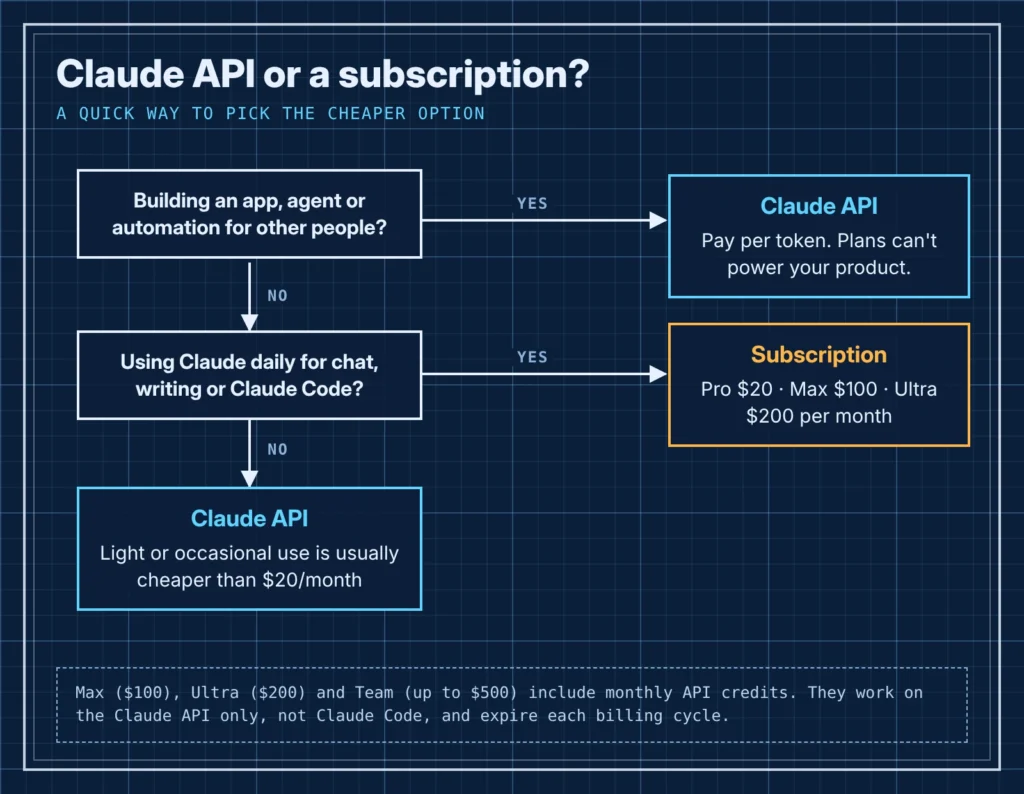
Here is a simple rule of thumb:
- Building an app, automation or agent for other people: use the API. Subscriptions can’t power your product.
- Occasional scripts or light testing: the API is usually cheaper than a $20 plan.
- Daily chat, writing or heavy Claude Code use for yourself: a subscription is usually far cheaper than paying API rates for the same work. Our Claude Code pricing guide compares the plans for coding.
- Businesses: Team adds pooled API credits for building. Enterprise costs $20 per seat a month, billed annually with a 20-seat minimum, plus usage billed at API rates.
If you’re still deciding whether Claude suits your work at all, our guide to what Claude AI is good for covers its strengths and limits.
FAQ
Is Claude’s API free?
No, there is no free tier. Anthropic gives new API accounts a small amount of free credits for testing but does not publish the amount. Max, Ultra and Team subscribers get monthly API credits included with their plans.
Why is the Claude API expensive?
Usually because of output tokens, long conversation histories re-sent with every request, large tool definitions, or running Opus or Fable on tasks Sonnet or Haiku could handle. Prompt caching, the Batch API, shorter outputs and a cheaper model for simple steps fix most bills.
How much do 100,000 tokens cost in Claude?
On Sonnet 5.5, 100,000 input tokens cost $0.20 and 100,000 output tokens cost $1.00. On Haiku 5.5 the same amounts cost $0.01 and $0.05, and on Opus 5.5 they cost $0.40 and $2.00.
Is there a Claude API pricing calculator?
Yes, you can use the calculator in the cost examples section of this article to estimate a monthly bill from your request volume and token counts. Anthropic doesn’t publish a price calculator, but its token counting endpoint gives exact token counts for your prompts, and the Cost page in the Claude Console shows what you’ve actually spent.
Do failed requests or failed web searches cost money?
A web search that fails with an error is not billed, according to Anthropic’s pricing documentation. For other failed API requests, the pricing documentation doesn’t spell out a billing rule, so check the usage field in responses and the Console’s Cost page if you see unexpected charges.
Can I use my Claude Pro subscription for the API?
No. Pro doesn’t include API credits, and API usage is billed separately through the Claude Console. Only Max, Ultra and Team plans include monthly API credits.
Which Claude model should you start with?
Start with Sonnet 5.5 at $2/$10 and track your actual input and output token usage. That data shows where to save: move high-volume, simple steps to Haiku 5.5, push non-urgent jobs through the Batch API, and cache any instructions you re-send with every request. If you build with Claude Code, our guide to Claude Code skills shows how to package repeat workflows.
Keep Exploring