Ahsan Javaid
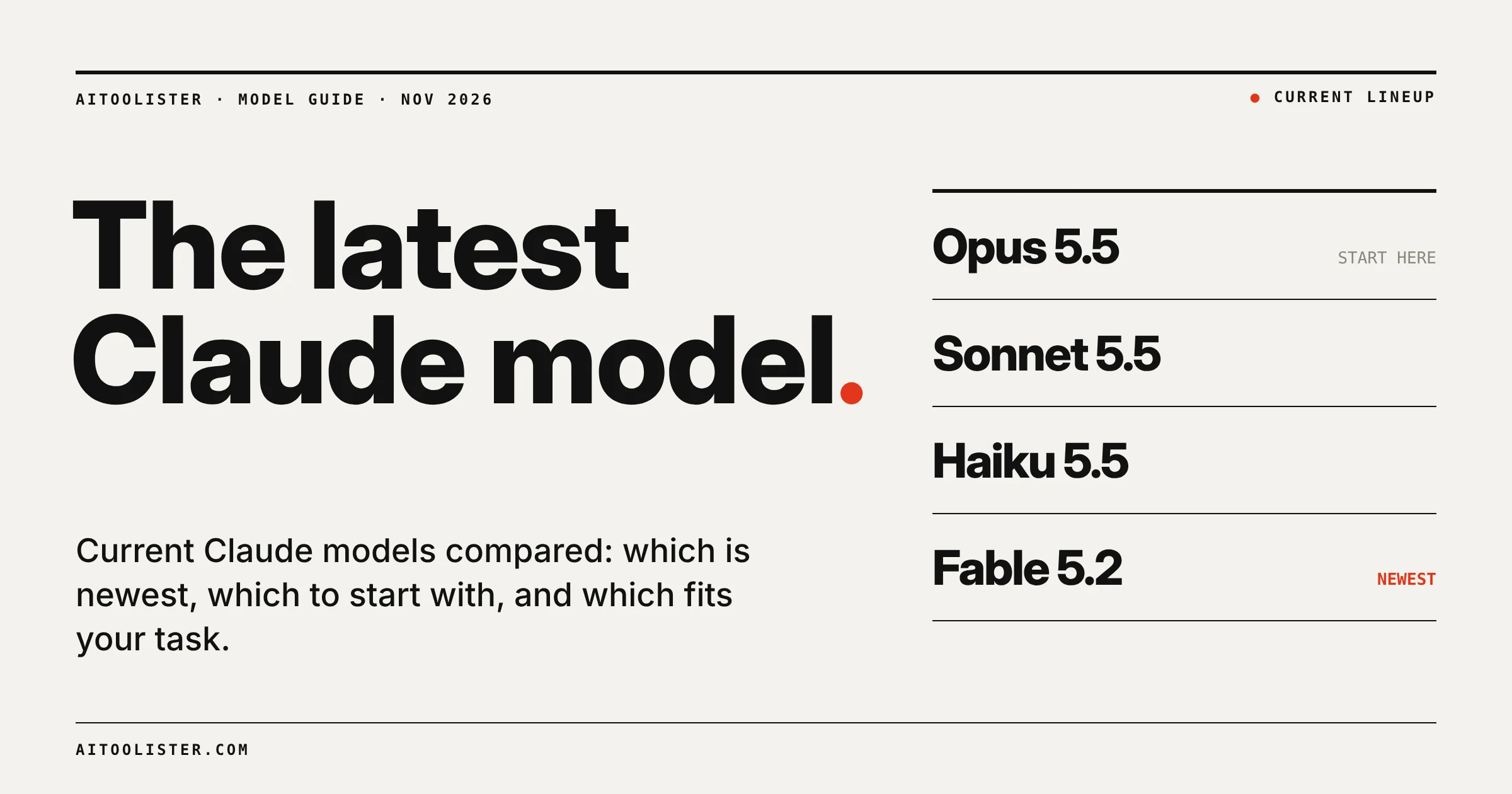
The latest Claude model is Claude Fable 5.2, released on November 9, 2026. It’s Anthropic’s model for the most demanding reasoning and long-running agent work, but newest doesn’t mean best for every job: for most work, Anthropic recommends starting with Claude Opus 5.5. Claude Sonnet 5.5 is the balance of speed and intelligence, and Claude Haiku 5.5 is the fastest and cheapest.
This guide explains what each current Claude model is for, how they differ, which one to use for coding, writing and research, and which models you can actually pick in the Claude app, Claude Code and the API.
How we checked: every model detail, price, ID and status below comes from Anthropic’s official documentation, announcements and Help Center, reviewed on November 9, 2026, and updated for Claude Fable 5.2 on November 12, 2026. Claims about performance are labeled as Anthropic’s own.
The latest Claude models at a glance: main model comparison
This table covers the four main publicly available Claude models. It isn’t a list of every active model ID; older models that still work are covered in the model history section below.
| Claude Opus 5.5 | Claude Sonnet 5.5 | Claude Haiku 5.5 | Claude Fable 5.2 | |
|---|---|---|---|---|
| Released | September 22, 2026 | September 28, 2026 | October 7, 2026 | November 9, 2026 |
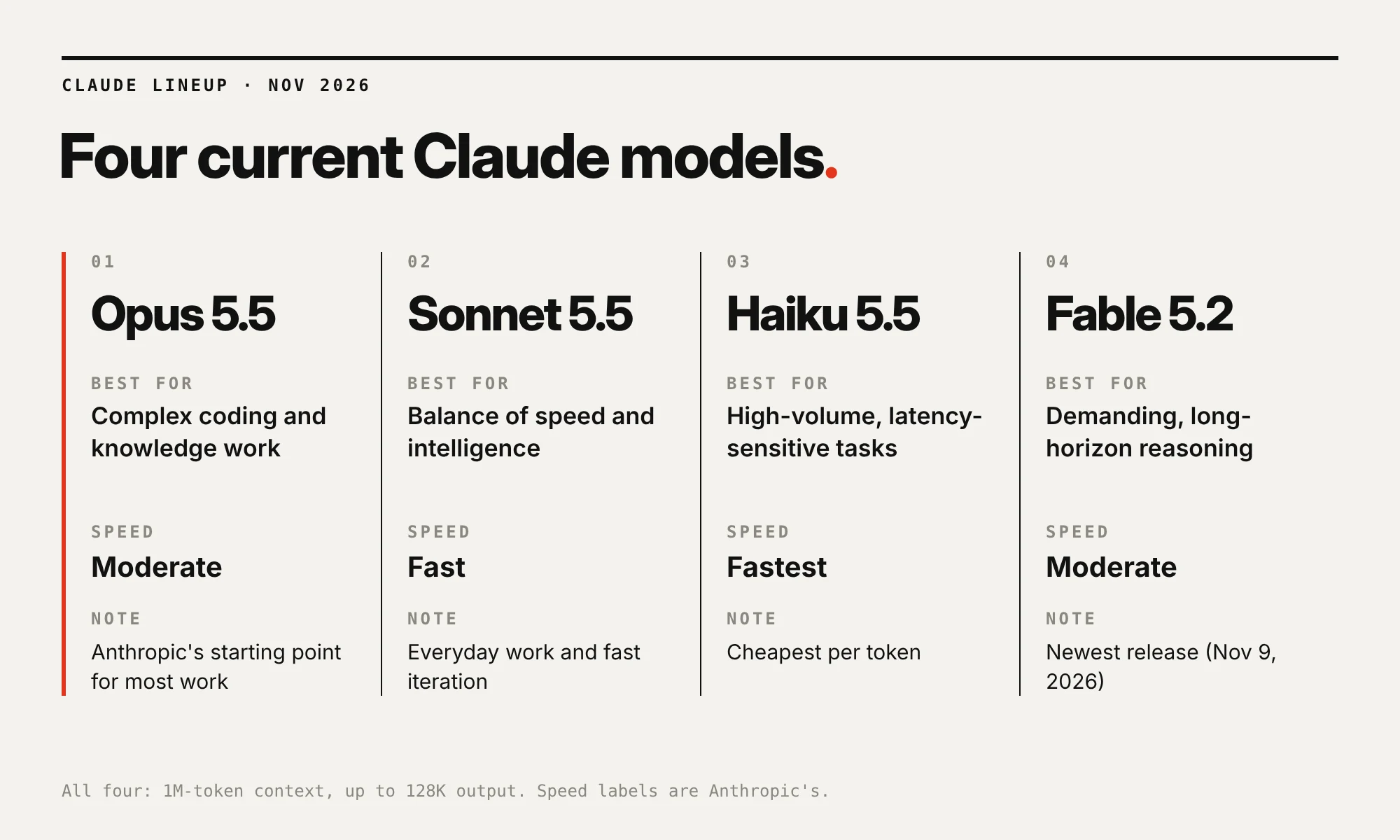
| Best for (Anthropic) | Long-running agentic coding and knowledge work | The best combination of speed and intelligence | High-volume, latency-sensitive tasks | Demanding reasoning and long-horizon agentic work |
| Speed (Anthropic’s label) | Moderate | Fast | Fastest | Moderate |
| Context window | 1M tokens | 1M tokens | 1M tokens | 1M tokens |
| Max output | 128K tokens | 128K tokens | 128K tokens | 128K tokens |
| API price (input / output per 1M tokens) | $4 / $20 | $2 / $10 | $0.10 / $0.50* | $8 / $40 |
| API model ID | claude-opus-5-5 | claude-sonnet-5-5 | claude-haiku-5-5 | claude-fable-5-2 |
*Haiku 5.5 costs $0.50 input and $2.50 output per million tokens when a prompt exceeds 100,000 tokens. Specifications and prices are from Anthropic’s model overview.
These are API prices for developers, not Claude subscription prices. Input tokens are what you send to the model; output tokens are what it writes back. At standard rates, Haiku 5.5 is 20 times cheaper per token than Sonnet 5.5. For prompts over 100,000 tokens, that gap shrinks to 4 times. What you actually pay depends on your mix of input and output and on caching, which our Claude API pricing breakdown covers in detail.
Claude Opus 5.5, Sonnet 5.5, Haiku 5.5 and Fable 5.2 explained
Claude Opus 5.5
Opus 5.5 is built for complex coding and knowledge work, and it’s the model Anthropic’s documentation recommends starting with for most workloads. Anthropic says it is particularly good at long, sprawling jobs such as codebase-wide migrations and audits.
Anthropic also makes two comparative claims: that Opus 5.5 “performs at the level of Claude Fable 5.1 on most work,” and that it costs about 40% less than Opus 5 on typical workloads. Both are Anthropic’s own results, not independent tests. The trade-off is speed and price: it’s slower than Sonnet and costs twice as much per token.
Claude Sonnet 5.5
Sonnet 5.5 is Anthropic’s balance of speed and intelligence. Anthropic describes it as strongest at well-scoped everyday tasks, fixing bugs, and creating polished documents, slides and spreadsheets.
Compared with Sonnet 5, Anthropic says it produces output more than 30% faster and, in its testing, costs up to 30% less per task. That saving comes from needing fewer tokens, not from a lower list price, which stays at $2 / $10. Its limit is hard, open-ended work: Anthropic says Opus 5.5 “remains clearly stronger at complex, open-ended work requiring sustained judgment.”
Claude Haiku 5.5
Haiku 5.5 is, according to Anthropic, the fastest Claude model it has released at standard speed. It’s designed for high-volume, cost-sensitive work such as summaries, classification and extraction, and it can run as a helper alongside Opus or Sonnet in larger workflows. It’s also the first Haiku model with an adjustable effort setting.
Anthropic says it costs about 75% less than Haiku 4.5 on average. The catches: Anthropic itself says Sonnet 5.5 and Opus 5.5 remain better for complex agentic coding, and prompts over 100,000 tokens move to the higher price tier.
Claude Fable 5.2
Fable 5.2, released November 9, 2026, is Anthropic’s newest model and its choice for demanding reasoning and long-horizon agentic work, the kind of task where a cheaper model still falls short at higher effort. It’s the most expensive of the four, though its API price dropped to $8 / $40 from Fable 5.1’s $10 / $50, and it isn’t the default model anywhere.
Two practical limits matter. On Pro plans and Team standard seats, Fable usage is billed to usage credits rather than coming out of your plan. And its safeguards still redirect some dual-use cybersecurity tasks and send life-sciences research questions to Opus models, as the Mythos section below explains.
Claude Opus vs Sonnet vs Haiku vs Fable: what’s the difference?
The four models trade reasoning depth against speed and cost:
| Opus 5.5 | Sonnet 5.5 | Haiku 5.5 | Fable 5.2 | |
|---|---|---|---|---|
| Typical job | Complex coding and knowledge work | Everyday work and fast iteration | Simple, repetitive, high-volume tasks | The hardest reasoning and long agent runs |
| Reasoning profile | Complex, sustained problem-solving | Strong everyday reasoning | Routine and simpler tasks | Demanding, long-horizon reasoning |
| Speed | Moderate | Fast | Fastest | Moderate |
| API cost (input / output) | $4 / $20 | $2 / $10 | From $0.10 / $0.50 | $8 / $40 |
These models aren’t a strict ladder where each one is simply better than the last. Each is tuned for a different balance of reasoning, speed and cost. Anthropic says Opus 5.5 performs at Fable 5.1’s level on most work, for example, and Sonnet 5.5 outscores Opus 5.5 on one of Anthropic’s coding benchmarks while trailing it on harder, open-ended tasks. The practical question is which balance fits your task. On price alone, Haiku is the cheapest by a wide margin, and Fable is the most expensive.
If you’ve seen Haiku listed at $1 / $5 or Sonnet at $3 / $15, those are prices for older models (Haiku 4.5 and the Sonnet 4 series), not the current lineup.
Which Claude model is best for coding, writing and research?
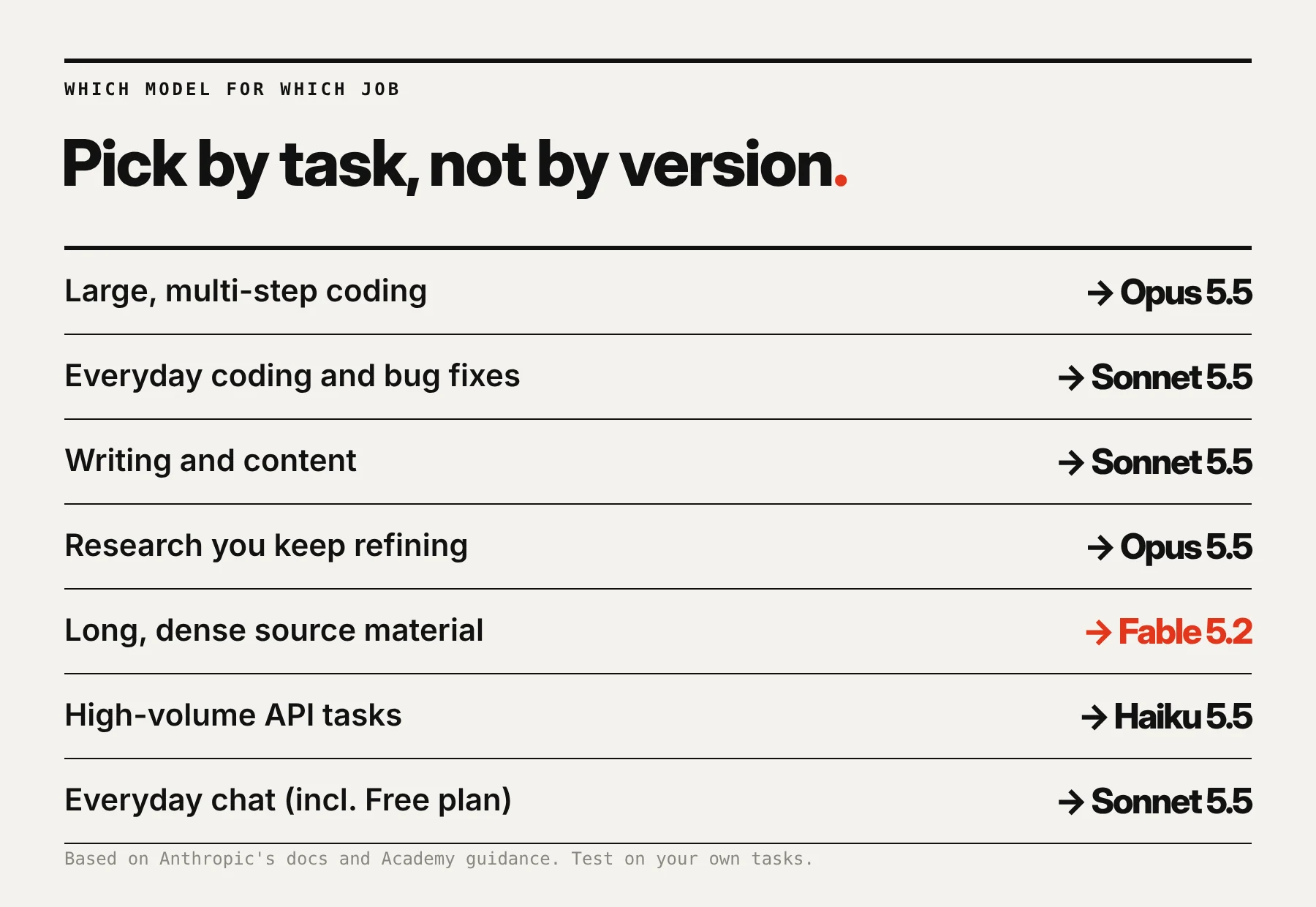
Anthropic gives two different starting points depending on where you use Claude. Its developer documentation recommends Opus 5.5 for most API workloads, while its Academy guide for Claude app users suggests starting with Sonnet if you’re unsure. Neither is wrong; they’re aimed at different users.
Best Claude model for coding
For large, multi-step work, such as refactoring across a whole codebase or long agentic sessions, Opus 5.5 is worth its higher price because it handles sustained judgment better. For well-scoped tasks like fixing a bug or writing a function, Sonnet 5.5 is faster and costs half as much per token. Haiku 5.5 can be useful for smaller tasks that run in parallel, such as summarizing files or quick checks, but not for the hard parts of the job.
In Claude Code, Opus 5.5 is the default model on Pro, Max, Team and Enterprise plans and on the Anthropic API. The opusplan option uses Opus and then switches to Sonnet to carry out the work, and you can pick Fable manually for the hardest problems. To extend Claude Code with your own workflows, see our guide to Claude Code skills.
Best Claude model for writing
Anthropic’s Academy guide recommends Sonnet for writing and content creation, which covers most emails, articles and reports. Opus 5.5 makes more sense for long or complex pieces where structure and judgment matter more than speed.
Best Claude model for research
For research you keep questioning and refining, Anthropic’s Academy guide points to Opus. For long, dense source material, such as lengthy documents or technical diagrams, it points to Fable.
Best Claude model for everyday chat
Sonnet is the practical everyday choice. It’s also one of the two models available on the Free plan, along with Haiku.
Best Claude model for API automation
For high-volume work where speed and cost matter more than deep reasoning, such as classification, extraction and routing, Haiku 5.5 is the model Anthropic positions for the job.
Claude Mythos vs Fable: what’s the difference?
The newest pair, Claude Fable 5.2 and Claude Mythos 5.2, keeps the same arrangement: Mythos 5.2 has the same capabilities and price but is available only to organizations verified through Anthropic’s programs. The details below come from the Fable 5.1 launch. Claude Mythos 5.1 and Claude Fable 5.1 are, in Anthropic’s words, “the same model, but with different levels of safeguards.” The difference is who can use it and for what.
Fable 5.1 is the generally available version. According to Anthropic’s announcement, it can now be used to discover software vulnerabilities, though not to develop exploits for them, and its safeguards still redirect several kinds of dual-use cybersecurity tasks, such as penetration testing, exploit generation and binary-based vulnerability scanning. In biology, Anthropic says its safeguards now fire 85% less often on benign elementary biology and medical questions than the safeguards that launched with Fable 5, while life-sciences research and development queries are still directed to Opus models.
Mythos 5.1 has less restrictive safeguards and is meant for vetted cyber defenders and life-sciences professionals. Anthropic says it is available only through its trusted access programs, and currently only to a set of US organizations. The two programs are at different stages. The Life Sciences Verification Program has enrolled its first participants. The Cyber Verification Program currently gives defensive security teams access to certain Opus- and Sonnet-class models with reduced cyber safeguards, and Anthropic says it will add Mythos-class models in the near future, so Mythos isn’t available through it yet. That’s why most people can’t select Mythos in the Claude app or API.
Which Claude models are available in the app, Claude Code and the API?
The Claude app, Claude Code and the API are separate products with different rules, so a model being in the API doesn’t mean you can pick it everywhere.
In the Claude app
The Claude app’s model choices depend on your subscription plan. Anthropic’s Academy guide says the Free plan includes Haiku and Sonnet, while Pro and Max add Opus and Fable; that guide doesn’t cover Ultra, Team or Enterprise. Anthropic’s Help Center confirms that Fable 5.2, 5.1 and 5 are available on all paid plans (Pro, Max, Ultra, Team and Enterprise) but not on Free, and that how Fable usage counts depends on the plan:
| Plan | Fable models | How Fable usage counts |
|---|---|---|
| Free | Not available | Not applicable |
| Pro | Available | Billed to usage credits, not plan limits |
| Max | Available | Up to 50% of weekly usage at no extra cost |
| Ultra | Available | Same as Max |
| Team standard seat | Available | Billed to usage credits |
| Team premium seat | Available | Same as Max |
| Enterprise, standard seat | Available | Billed to usage credits, if the organization enables them |
| Enterprise, premium seat | Available | Same as Max |
| Enterprise, usage-based | Available | Billed at standard API rates |
The 50% figure is part of your existing weekly usage limit, not an extra 50% on top of it. On Team and Enterprise plans, your organization may also need to enable Fable for members, for example by turning on usage credits or allowing the model. On Enterprise plans, Fable 5.2 stays off until an admin enables it.
Claude Cowork, Claude’s mode for multi-step tasks, is included only in paid plans, so Free users can’t use it with any model. Fable models work in Cowork on all paid plans, and Anthropic says you need the latest version of the Claude desktop app to use it there.
In Claude Code
Claude Code lets you pick models with short aliases instead of full IDs, using the /model command. These aliases belong to Claude Code, not the API, and Anthropic updates them to point to newer models over time. When you use Claude Code with the Anthropic API, opus, sonnet and haiku point to Opus 5.5, Sonnet 5.5 and Haiku 5.5, and fable points to Fable 5.1. The best alias picks Fable where it’s available to you and Opus otherwise.
The aliases can point to different versions on other providers. On Amazon Bedrock and Google Cloud, sonnet and haiku point to older models, and on Microsoft Foundry, opus, sonnet and haiku all do. To use one exact version in Claude Code, select its full model name, such as claude-opus-5-5. When Fable is billed to usage credits on your plan, the model picker labels it “Requires usage credits.”
In the API
Developers call models by their API IDs, such as claude-opus-5-5 or claude-haiku-5-5, and pay per token. According to Anthropic’s documentation, IDs from the Claude 4.6 generation onward are fixed: each one maps to a single model snapshot, and when Anthropic updates a model, it ships under a new ID. That means an ID like claude-opus-5-5 behaves predictably in production, and you move to a newer model only by changing the ID yourself. Some older models also accept shorter API aliases, such as claude-sonnet-4-5, which point to that model’s latest dated snapshot.
Can you download Claude models?
No. You can download the Claude desktop app for Mac and Windows, but the models themselves run on Anthropic’s servers and its cloud partners. Anthropic doesn’t offer Claude model weights for download.
Claude model history: 2026 releases and older versions
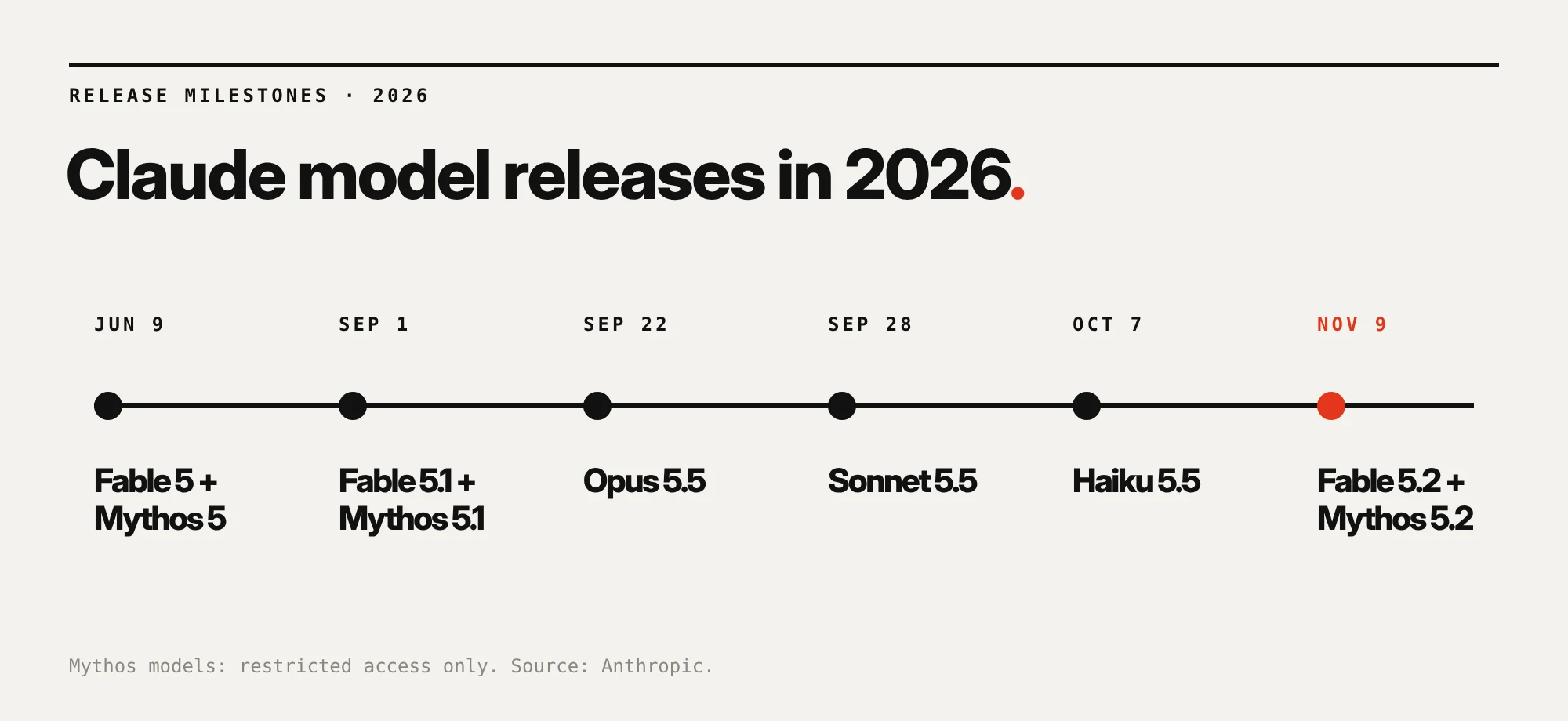
Anthropic has had six release milestones in 2026 so far:
- June 9: Claude Fable 5 and Claude Mythos 5
- September 1: Claude Fable 5.1 and Claude Mythos 5.1
- September 22: Claude Opus 5.5
- September 28: Claude Sonnet 5.5
- October 7: Claude Haiku 5.5
- November 9: Claude Fable 5.2 and Claude Mythos 5.2
Anthropic uses four lifecycle statuses. Active models are fully supported. Legacy models no longer receive updates and may be deprecated later; no model currently has this status. Deprecated models still work but aren’t recommended and have a retirement date. Retired models no longer work.
Here’s where the older models stand, according to Anthropic’s model deprecations page:
| Status | Models (API IDs) |
|---|---|
| Active | Fable 5.1 (claude-fable-5-1), Fable 5 (claude-fable-5), Mythos 5.2 (claude-mythos-5-2), Mythos 5.1 (claude-mythos-5-1) and Mythos 5 (claude-mythos-5) with restricted access, Opus 5 (claude-opus-5), Opus 4.8 (claude-opus-4-8), Opus 4.7 (claude-opus-4-7), Opus 4.6 (claude-opus-4-6), Opus 4.5 (claude-opus-4-5-20251101), Sonnet 5 (claude-sonnet-5), Sonnet 4.6 (claude-sonnet-4-6), Haiku 4.5 (claude-haiku-4-5-20251001) |
| Deprecated | Sonnet 4.5 (claude-sonnet-4-5-20250929), retiring November 30, 2026, replacement Sonnet 5.5; Mythos Preview (claude-mythos-preview), retirement date to be announced |
These Claude 3 and Claude 4 models are retired, which means requests to them no longer work:
| Retired model | API ID | Retired on |
|---|---|---|
| Opus 4.1 | claude-opus-4-1-20250805 | August 5, 2026 |
| Opus 4 | claude-opus-4-20250514 | June 15, 2026 |
| Sonnet 4 | claude-sonnet-4-20250514 | June 15, 2026 |
| Claude 3 Haiku | claude-3-haiku-20240307 | April 20, 2026 |
| Claude 3.7 Sonnet | claude-3-7-sonnet-20250219 | February 19, 2026 |
| Claude 3.5 Haiku | claude-3-5-haiku-20241022 | February 19, 2026 |
| Claude 3 Opus | claude-3-opus-20240229 | January 5, 2026 |
| Claude 3.5 Sonnet | claude-3-5-sonnet-20241022, claude-3-5-sonnet-20240620 | October 28, 2025 |
| Claude 3 Sonnet | claude-3-sonnet-20240229 | July 21, 2025 |
The earlier Claude 2 and Claude 1 models were retired before these.
So the Claude 4.5 models haven’t all gone away: Opus 4.5 and Haiku 4.5 are still active, while Sonnet 4.5 is deprecated and close to retirement.
Frequently asked questions about Claude models
What is the latest Claude model in 2026?
Claude Fable 5.2, released on November 9, 2026, is the newest. The current lineup is Opus 5.5, Sonnet 5.5, Haiku 5.5 and Fable 5.2.
Which Claude model is best overall?
It depends on the job. Anthropic recommends Opus 5.5 as the starting point for most workloads and Fable 5.2 for the most demanding reasoning. For everyday use in the Claude app, Anthropic suggests starting with Sonnet.
Which Claude model is best for coding?
Opus 5.5 for large, complex coding work and Sonnet 5.5 for well-scoped everyday tasks. Opus 5.5 is also Claude Code’s default model on Pro, Max, Team and Enterprise plans.
Which Claude model is best for writing?
Anthropic’s Academy guide recommends Sonnet for writing and content creation. Opus is a better fit for long or complex pieces.
Is Haiku cheaper than Sonnet and Opus?
Yes. In the API, Haiku 5.5 starts at $0.10 per million input tokens, compared with $2 for Sonnet 5.5 and $4 for Opus 5.5. Prompts over 100,000 tokens cost more on Haiku.
Can you download Claude models?
No. You can download the Claude desktop app, but the models run on Anthropic’s and its cloud partners’ servers, and the model weights aren’t available for download.
Is Anthropic releasing a new Claude model?
As of November 12, 2026, Anthropic hasn’t announced any model beyond the current lineup, which gained Fable 5.2 on November 9. This article will be updated when Anthropic officially releases a new model.
What is the difference between Claude Opus 5.5 and Opus 5?
Opus 5.5 is the newer version, released on September 22, 2026. Its API price is lower ($4 / $20 per million tokens versus $5 / $25), and Anthropic says it costs about 40% less to run than Opus 5 on typical workloads. Opus 5 is still active in the API.
Which Claude model should you start with?
If you use the Claude app and aren’t sure, start with Sonnet 5.5 and move up to Opus 5.5 when a task needs more careful judgment. If you’re building on the API, Anthropic recommends Opus 5.5 for most workloads, with Haiku 5.5 for high-volume jobs and Fable 5.2 for the hardest problems. Whichever you pick, test it on your own tasks before committing.
Keep Exploring