Ahsan Javaid
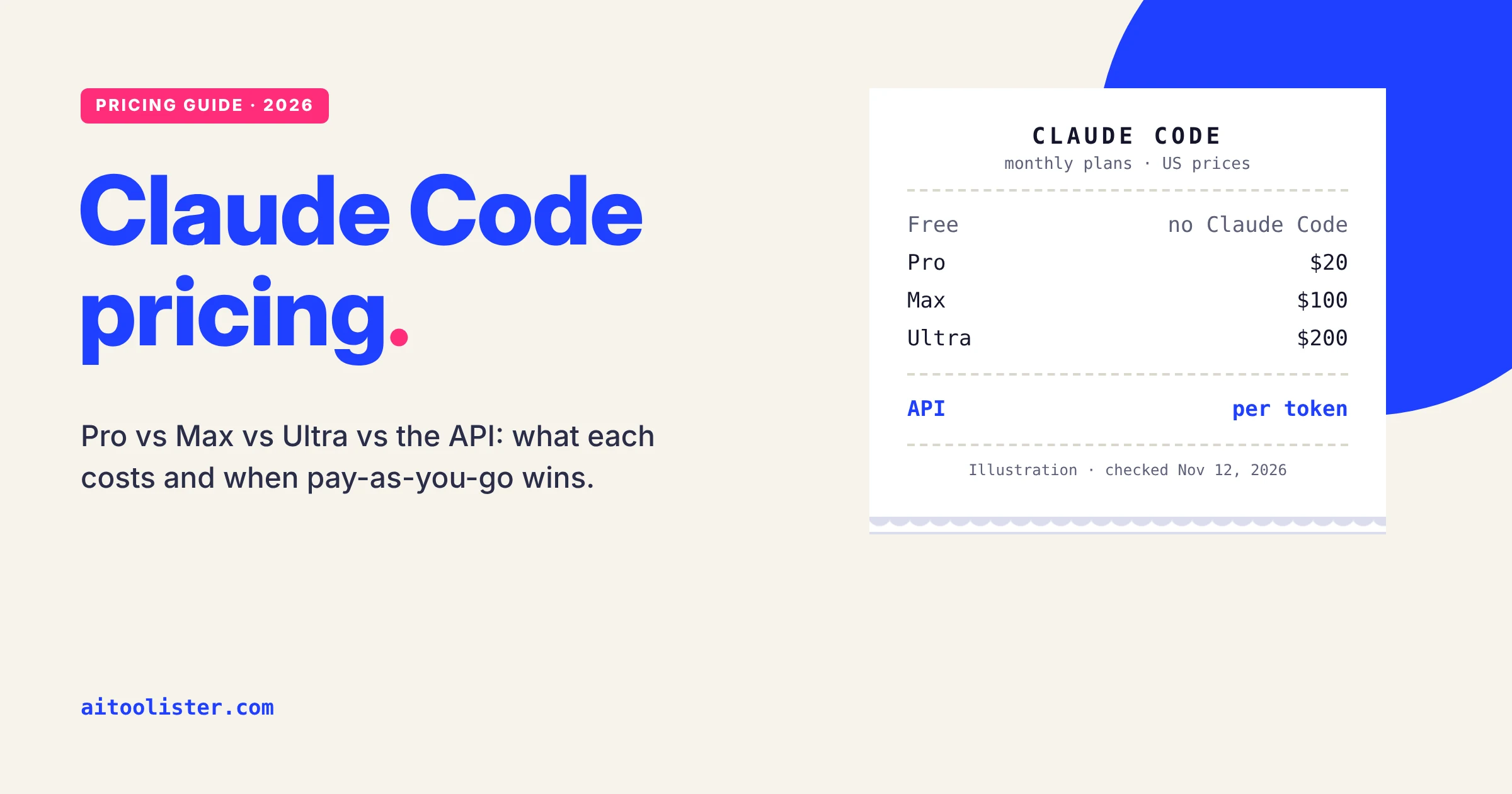
Claude Code pricing works differently from most developer tools: there’s no standalone Claude Code subscription. You get it with a paid Claude plan (Pro at $20 a month, Max at $100 or Ultra at $200), with a Team or Enterprise seat, or you pay per token through the Claude API. The Free plan doesn’t include it. For everything outside coding, our Claude AI pricing guide compares every plan.
Below, you’ll see every plan side by side, how the usage limits actually work, what Anthropic says developers really spend, and when paying per token beats a subscription.
Claude Code Pricing at a Glance
| Plan | Price | Claude Code | Usage | Monthly API credits | Best for |
|---|---|---|---|---|---|
| Free | $0 | No | n/a | None | Trying Claude chat only |
| Pro | $20/month, or $17/month billed yearly ($200) | Yes | Baseline | None | Learning and a few focused sessions a week |
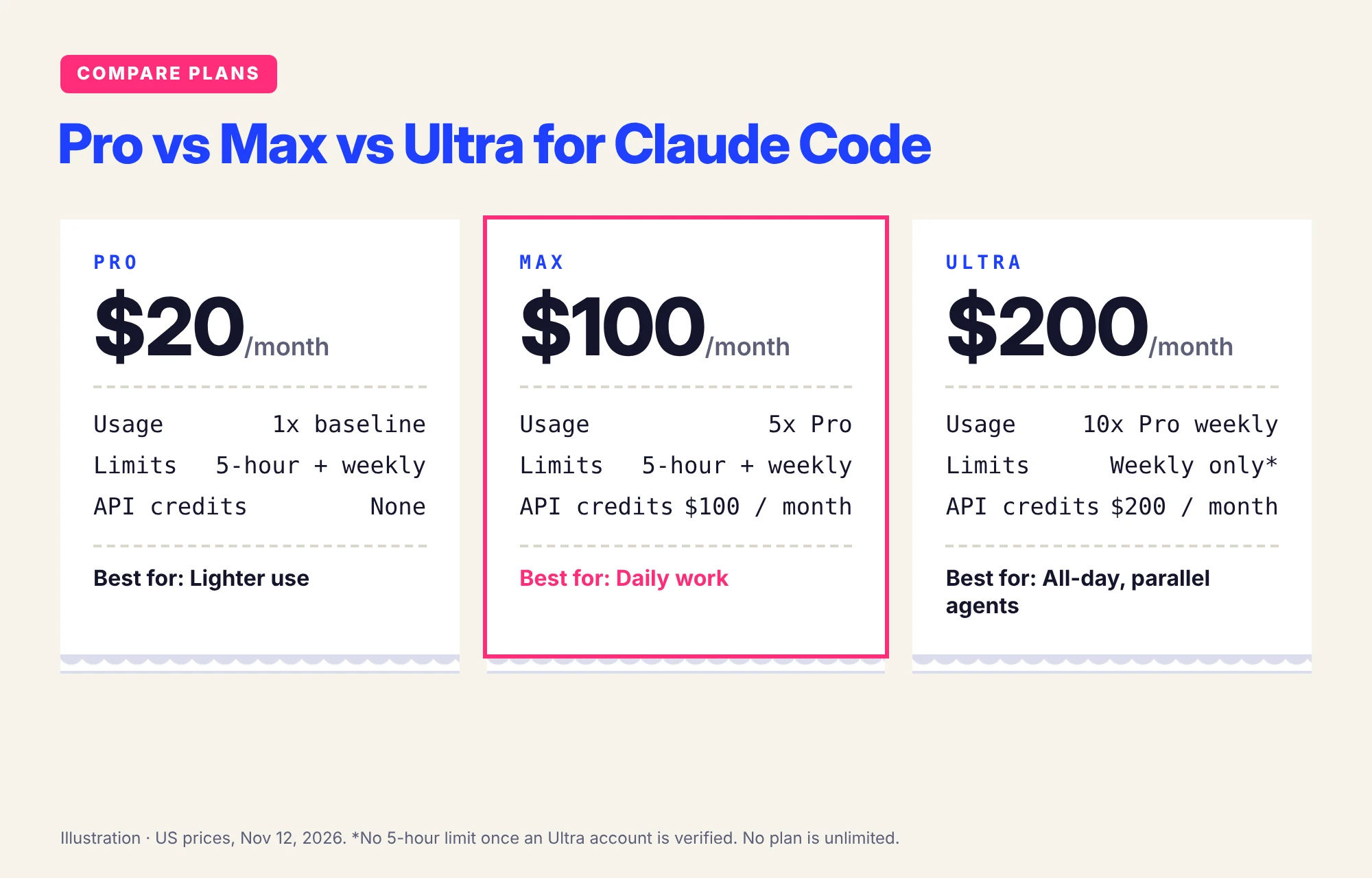
| Max | $100/month | Yes | 5x Pro | $100 | Daily professional coding |
| Ultra | $200/month | Yes | 10x Pro’s weekly usage | $200 | All-day work and parallel agents |
| Team Standard | $25/seat/month, or $20 billed yearly | Yes | More than Pro | Pooled (see Teams) | Small teams that need central billing |
| Team Premium | $125/seat/month, or $100 billed yearly | Yes | 5x a Standard seat | Pooled (see Teams) | Team members who code heavily |
| Enterprise | $20/seat/month billed yearly, plus usage at API rates | Yes | Scales with usage | Not listed | Larger organizations |
| Claude API | Pay per token | Yes | Billed per token, with API rate limits and spend controls | n/a | Occasional use and automation |
These are Anthropic’s listed US prices before tax, taken from Claude’s pricing page. Max and Ultra are billed monthly only, and Anthropic notes that prices in the mobile apps can differ.
What Changed in November 2026
If an older guide shows different plan names or prices, these changes are why:
- November 2: Anthropic renamed its two Max tiers. Max 5x is now simply Max, and Max 20x is now Ultra. Prices stayed at $100 and $200, and existing subscribers moved over automatically.
- Ultra’s 5-hour limit is gone for verified accounts. The weekly limit still applies.
- Max and Ultra now include monthly API credits: $100 and $200 respectively, for building on the Claude Platform. Section 8 explains what they do and don’t cover.
- November 9: Anthropic released Fable 5.2, priced at $8 per million input tokens and $40 per million output tokens on the API.
- A one-week Fable 5.2 launch offer: until November 16, 2026 at 11:59 pm PT, eligible Pro subscribers and Team Standard seats get Fable included in their plan, capped at 50% of their weekly usage limits. Those accounts also get one usage limit reset, and Max, Ultra and eligible premium seats get one to three resets depending on how long they’ve subscribed. The offers apply to accounts with paid billing in place before November 9, 2026 at 10:00 am PT. After November 16, Fable on Pro goes back to being paid with usage credits.
How Claude Code Usage Limits Work on a Subscription
Does Claude Code share usage with Claude chat?
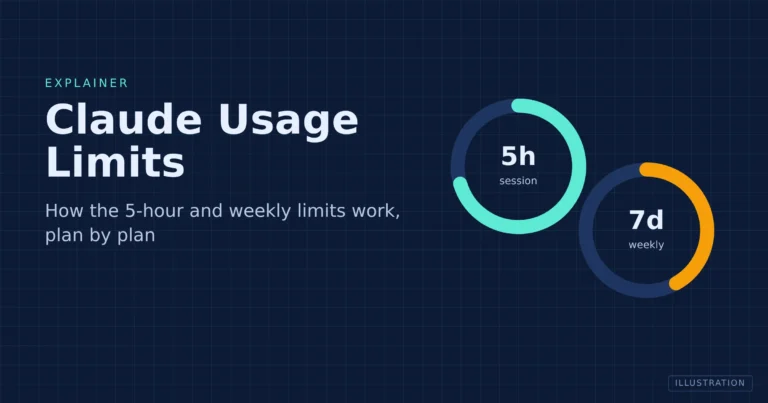
Yes. Claude on the web, desktop and mobile, and Claude Code all draw from the same usage pool. A long research chat in the morning leaves less room for coding in the afternoon. Our guide to Claude usage limits explains how the five-hour and weekly limits work on each plan.
The limits on each plan
| Plan | 5-hour session limit | Weekly limit |
|---|---|---|
| Pro | Yes | Yes |
| Max | Yes, at 5x Pro | Yes, at 5x Pro |
| Ultra | None once your account is verified | Yes, at 10x Pro |
| Team (Standard or Premium seat) | Yes | Yes |
New Ultra accounts have a temporary 5-hour limit until verification finishes. Anthropic’s Help Center says that if you don’t see a Current session bar under Settings > Usage, your account is verified.
Does Opus use more of your limit than Sonnet?
Yes. How fast you reach a limit depends on the model, how long your conversation is and how large your files are. Heavier models, long sessions and extended thinking all use the allowance faster than short Sonnet or Haiku tasks.
What happens when you hit a limit?
Claude Code tells you that you’ve hit your session or weekly limit and shows when it resets. You can wait for the reset or keep working with usage credits, which are prepaid and billed at standard API rates. You set a monthly spend limit, so you stay in control of extra charges.
How to check your Claude Code usage
Run /usage inside Claude Code. On a subscription, it shows your plan usage bars, a breakdown of which skills, subagents, and tools were used most, and suggestions for cutting usage. If you bill through the API, it shows the session’s token cost instead, which Claude Code estimates locally from token counts at list price. For your actual bill, check your Claude account’s usage settings or the Claude Console.
Is Claude Pro Enough for Claude Code?
Pro is a sensible starting point, and plenty of developers never need more. It gives you Claude Code in the terminal, IDE, desktop app and on the web, plus the latest Claude models except Fable, which Pro users normally pay for with usage credits (the November launch offer above was a one-week exception).
Pro works well if you:
- Use Claude Code a few times a week for focused tasks
- Work on small or medium codebases
- Are learning Claude Code or testing it before committing
You’ve probably outgrown Pro if you:
- Hit the 5-hour limit most working days
- Run long agentic tasks or several sessions at once
- Keep buying usage credits to finish your work
The Reddit thread calling Pro “a trap” for dev work reflects that last group. Pro isn’t a bad deal; it’s sized for lighter use. A practical test: if you’ve bought usage credits two months in a row, compare what you spent with the $80 difference between Pro and Max.
Max vs Ultra: Which Plan Do Developers Need?
| Max | Ultra | |
|---|---|---|
| Price | $100/month | $200/month |
| Usage | 5x Pro, every 5 hours and every week | 10x Pro’s weekly usage |
| 5-hour limit | Yes | None for verified accounts |
| Fable access | Included, using up to half of your weekly limit | Included, using up to half of your weekly limits |
| Monthly API credits | $100 | $200 |
Choose Max if Claude Code is part of your daily work, but you mostly run one session at a time. Five times Pro’s allowance covers a full working day for many developers.
Choose Ultra if you run parallel agents, work long stretches without breaks or keep hitting Max’s 5-hour window. For heavy users, losing that window matters more than the extra weekly allowance, because it stops a long session from being cut off midway.
On both plans, Fable’s share comes out of your existing weekly allowance. It caps how much of that allowance Fable can use, not extra usage on top.
One note on names: Ultra used to be called Max 20x. Anthropic now describes its allowance as 10 times Pro’s weekly usage and hasn’t published a comparison with the old figure, so compare plans by their current descriptions, not their old names. Neither plan is unlimited.
Claude Code on the API: Pay-As-You-Go Costs
If you sign in with a Claude Console account, Claude Code bills you per token instead of using a plan’s limits. These are the API list prices per million tokens:
| Model | Input | Output | Cache read |
|---|---|---|---|
| Fable 5.2 | $8 | $40 | $0.20 |
| Opus 5.5 | $4 | $20 | $0.20 |
| Sonnet 5.5 | $2 | $10 | $0.10 |
| Haiku 5.5 (prompts up to 100K tokens) | $0.10 | $0.50 | $0.01 |
For every model and billing option, see our full breakdown of Claude API pricing.
What Anthropic reports developers actually spend
In its Claude Code cost guide, Anthropic says that across enterprise deployments, the average cost is around $13 per developer per active day and $150 to $250 per developer per month, with costs staying below $30 per active day for 90% of users. These are Anthropic’s own observations across its enterprise customers, not a guaranteed bill. Your costs depend on your model choice, codebase size and habits.
Why API bills vary
- Context size: Claude Code sends the conversation with every request, so long sessions cost more per message.
- Cache misses: after a break, the first message can reprocess your full context at the normal input rate.
- Thinking tokens: extended thinking is billed as output, the most expensive token type.
- Subagents and agent teams: each one runs its own requests. Anthropic says agent teams use about 7x more tokens than standard sessions when teammates run in plan mode.
- Model choice: Opus costs twice as much as Sonnet per token.
Subscription vs API: When Is Pay-As-You-Go Cheaper?
One session, priced out
Here’s a single Claude Code session on the API, using Sonnet 5.5 and these assumptions: 1 million input tokens, 80% of them read from the cache, and 100,000 output tokens.
| Part | Calculation | Cost |
|---|---|---|
| Uncached input | 200,000 tokens × $2 per million | $0.40 |
| Cache reads | 800,000 tokens × $0.10 per million | $0.08 |
| Output | 100,000 tokens × $10 per million | $1.00 |
| Total | $1.48 |
This excludes cache writes, which cost $2.50 per million tokens on Sonnet 5.5 and add to the first request that fills the cache. The same session on Opus 5.5 would cost about twice as much.
Monthly cost by workload
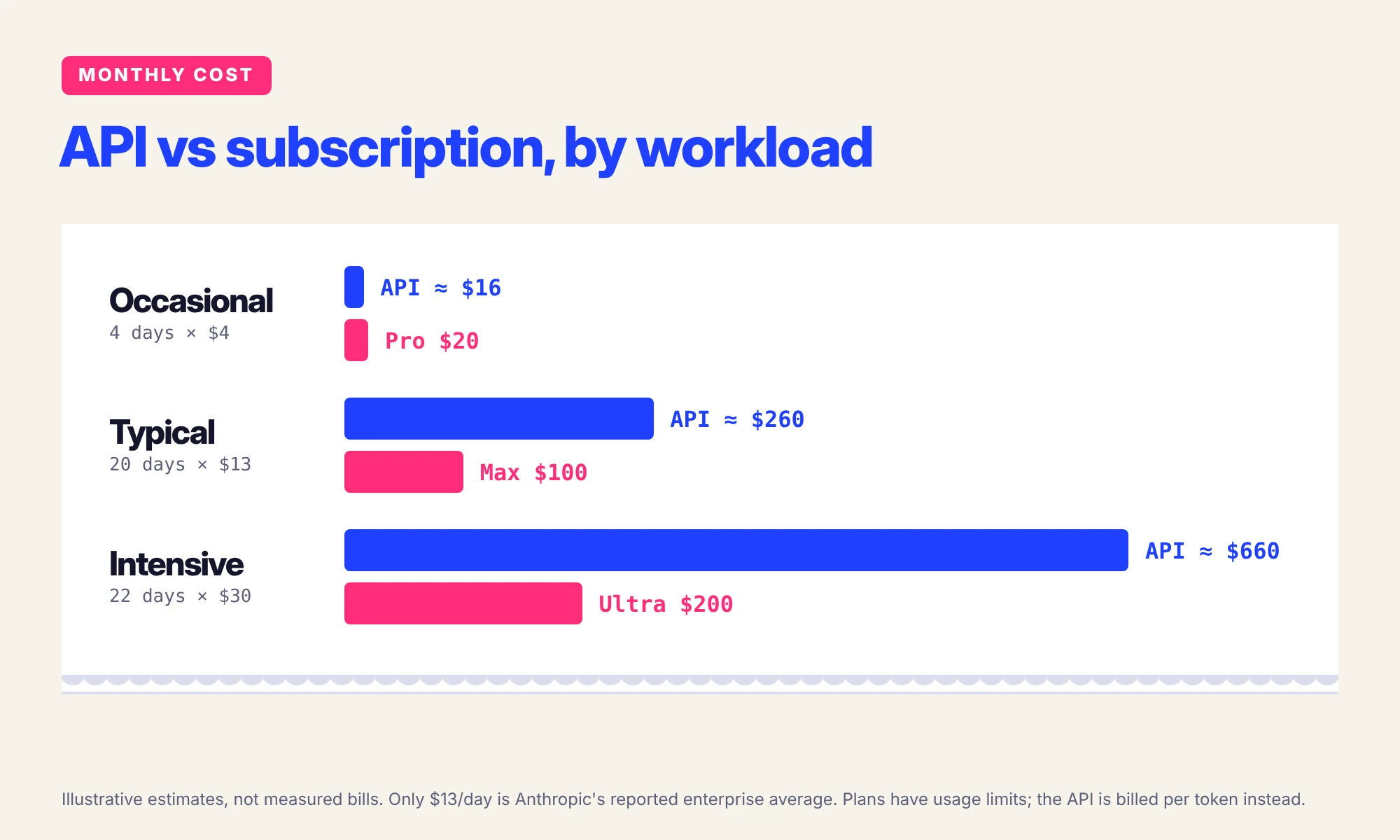
These three scenarios are illustrations, not measured results. Only the $13-per-day figure is Anthropic’s reported average. The $4/day figure is our assumption for light use, and the $30/day figure is an illustrative heavy-use figure based on Anthropic’s observation that 90% of users stay below $30 per active day. It isn’t a measured average for intensive users.
| Scenario | Assumption | API estimate | Closest plan |
|---|---|---|---|
| Occasional | 4 active days × $4 a day (our assumption) | ≈ $16/month | Pro at $20 |
| Typical | 20 active days × $13 a day (Anthropic’s reported average) | ≈ $260/month | Max at $100 |
| Intensive | 22 active days × $30 a day (illustrative, based on Anthropic’s 90% figure) | ≈ $660/month | Ultra at $200 |
If you code with Claude only a few days a month, the API can cost less than Pro. Once you use it most working days, a subscription usually costs a fraction of the API bill, as long as your work fits within the plan’s limits. The API’s advantage is flexibility: no weekly cap to plan around, and nothing to pay in a quiet month.
Which option should you pick?
| You are… | Best fit | Why |
|---|---|---|
| An occasional user or running scripts | API | You only pay for what you use |
| A regular daily user | Pro, then Max | A flat price is cheaper than daily API costs |
| An intensive user with parallel agents | Ultra | No 5-hour window once verified |
| A team that needs admin controls | Team or Enterprise | Central billing, spend limits and reports |
Do Max and Ultra API Credits Cover Claude Code?
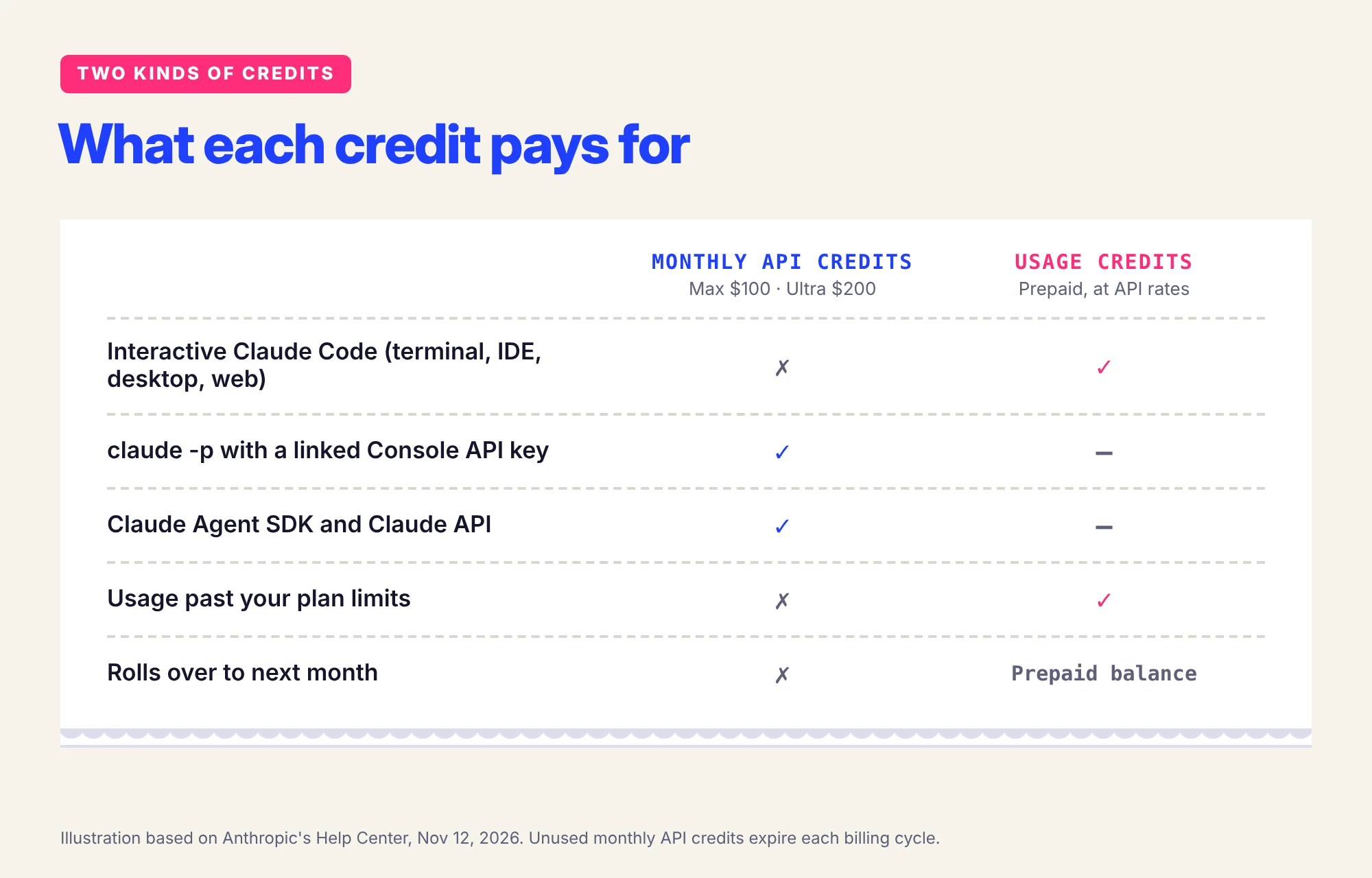
No, not for normal use. Anthropic offers two different kinds of credits, and they’re easy to confuse.
Monthly API credits vs usage credits
| Monthly API credits | Usage credits | |
|---|---|---|
| Who gets them | Max ($100), Ultra ($200), Team (pooled) | Pro, Max and Ultra, if you buy them |
| What they pay for | The Claude Platform: the API, Playground, Managed Agents and Agent SDK | Usage beyond your plan’s limits, including Claude Code |
| Interactive Claude Code | Not covered | Covered |
| Cost | Included in the plan | Prepaid, at standard API rates |
Interactive Claude Code in the terminal, IDE, desktop app or on the web always draws from your plan’s usage, then from usage credits. The monthly API credits only apply to claude -p and the Claude Agent SDK when you run them yourself with an API key from the Console organization linked to your plan. If you run claude -p while signed in with your subscription instead, it uses your plan’s limits.
Can you carry credits over or avoid surprise charges?
Monthly API credits don’t roll over; unused credits expire at the end of each billing cycle. To claim them, link a Console organization to your plan; new subscribers can claim after seven days on an eligible plan. To avoid surprise charges, set a monthly spend limit on usage credits, and use workspace spend limits in the Claude Console if you bill through the API.
Claude Code Pricing for Teams and Enterprise
Team plans come in two seat types. A Standard seat costs $25 a month, or $20 billed yearly, and gives more usage than Pro. A Premium seat costs $125 a month, or $100 billed yearly, and includes five times the usage of a Standard seat. Teams also get monthly API credits of $20 per Standard seat and $100 per Premium seat, pooled into one balance capped at $500 a month.
Enterprise costs $20 per seat a month billed yearly, with a 20-seat minimum, plus usage billed at API rates.
A Team plan makes more sense than individual subscriptions when you want one bill, admin controls and spend reports for everyone. On Team and Enterprise, admins can set spend limits for usage credits by organization, group or member and download per-user spend reports.
How to Lower Your Claude Code Costs
These habits come from Anthropic’s own cost guidance, and they help on both subscriptions and the API:
- Clear between tasks: run
/clearwhen you switch to unrelated work, so old context doesn’t ride along with every message. - Default to Sonnet: it handles most coding well. Save Opus for complex architecture or multi-step reasoning.
- Lower the effort level: use
/effortfor simple tasks that don’t need deep thinking. - Use subagents selectively: they keep verbose output like test runs and logs out of your main context, but their own requests still use tokens. Pick a smaller model for simple delegated tasks.
- Move long instructions into skills: skills load only when needed, unlike a large CLAUDE.md file. Our guide to Claude Code skills shows how.
- Check
/usagerecommendations: it flags what’s eating your allowance, like an oversized CLAUDE.md.
Which Claude Code Plan Should You Choose?
Start with Pro if you’re learning Claude Code or use it a few times a week. Move to Max once it’s part of your daily work and Pro’s limits slow you down. Pick Ultra if you run parallel agents or long sessions that Max’s 5-hour window keeps interrupting. Use the API for occasional or automated work, or when your usage swings a lot from month to month. Whatever you choose, check /usage after a couple of weeks; it shows whether your plan fits how you actually work.
Frequently Asked Questions
Is Claude Code free?
No. The Free plan doesn’t include Claude Code. The cheapest way in is Pro at $20 a month, or $17 a month billed yearly, or pay-as-you-go API billing.
Can I use Claude Code with Claude Pro?
Yes. Pro includes Claude Code, and it shares the same usage limits as your Claude chats.
Is there unlimited Claude Code on any plan?
No. Every plan has limits. Verified Ultra accounts have no 5-hour limit, but the weekly limit still applies. Usage credits let you keep going past a limit at API rates.
Is Claude Max worth $100 a month?
It is if you use Claude Code most working days. Anthropic’s reported enterprise average of about $13 per active day would come to roughly $260 for 20 days on the API, so Max costs much less for steady daily use, as long as your work fits its limits.
Is Claude Code free for 6 months?
Only for qualifying open source developers. Through the Claude for Open Source program, eligible maintainers and contributors can get six months of Ultra free. Eligibility includes paths such as 100 or more merged pull requests to other people’s repositories in the past 12 months, or maintaining a widely used package.
Can I switch between Pro, Max and Ultra without losing my Claude Code setup?
Yes. Your Claude Code settings, CLAUDE.md files and skills live on your computer and in your projects, not in your plan. Upgrades are charged on a prorated basis. If you move from annual Pro and your remaining balance is more than the new plan’s price, Anthropic credits the difference toward future charges, as long as your billing address matches. Subscriptions bought through Google Play are handled differently.
How we checked: prices, limits, and credit rules come from Claude’s pricing page, the Claude Help Center articles on the Pro, Max, and Ultra plans, usage credits, monthly API credits, and the Fable 5.2 launch offers, and Anthropic’s Claude Code cost guide, reviewed on November 12, 2026. API cost examples multiply token counts by Anthropic’s listed per-million-token prices, and the monthly scenarios multiply active days by the per-day figures stated in each row. Prices can change, so check claude.com/pricing before you buy. We didn’t run our own billing tests.
Keep Exploring