
Stable Diffusion
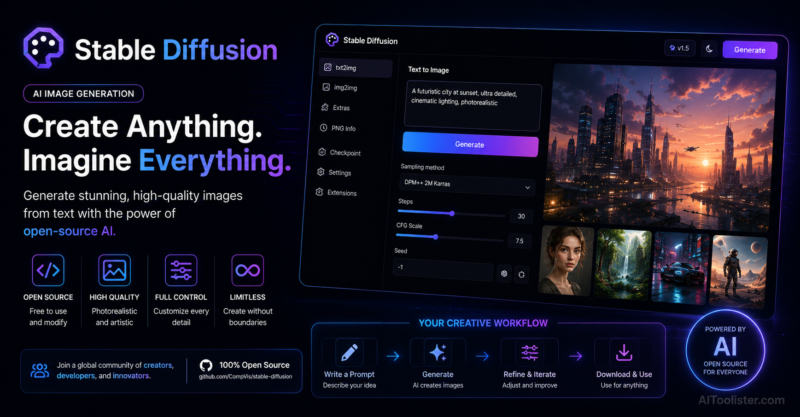
In this Stable Diffusion Review, we explore how this AI-powered image generation model helps artists, designers, developers, and creators produce high-quality images, illustrations, and digital artwork from text prompts.
Most AI image tools give you a finished product and limited say in how you got there. You prompt, the model decides, and you either like the result or try again. Stable Diffusion works differently — and that difference is the reason it has a following that goes well beyond casual creators into a community of artists, developers, and researchers who treat it less like a product and more like a medium.
Stable Diffusion is an open-source AI image generation model developed by Stability AI that you can run locally on your own hardware, use through browser-based interfaces, or access via API. The open-source part is what changes everything about how it fits into a creative workflow. There’s no platform controlling what you can generate, no credit system limiting how much you produce, no company deciding which features get gated behind a subscription. You own the tool, you run the tool, and the creative ceiling is defined by your hardware and your willingness to explore.
If you want greater creative control over AI-generated artwork, our Best Free AI Image Generators in 2026 guide explains how Stable Diffusion compares with other leading tools for creating high-quality images.
The fine-tuning ecosystem built around Stable Diffusion is what I find most compelling. The community has produced thousands of custom models trained on specific styles, aesthetics, artists, and subject matter — from photorealistic portrait models to anime illustration engines to architecture visualization tools. Platforms like Civitai host these models freely, which means you can download a model trained specifically for the kind of output you need rather than forcing a general-purpose engine toward a specialized result.
ControlNet changed what was possible with Stable Diffusion in a way that’s hard to overstate. Before ControlNet, controlling the composition and structure of generated images required elaborate prompting and a lot of luck. ControlNet lets you feed in a sketch, a pose reference, a depth map, or an edge detection of an existing image and use that as a structural guide for generation — producing output that follows your intended composition rather than interpreting your prompt however the model sees fit.
The tradeoff is real: running Stable Diffusion properly requires a capable GPU, technical comfort with installation and configuration, and patience for a learning curve that doesn’t exist on the simpler platforms. But for creators who have hit the ceiling of what guided tools allow and want genuine creative control over AI image generation, Stable Diffusion is where that control actually lives.
If you’re evaluating advanced AI image creation platforms, it’s worth exploring our AI Image category to compare tools for text-to-image generation, artistic styles, concept design, and commercial creative workflows.
Stable Diffusion Review: Key Features
- Open-source model architecture with full local deployment on compatible hardware
- Thousands of community fine-tuned models available for specific styles and subject matter
- ControlNet integration for composition and structure guidance from sketches and reference images
- img2img generation for using existing images as style and composition references
- Inpainting and outpainting for targeted editing and boundary extension within images
- Negative prompting for precise exclusion of unwanted elements from generation output
- AUTOMATIC1111 and ComfyUI interfaces for full workflow customization and control
- Textual inversion and LoRA training for creating custom style and subject models
- API access for developers building image generation into applications and products
- Active open-source community continuously developing extensions, models, and workflow tools
Stable Diffusion Pros
In this Stable Diffusion Review, these are the biggest advantages we found after evaluating its AI-powered text-to-image generation, image customization, prompt control, open-source flexibility, and creative design capabilities.
- Open-source foundation means no platform restrictions, no credit limits, no subscription ceiling
- Fine-tuned model ecosystem gives specialized output quality that general-purpose tools can’t match
- ControlNet delivers structural control over generation that prompt engineering alone never achieves
- Local deployment keeps generated images private without uploading to third-party servers
- Community development pace means new capabilities arrive faster than any single company produces them
Stable Diffusion Cons
- Requires a capable GPU and technical comfort to run locally — not a beginner-friendly entry point
- Setup and configuration time is significant compared to browser-based alternatives
- No central support structure — troubleshooting relies on community forums and documentation
Best For
Digital artists, AI art enthusiasts, developers, researchers, and creative professionals who want full control over the image generation process and are willing to invest in the setup and learning curve that genuine creative freedom requires.
Use Cases
Digital illustration, concept art, photorealistic image generation, character design, fine-tuned style replication, architecture visualization, fashion design, product mockups, creative research, and building custom AI image generation workflows for specific professional or artistic applications.
Stable Diffusion Pricing
- Free and open-source for local deployment on compatible hardware
- Cloud-based access available through platforms like DreamStudio with credit-based pricing
- API access via Stability AI with usage-based pricing for developers
- Third-party hosted interfaces offer varying free and paid tiers
Things to Consider Before Using Stable Diffusion
The honest prerequisite for getting real value out of Stable Diffusion is a dedicated GPU — ideally NVIDIA with at least 8GB VRAM. Without that, generation speeds on consumer hardware make the experience frustrating rather than productive. The learning curve for interfaces like AUTOMATIC1111 or ComfyUI is also steeper than most AI art tools prepare you for. Expect to spend time in community forums, YouTube tutorials, and Reddit threads before things click. That investment pays off significantly once it does — but going in expecting the same experience as a polished consumer product will lead to disappointment.
AIToolister Verdict on Stable Diffusion
Overall, this Stable Diffusion Review shows that the platform is an excellent solution for digital artists, designers, developers, marketers, and content creators looking to generate high-quality AI images with extensive customization and creative control. Stable Diffusion is the tool that makes every other AI image generator make more sense once you’ve used it. Understanding what the underlying model can do when you have full control over it changes how you think about the decisions that consumer platforms are quietly making for you. For casual creators, the setup cost isn’t worth it when better-supported alternatives exist. But for artists who want to own their creative process rather than rent access to someone else’s platform, developers who need image generation they can build on without restriction, and enthusiasts who find the technical depth genuinely interesting rather than merely tolerable — Stable Diffusion remains the most powerful option in the category. The ceiling here is yours to set.
Official Stable Diffusion Website
Visit the official Stable Diffusion website to explore its AI-powered image generation technology, discover supported models, and learn how to create professional artwork and visual content from text prompts.
Frequently Asked Questions
What is Stable Diffusion used for?
Stable Diffusion is an AI-powered image generation model that creates artwork, illustrations, concept art, realistic images, and digital designs from text prompts.
Is Stable Diffusion open source?
Yes. Stable Diffusion is an open-weight AI model that allows developers and creators to run, customize, and fine-tune the model for various image generation applications.
Who should use Stable Diffusion?
Stable Diffusion is ideal for digital artists, graphic designers, developers, game studios, marketers, researchers, and content creators who need flexible AI image generation.
Can Stable Diffusion generate realistic images?
Yes. Stable Diffusion can generate highly realistic images as well as anime, fantasy art, product mockups, concept art, and many other visual styles depending on the prompt and model used.
Is Stable Diffusion worth it?
Stable Diffusion is worth considering for users who want powerful, customizable AI image generation with the flexibility to run models locally or through cloud-based platforms.