Ahsan Javaid
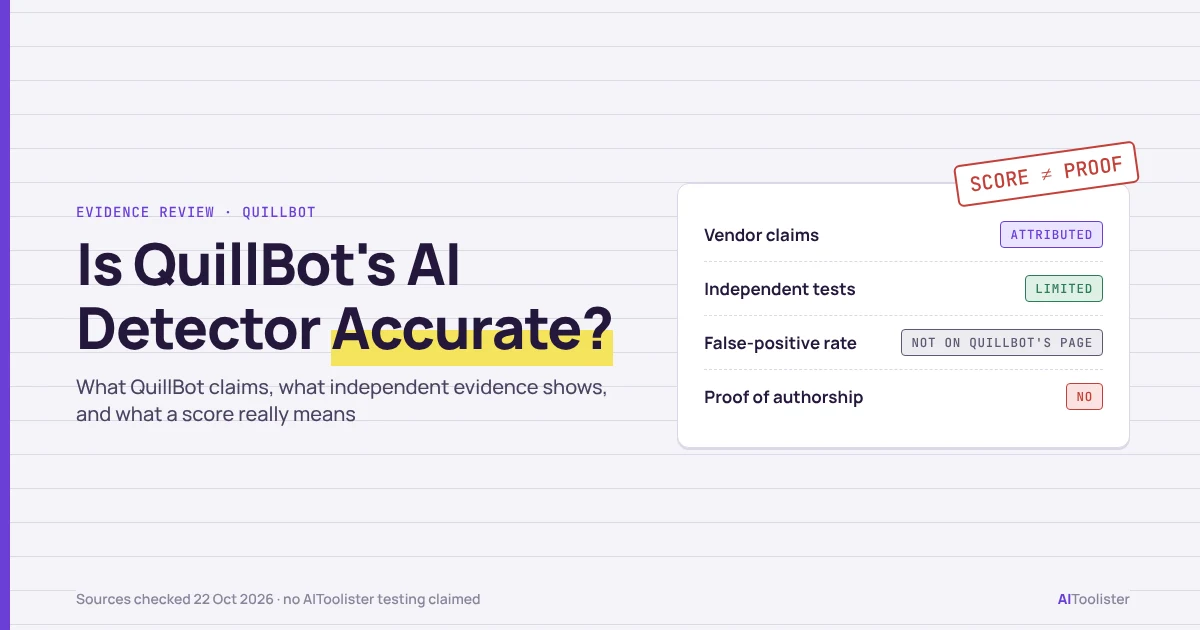
Is QuillBot’s AI detector accurate? It can be useful, but the independent evidence is thinner than most reviews suggest. Many of the pages ranking for this question are published by companies that sell a rival AI detector, an AI humanizer or an essay writer. This guide separates what QuillBot claims from what independent testing and research have actually found, and explains what its scores do and don’t mean.
QuillBot’s claims and limits were checked on its official site on 22 October 2026. No claims here come from our own testing.
Is QuillBot’s AI Detector Accurate? The Short Answer
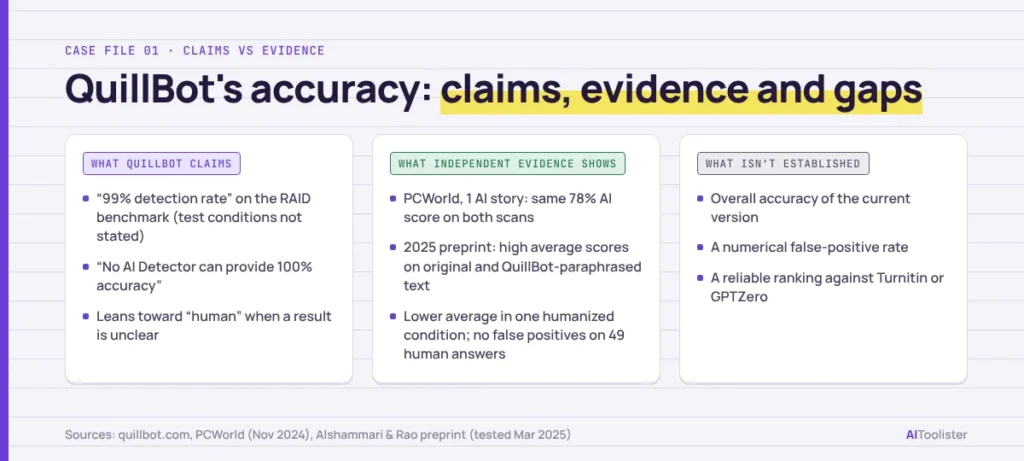
QuillBot’s AI detector performed well on original AI text and on text run through QuillBot’s own paraphraser in one limited research study. In the same study, its scores dropped on text that had been rewritten in a “humanized” mode. A separate journalist test on a single AI story gave the same 78% AI score on both scans.
That’s useful as a quick check, but it isn’t proof. QuillBot itself says its scores are “signals, not verdicts” and warns against making academic or employment decisions on a detector score alone. I couldn’t verify a large independent evaluation of the current version, so treat any result as one piece of evidence, not a ruling.
What QuillBot Claims About Its Accuracy
On its AI detector page, QuillBot says it detects AI text “with a 99% detection rate, according to independent evaluations from RAID.” That figure is QuillBot’s own claim.
RAID is a benchmark created by academic researchers and described in a 2024 paper. It tests detectors on more than 6 million pieces of text from 11 language models, across 8 domains, 4 ways of generating text and 11 kinds of adversarial attack designed to fool detectors. A benchmark like this is a fair way to compare detectors, but a single headline number depends on which of those conditions it covers. QuillBot’s page doesn’t say which models, domains, attacks or false-positive threshold produced its 99% figure, and I couldn’t independently verify the result.
QuillBot also makes several more cautious statements on the same page:
- “No AI Detector can provide 100% accuracy.”
- When a result is unclear, its model “tends to classify texts as human written, which reduces false positives.”
- A scan needs at least 80 words.
- The detector supports more than 20 languages.
What Independent Tests and Research Actually Found
Only a small amount of evidence comes from sources without a commercial stake in the result.
| Source | Type and date | Method | What it found for QuillBot | Limits |
|---|---|---|---|---|
| PCWorld | Technology journalist, Nov 2024 | One Gemini-written story, scanned twice on free versions of four detectors | 78% AI score on both runs | One sample; a detector score, not an accuracy rate |
| Alshammari & Rao | Research preprint (not peer-reviewed); tested Mar 2025, published Jul 2025 | 294 samples: 49 human answers plus DeepSeek text in five original and transformed conditions | No false positives on the 49 human answers; average AI scores of 98.4% (original DeepSeek-V3), 95.5% (paraphrased with QuillBot) and 58% (one humanized condition) | One AI model family, small dataset, earlier version of the detector |
PCWorld. In its test of four AI detectors, PCWorld generated one short story with Google Gemini and pasted it into each tool twice. QuillBot gave it a 78% AI score both times. Grammarly’s detector scored the same story at 37%, GPTZero at 62% and Originality.ai at 100%. It’s a useful demonstration of consistency, but one story can’t establish an accuracy rate.
The 2025 preprint. Researchers Hulayyil Alshammari and Praveen Rao tested six detectors on text from DeepSeek, a model earlier studies had largely skipped. Their preprint used 49 human-written answers and 49 matching answers in each of five AI conditions: DeepSeek-V3 originals, the same answers paraphrased with QuillBot, DeepThink originals, and DeepThink answers rewritten in a standard mode and in a “humanized” mode. The detectors were tested in March 2025, and the preprint was published that July. QuillBot flagged none of the human answers as AI and gave high average AI scores to the original and QuillBot-paraphrased text. Its average fell to 58% in the humanized condition. That result applies to that specific rewriting method, not to every kind of heavily edited text.
One detail matters when you read these numbers. The researchers label these figures “accuracy,” but calculate them as average detector scores. They are not the percentage of documents correctly classified.
The takeaway. PCWorld shows how QuillBot responded to one AI-generated story. The preprint provides broader but still limited evidence: average scores were high on original and QuillBot-paraphrased text, and lower in its humanized DeepThink condition. Neither establishes the current detector’s overall accuracy, and I couldn’t find a large independent evaluation of the current version.
What Does QuillBot’s AI Percentage Mean?
QuillBot describes its result as a “confidence score between 0 and 100% that states the likelihood of the text being AI or human written.” In other words, the document score is an estimate of how likely the text is to be AI-generated. Don’t read “30% AI” as “30% of the words were written by AI.”
The detector also works line by line, highlighting specific passages it thinks look AI-generated and explaining why. QuillBot says it distinguishes text that is entirely AI-written, entirely human-written, or human-written with some AI refinement.
Neither the overall score nor the highlighted passages proves who wrote a text. They also don’t tell you how accurate the detector is. A tool can give a confident score and still be wrong about that particular document.
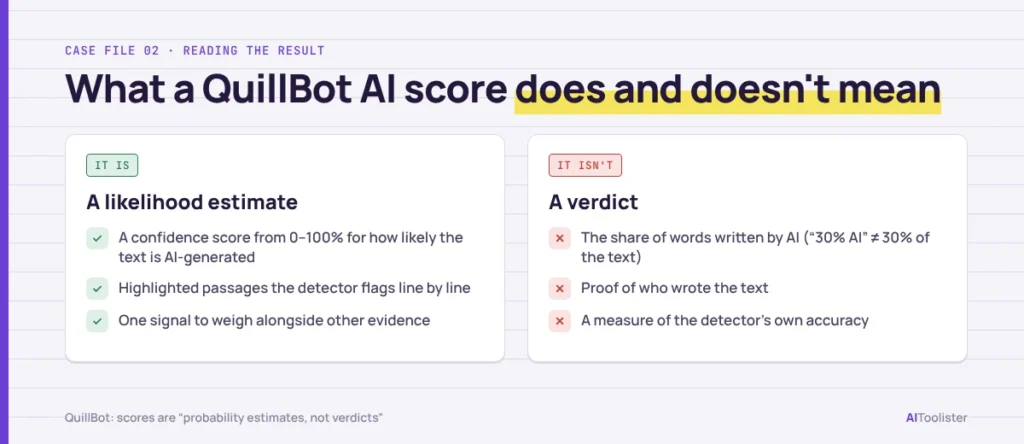
This is also why there’s no official answer to “is 30% AI detection bad?” A 30% score means the tool sees some likelihood of AI writing, not that a fixed share of the text is AI or that a rule has been broken. QuillBot doesn’t publish a pass or fail threshold.
Why QuillBot’s Results Vary Across Different Texts
The same detector can look excellent or unreliable depending on what you feed it:
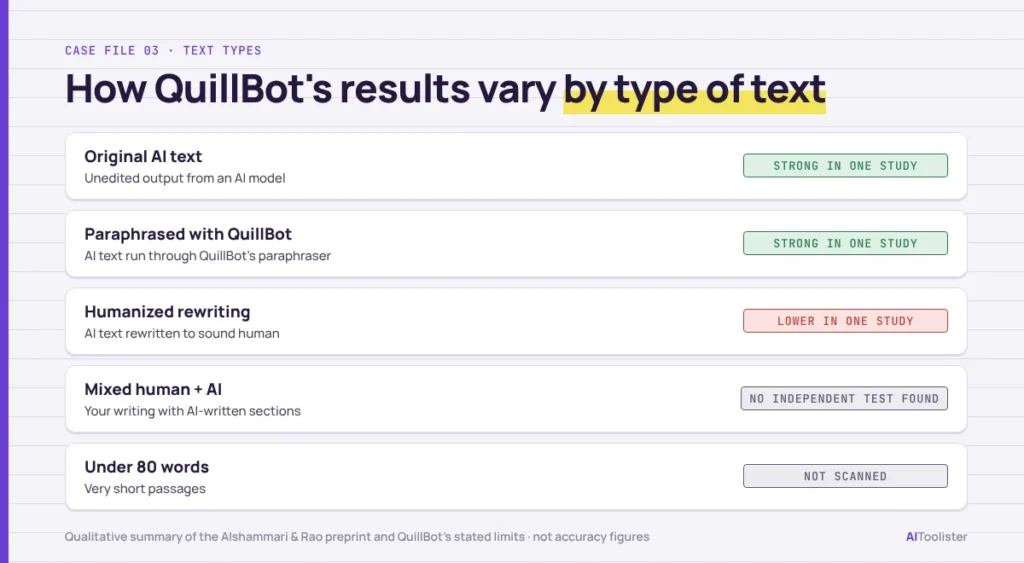
- Original AI text. This is where QuillBot did best in the 2025 preprint, with average AI scores above 95% on unedited DeepSeek text.
- Text paraphrased with QuillBot. Running AI text through QuillBot’s own paraphraser barely changed the result in that study: a 95.5% average score.
- “Humanized” text. The one humanized condition in the preprint brought the average down to 58%. Across all six detectors tested, the researchers found humanization to be the most effective way of evading detection.
- Mixed human and AI writing. QuillBot says it can flag AI sections inside mixed documents. I couldn’t find independent research testing how well it does this.
- Short text. QuillBot won’t scan fewer than 80 words, and very short passages give any detector less to work with.
QuillBot AI Detector False Positives: Can Human Writing Be Flagged?
Yes, it can. QuillBot says no detector is 100% accurate, and its detector page doesn’t provide a numerical false-positive rate.
What QuillBot itself acknowledges. Its FAQ says heavily paraphrased writing and highly formulaic content are “more likely to present a false positive.” It adds that “formulaic human writing (academic definitions, legal copy, structured templates) can score higher than expected.” These are risks QuillBot names itself, not results from an independent test.
What independent research shows. In the 2025 preprint, QuillBot didn’t flag any of the 49 human-written answers as AI. That’s encouraging, but 49 informal Q&A answers are a small and narrow sample.
What research on other detectors suggests. A 2023 study by Liang and colleagues, later published in the journal Patterns, found that several widely used AI detectors consistently flagged writing by non-native English speakers as AI-generated. QuillBot’s detector wasn’t among the tools tested, so this shows a risk for detectors generally rather than a measured QuillBot problem.
Reddit and Quora threads include plenty of reports of human work being flagged. They’re worth knowing about, but they’re individual experiences, not measurements.
How QuillBot Compares With Turnitin and GPTZero
The evidence reviewed here does not establish a reliable accuracy ranking between QuillBot, Turnitin and GPTZero. The practical differences are clearer:
- QuillBot is a free, public tool that writers mostly use to check their own text.
- Turnitin runs inside schools’ systems, and in most setups only instructors see the AI score. Our guide to how Turnitin’s AI detector works explains who can see it and what the score bands mean.
- GPTZero offers both a free checker and paid tools for educators.
A QuillBot score also doesn’t predict what Turnitin will say about the same document. The two tools use different models, and Turnitin has its own documented limits, covered in our look at whether Turnitin AI detection is accurate.
Is QuillBot’s AI Detector Free? Current Limits
Yes, there’s a free version, with limits:
| Feature | Free | Premium |
|---|---|---|
| Words per scan | Up to 1,200 | No word limit |
| Scans | Up to 6 per day | Unlimited |
| Explanations of flagged text | 1 explainer card | Unlimited |
| Full report download | No | Yes |
| Minimum length | 80 words | 80 words |
Limits were checked on QuillBot’s detector page on 22 October 2026 and can change.
What to Do If QuillBot Flags Your Writing
A high QuillBot score on work you wrote yourself isn’t proof of anything, but it’s worth being prepared:
- Don’t panic over one score. Detectors disagree with each other, and QuillBot says its results are estimates.
- Keep dated drafts and version history. Google Docs records revisions; Word’s version history is available when files are stored in OneDrive or SharePoint.
- Keep your notes and sources. Outlines, research notes and reading lists all show your process.
- Find out which detector actually matters. Your school may use Turnitin or another tool, not QuillBot.
- Talk to your instructor early. Bring your drafts and explain how you wrote the piece.
- Don’t run honest work through a humanizer. It won’t prove anything, and it can make your writing harder to defend.
FAQ
What is the most trusted AI detector?
No AI detector has been shown to be accurate enough to prove who wrote a text. Tools differ in how they’re tested and used, and results change as AI models change. Treat any detector, including QuillBot, as one signal alongside other evidence.
Does QuillBot get detected by AI detectors?
It can. In the 2025 preprint, AI text paraphrased with QuillBot’s own tool still received an average AI score of 95.5% from QuillBot’s detector. Paraphrasing AI text with QuillBot shouldn’t be assumed to hide it from detectors.
Is QuillBot’s AI detector more accurate than Grammarly’s?
There isn’t enough evidence to say. In PCWorld’s single-story test, QuillBot scored the AI-written story at 78% and Grammarly’s detector at 37%. That’s one sample, so it shows how the two tools responded to one text, not which is more accurate overall.
The Bottom Line
QuillBot’s AI detector is a reasonable free first check on your own writing, and it did well on unedited AI text in the limited independent research available. It’s much weaker evidence about someone else’s work. Its scores are likelihood estimates, rewritten text can lower them, and human writing can still be flagged.
Keep Exploring