
DentalWriter AI✓
From $315/month
Dental sleep medicine and TMJ practices needing SOAP documentation and medical billing support
A busy dental practice runs on two parallel tracks simultaneously.
From $315/month
Dental sleep medicine and TMJ practices needing SOAP documentation and medical billing support
From $249/month
Dental and medical practices wanting an all-in-one VoIP phone, texting, and payment platform with AI-driven appointment scheduling
From Custom pricing
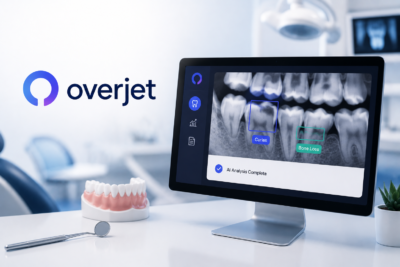
Multi-location dental groups and DSOs wanting FDA-cleared imaging AI combined with revenue cycle management and enterprise analytics
From Custom pricing
Dental practices wanting FDA-cleared, chairside AI detection of pathologies directly on X-rays for real-time patient case presentation
A busy dental practice runs on two parallel tracks simultaneously. The clinical side — examinations, imaging, diagnosis, treatment — demands focused professional attention and careful documentation at every step. The administrative side — patient communication, appointment management, billing, reputation management, and note writing — runs alongside it, consuming staff time that could otherwise support patient care. In many practices, those two tracks are perpetually competing for the same limited resources. AI dentistry tools have emerged as a practical way to ease that competition.
AI dentistry tools are software platforms that apply artificial intelligence to specific tasks within dental practice — both clinical and operational. On the clinical side, AI imaging tools analyse dental radiographs and flag areas of interest for the clinician to review, supporting more consistent and thorough evaluation of X-rays during a busy appointment schedule. On the operational side, AI tools assist with clinical documentation, patient communication, appointment reminders, online review management, and practice analytics — reducing the administrative burden on dentists and front office staff without reducing the quality of patient interaction.
The clinical imaging applications work by analysing digital radiographs using models trained on large datasets of annotated dental X-rays. These tools identify potential areas of concern — cavities, bone loss, calculus, and other findings — and present them visually to the clinician, who makes the final clinical judgment. The role of the AI is to support consistency and thoroughness, not to replace the dentist’s expertise or clinical decision-making. In a high-volume practice, this kind of systematic support for radiograph review can help ensure that findings are less likely to be overlooked during time-pressured appointments.
The administrative AI tools work differently. Patient communication platforms use automation and AI to handle appointment reminders, recall outreach, and post-appointment follow-up at a scale that front office staff couldn’t manage manually without dedicating significant hours to it. Clinical documentation tools assist with the creation of dental notes and treatment records, reducing the time dentists spend on charting after each appointment. Reputation management platforms use AI to monitor and respond to patient reviews across online platforms, helping practices maintain a consistent and professional presence without manual monitoring.
The dental professionals benefiting most from AI tools span solo practices and larger group practices alike. General dentists in private practice use AI imaging support to strengthen their radiograph review process and clinical documentation tools to reduce after-hours charting time. Dental office managers use patient communication and practice analytics tools to improve appointment adherence and reduce no-shows. Dental service organisations managing multiple locations use AI platforms to standardise processes and gain visibility across their practice portfolio. The right combination of tools depends on which operational or clinical challenge is most acute.
Choosing between AI dentistry tools requires careful consideration of several factors specific to a clinical environment. HIPAA compliance is non-negotiable for any tool handling patient health information — verifying a provider’s compliance posture before implementation is an essential step, not an afterthought. Integration with existing practice management software and imaging systems affects how well a tool fits into an established workflow without creating duplicate data entry. Clinical AI tools require a period of evaluation to understand how they perform on your patient population and imaging equipment. Ease of adoption matters when tools need to be used by both clinical and administrative staff with different technical comfort levels. Pricing structures vary considerably between platforms and often scale with practice size or patient volume.
The AI dentistry tools listed below cover a range of clinical and operational applications across imaging analysis, documentation, patient communication, and practice management. You can compare them directly by features, compliance posture, integration support, and use case fit to find the platform best suited to your practice.
AI dentistry tools are software platforms that apply artificial intelligence to clinical and administrative tasks within dental practices. On the clinical side, they include AI-powered radiograph analysis tools that help dentists identify areas of concern in dental X-rays more consistently. On the operational side, they include tools for clinical documentation, patient communication and recall, appointment management, online review monitoring, and practice analytics. The category spans point solutions that address one specific task and broader platforms that support multiple aspects of practice management with AI-enhanced features throughout.
AI dental imaging tools analyse digital radiographs using machine learning models trained on large annotated datasets of dental X-rays. When a radiograph is captured, the AI processes the image and highlights areas that may warrant clinical attention — potential cavities, bone loss, calculus deposits, or other findings — overlaying these annotations on the image for the dentist to review. The dentist makes all clinical judgments and diagnostic decisions; the AI functions as a systematic support layer that helps ensure consistent review of every image. Overjet and Pearl AI are examples of platforms offering this type of radiograph analysis capability for dental practices.
No — AI tools in dentistry are designed to support clinical judgment, not replace it. Dental diagnosis requires the integration of radiographic findings with clinical examination, patient history, symptoms, and professional expertise that AI models are not equipped to replicate. AI imaging tools surface potential findings for the dentist to evaluate; the interpretation and treatment planning decisions remain entirely with the clinician. Using AI imaging support doesn’t change the dentist’s clinical responsibility — it provides an additional layer of systematic review that can support consistency, particularly during high-volume appointment schedules.
Compliance status must be verified directly with each provider before implementation, since HIPAA requirements apply to any tool that handles protected health information in a dental setting. Reputable dental AI platforms document their HIPAA compliance posture and offer Business Associate Agreements for practices that deploy their software. Compliance requirements evolve and individual providers update their certifications over time, so checking current documentation directly is more reliable than relying on general claims. Before integrating any AI tool into a workflow that touches patient health records, imaging, or communications, confirm the provider’s current compliance posture with your own privacy officer or legal counsel where appropriate.
AI-powered patient communication tools automate the outreach tasks that front office staff would otherwise handle manually — appointment reminders, recall messages, post-treatment follow-up, and reactivation of lapsed patients. They can send personalised communications across SMS, email, and other channels based on each patient’s appointment history and preferences, at volumes and consistency levels that manual processes can’t sustain. Platforms like Weave AI and Birdeye AI include patient communication capabilities alongside other practice management features. The result is more consistent patient contact with less staff time devoted to outreach, which can improve appointment adherence and reduce no-show rates.
AI dental note writing tools assist dentists in creating clinical documentation more efficiently by generating structured notes based on input from the appointment — through dictation, structured prompts, or integration with clinical data captured during the visit. The dentist reviews and approves the output before it becomes part of the patient record. Tools like DentalWriter AI are built specifically for dental documentation, producing clinical notes, treatment narratives, and insurance-related documentation formats. The time saving comes from replacing manual note writing with a faster review-and-edit process, which can be significant for dentists completing documentation across a full day of appointments.
AI reputation management tools monitor patient reviews across Google, Yelp, Healthgrades, and other platforms, alerting practice staff to new reviews and in some cases generating suggested response drafts for the practice to review and post. Consistently responding to reviews — particularly negative ones — is important for practice reputation and patient trust, but doing so manually across multiple platforms is time-consuming. Platforms like Birdeye AI provide reputation management alongside broader patient communication features, allowing practices to maintain a consistent and professional online presence without dedicating significant staff hours to monitoring and responding to reviews across every channel.
Start with HIPAA compliance — this is a non-negotiable baseline for any tool handling patient information in a dental practice. Then evaluate integration with your existing practice management software and imaging systems, since tools that sit outside your current workflow create additional steps rather than removing them. For clinical AI tools, assess how the software performs on your specific imaging equipment and patient population before committing. For operational tools, consider which administrative tasks consume the most staff time and whether the tool addresses those specifically. Pricing relative to your practice size and patient volume, ease of adoption across both clinical and administrative staff, and the quality of implementation support all affect whether a tool delivers its intended value in practice.