Ahsan Javaid
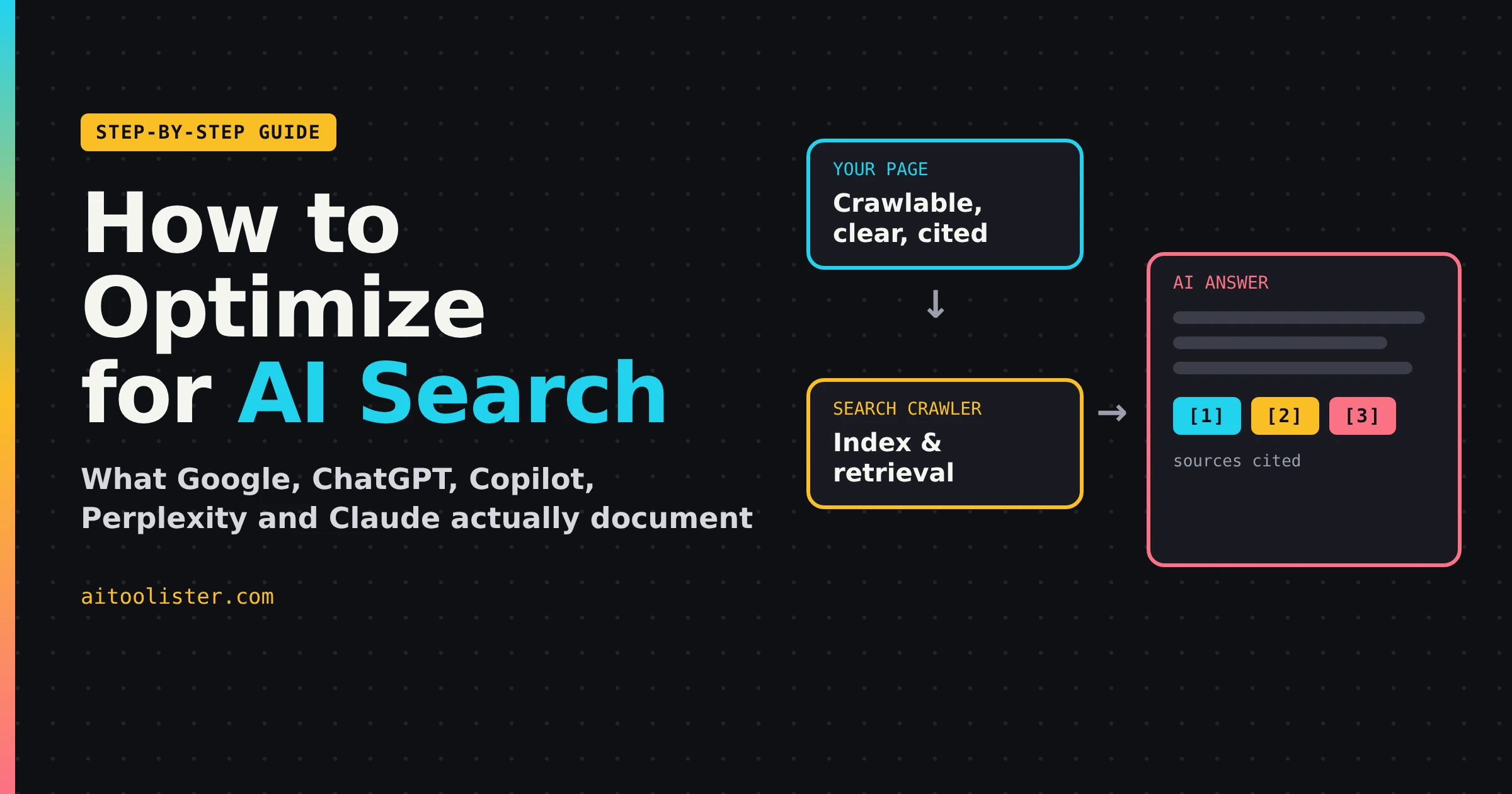
How to optimize for AI search: mostly by doing good SEO well, then adding a few platform-specific steps. The main takeaway is simple: let the right crawlers in, publish content that is genuinely useful and easy to quote, and measure what you can. Google says its AI Overviews and AI Mode pull pages from the same Search index and use its core ranking systems. ChatGPT, Perplexity and Claude each run their own search crawler, and if you block that crawler, your site can’t show up in their search answers.
No platform publishes a formula that guarantees a citation. This guide sticks to what the platforms document, shows where research adds to that, and labels the rest as practitioner advice.
How we put this guide together: it draws on official documentation from Google, OpenAI, Microsoft Bing, Perplexity and Anthropic, plus one peer-reviewed study, all checked October 30, 2026. We separate what platforms document from research findings and practitioner advice, and AIToolister did not run its own citation experiments for this guide.
What AI Search Optimization Means (AEO, GEO and AI SEO)
AI search optimization is the work of making your content easy for AI-powered search features to find, understand and cite. You’ll see it called AEO (answer engine optimization), GEO (generative engine optimization) or AI SEO. The names differ, but the goal is the same: appear as a source in AI-generated answers on Google, ChatGPT, Copilot, Perplexity and similar tools.
“Generative engine optimization” comes from a 2024 research paper presented at KDD, a major data-mining conference, which tested ways to make content more visible in AI answers. It is now used as a general industry term.
Google’s position is that you don’t need a separate discipline for its AI features. Its guide to optimizing for generative AI features says you don’t need to write in a specific way just for generative AI search, because its systems understand synonyms and general meaning.
How AI Search Engines Choose Which Pages to Cite
Each platform documents how it discovers and retrieves sources, but none publishes the full set of factors that decide which page gets cited. Treat any claim about exact “citation rules” with caution.
Google AI Overviews and AI Mode
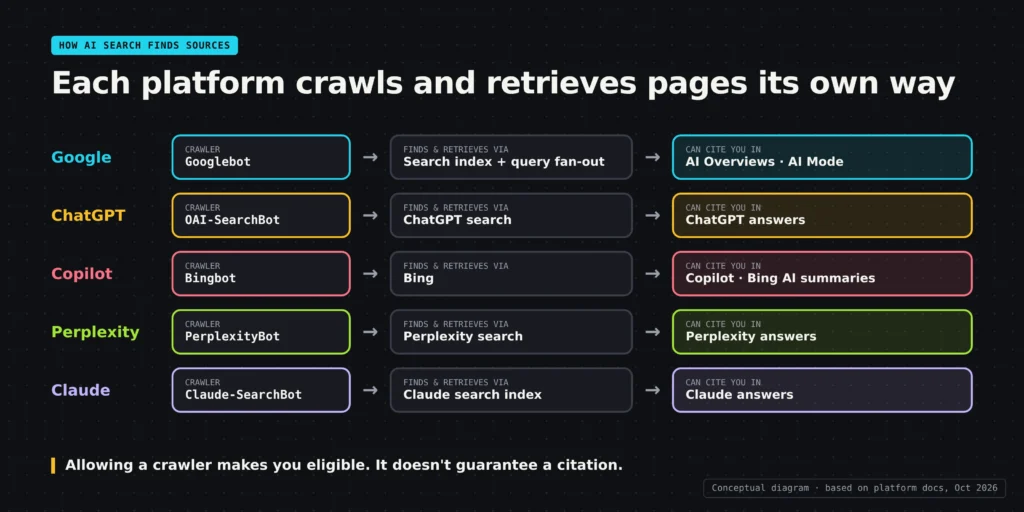
Google describes these features as using retrieval-augmented generation, which it also calls grounding: they pull relevant, up-to-date pages from Google’s Search index using its core ranking systems, then generate an answer grounded in those pages. They also use query fan-out, which runs related searches to gather more sources. For example, a question about fixing a weed-filled lawn can trigger searches such as “best herbicides for lawns.”
To be eligible, a page must be indexed and able to show a snippet in Google Search. Google adds that meeting these requirements doesn’t guarantee a page will show.
ChatGPT search
OpenAI’s OAI-SearchBot crawls websites for ChatGPT search. Blocking it keeps your site out of ChatGPT search answers, and allowing it still doesn’t guarantee a citation. OpenAI recommends allowing OAI-SearchBot if you want to appear.
Microsoft Copilot
Copilot’s citations come through Bing. Bing’s AI Performance report, covered in the tracking section below, counts citations across Copilot, AI summaries in Bing and some partner services, and Bing says it respects the preferences site owners set in robots.txt.
Perplexity
According to Perplexity’s crawler documentation, PerplexityBot surfaces and links websites in Perplexity’s search results, and Perplexity says it doesn’t use it to collect content for training AI models.
Claude
According to Anthropic’s help center, Claude-SearchBot crawls the web to improve Claude’s search responses, and Anthropic says blocking it may reduce your site’s visibility and accuracy in Claude’s search results.
Most of these platforms also have a separate fetcher that visits a page only when a user asks a question that needs it. That is the same idea as an AI agent acting on someone’s behalf, as our guide to AI agents explains.
Step 1: Make Sure AI Crawlers Can Access Your Site
The most common technical problem is accidentally blocking the crawler a platform uses for search, and most AI companies separate three kinds of access that you can control independently.
| Platform | Search crawler | Training / model-use control | User-triggered fetcher |
| Googlebot | Google-Extended (a robots.txt token, not a separate crawler) | No equivalent in this comparison | |
| OpenAI | OAI-SearchBot | GPTBot | ChatGPT-User |
| Perplexity | PerplexityBot | No separate training crawler documented | Perplexity-User |
| Anthropic | Claude-SearchBot | ClaudeBot | Claude-User |
| Microsoft Bing | Bingbot | No separate crawler identified in Bing’s documentation | No equivalent identified |
The key point is that you can block model training and still allow search. For example, a site that doesn’t want its content used to train OpenAI’s models but does want to appear in ChatGPT search could use:
User-agent: GPTBotDisallow: /User-agent: OAI-SearchBotAllow: /
OpenAI says robots.txt changes can take about 24 hours to affect its search systems.
User-triggered fetchers don’t always behave like search crawlers. OpenAI’s crawler documentation says robots.txt rules may not apply to ChatGPT-User, Perplexity says Perplexity-User generally ignores robots.txt because a person requested the page, and Anthropic says its bots honour robots.txt.
Google works differently. Google-Extended controls whether content Google has already crawled can be used to train Gemini models and to ground answers in Gemini Apps. Google says it does not affect a site’s inclusion in Google Search. Whether your site appears in AI Overviews and AI Mode is governed by Googlebot access and a separate Search Console setting for Search’s generative AI features, which Google’s guide says your site must be included in.
Finally, check your firewall, CDN and bot-protection settings, since security tools sometimes block crawlers that robots.txt allows. OpenAI and Perplexity publish their crawlers’ IP ranges so you can verify genuine requests.
Step 2: Build on Strong SEO Foundations
Because Google’s AI features are rooted in its core Search ranking and quality systems, the usual technical basics still apply: make content crawlable, follow JavaScript SEO practices, provide a good page experience and reduce duplicate content.
In practice, that means pages that index, load properly, render their main content without relying on scripts crawlers can’t run, and link clearly to related pages on your site. Bing also recommends IndexNow, a protocol that lets participating search engines know when your content changes so they pick up updates quickly.
If your pages don’t rank or get indexed in regular search, AI optimization won’t fix that. The key takeaway is that regular search performance still comes first.
Step 3: Write Answer-First, Self-Contained Sections
Google recommends unique, people-first content with clear sections and an original, first-hand or expert perspective. Bing’s guidance is more specific about format: it says clear sections, tables and FAQ sections help AI systems reference your information accurately.
Two practitioner habits fit that guidance well:
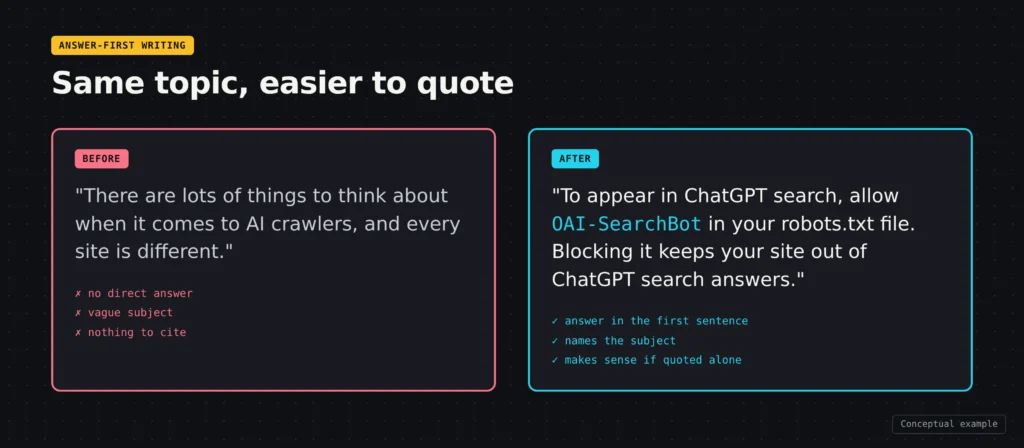
- Put the answer first. Open each section with the direct answer, then explain.
- Make sections self-contained. Name the subject instead of relying on “it” or “this,” so a paragraph still makes sense if it’s quoted on its own.
Before: “There are lots of things to think about when it comes to AI crawlers, and every site is different.”
After: “To appear in ChatGPT search, allow OAI-SearchBot in your robots.txt file. Blocking it keeps your site out of ChatGPT search answers.”
Google also says there’s no requirement to break content into tiny pieces for AI, and there’s no ideal page length. Write sections that answer the question fully, then stop. If you use AI writing tools to help draft, our roundup of AI tools for content creators compares options; the expert perspective Google asks for has to come from you.
Step 4: Make Your Entity and Expertise Clear
An “entity” is the person, business, product or concept a page is about. Search systems try to connect your content to clear entities.
What the platforms document: Google asks for content with a first-hand or expert perspective.
- Google’s structured data guidelines say markup must be a true representation of visible page content, and that structured data doesn’t guarantee a search feature will appear. Its AI guide adds that there’s no special schema.org markup needed for generative AI search.
- Bing recommends keeping text, images, and video consistent across the same products, entities, and concepts, and says local businesses should keep their Bing Places for Business listing current.
Practitioner advice (reasonable, but not documented as a ranking factor):
- Show who wrote each page and why they’re qualified.
- Use one consistent name and description for your organization and products across the site.
- Publish an about page and an editorial or review policy.
Structured data still helps with rich results in Google Search, but don’t expect schema alone to increase AI citations.
Step 5: Back Claims With Evidence and Keep Content Fresh
Bing recommends supporting claims with examples, data and sources, and keeping content current. Research points the same way.
In the KDD 2024 study by Aggarwal and colleagues, adding quotations raised a page’s visibility in AI answers by about 41% on the paper’s main measure, adding statistics by about 31% and citing sources by about 27%. Keyword stuffing performed worse than the unmodified page.
Those results come with important limits: the main experiments used a simulated generative search engine built on GPT-3.5 and top Google results, not live commercial products, and the paper found that results varied by subject. The improvements are changes in the paper’s visibility measure, not increases in traffic, rankings or real-world citations. Read them as support for evidence-rich writing, not as a formula such as “add three statistics.”
For freshness, update content when something has actually changed, and change the date only after a real review. Google also lists chasing inauthentic mentions of your brand as less helpful than it might seem.
What Doesn’t Help: Common AI Search Optimization Myths
Not every popular tactic is backed by evidence. It helps to separate three kinds of claims.
What Google explicitly says is unnecessary for its AI features
- llms.txt and other AI-specific files or markup. Google says Google Search doesn’t use them. Creating them won’t help or harm your Google visibility, and they may be useful for other services.
- Chunking content into tiny pieces. Not required, and there’s no ideal page length.
- Rewriting content specifically for AI. Not needed, because its systems understand meaning and synonyms.
- Special schema.org markup for AI. There isn’t any.
- Pages for every query variation. Creating separate pages for each fan-out query mainly to manipulate rankings or AI answers violates Google’s scaled content abuse policy.
What platform documentation doesn’t establish
- Whether llms.txt helps on other platforms: none of the OpenAI, Perplexity, Anthropic or Bing pages checked for this guide documents using it.
- A guaranteed citation factor. No platform says a specific format, schema type or crawler setting guarantees a citation.
Unsupported practitioner claims
- Keyword stuffing for chatbots. It performed below the baseline in the GEO study.
- Precise “rules” for getting cited. Claims about exact sentence lengths or citation formulas aren’t supported by any platform documentation.
How to Track Whether AI Search Is Citing You
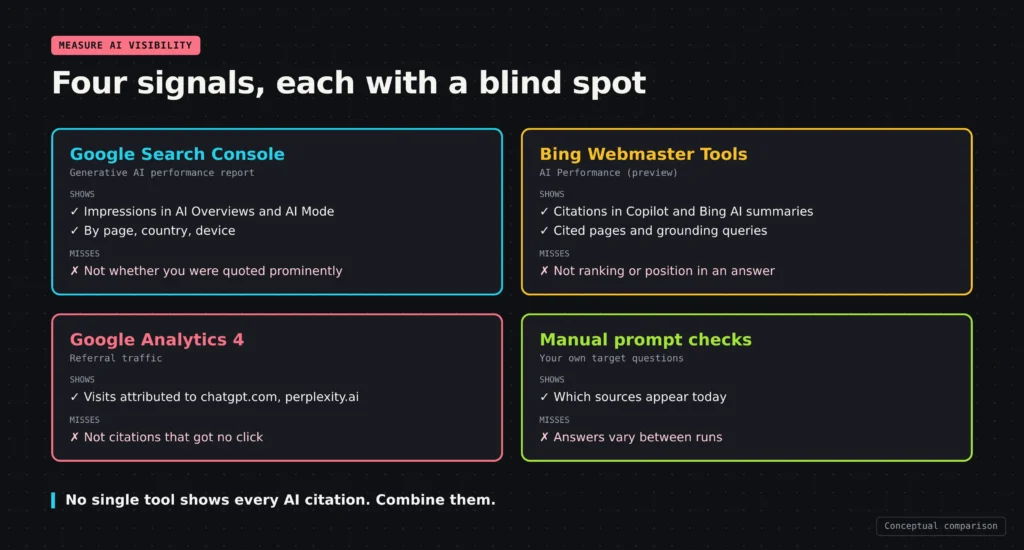
No single tool shows every AI citation, so combine several imperfect signals.
- Google Search Console. The Generative AI performance report shows impressions of links to your site in AI Overviews and AI Mode, by page, country, device and search type. Google says it has been available for all sites since August 31, 2026, but it may not appear if your site has too few impressions. It counts impressions, not whether your page was quoted prominently.
- Bing Webmaster Tools. The AI Performance report, in public preview, shows total citations, average cited pages, the searches the AI used to find your content (which Bing calls grounding queries) and citations by page across Copilot and Bing’s AI summaries. Bing says these metrics don’t indicate ranking or position within an answer.
- Google Analytics 4. Referral traffic from sources such as chatgpt.com and perplexity.ai shows visits attributed to AI platforms. It doesn’t capture citations that didn’t get a click or visits where the referrer wasn’t passed along.
- Manual prompt checks. Ask your target questions on each platform every few weeks and note which sources appear. Answers vary between runs, so look for patterns rather than single results.
Paid AI-visibility tools automate prompt tracking across platforms. They can save time, but they sample answers too, so treat their numbers as estimates. If you’re comparing options, our guide to AI marketing tools covers the wider category.
Frequently Asked Questions
How do you optimize for AI search results in 2026?
Make sure search crawlers such as Googlebot, OAI-SearchBot, PerplexityBot and Claude-SearchBot can access your site; keep strong SEO foundations; write clear, answer-first sections with an expert perspective; support claims with evidence; and track results in Search Console and Bing Webmaster Tools. None of these steps guarantees a citation.
Is AI search optimization different from SEO?
Mostly not. Google says its AI features use its core Search ranking and quality systems, and that you don’t need to write differently for them. The main differences are managing each AI platform’s crawlers and using new reports to measure AI visibility.
How do I get cited by ChatGPT?
Allow OAI-SearchBot in your robots.txt, since blocking it keeps your site out of ChatGPT search answers. Beyond that, OpenAI doesn’t publish citation criteria, so focus on indexable, useful pages that answer questions directly. Allowing the crawler makes you eligible; it doesn’t guarantee a citation.
What are the best AI search optimization tools?
Start with the free official reports: Google Search Console’s Generative AI performance report, Bing Webmaster Tools’ AI Performance report and GA4 referral data. Paid AI-visibility tools can track prompts across platforms at scale, but their results are samples, not complete citation counts.
Sources
- Google Search Central: Optimizing your website for generative AI features on Google Search
- Google Search Console Help: Generative AI performance report (Search)
- Google: List of Google’s common crawlers (Google-Extended)
- Google: General structured data guidelines
- OpenAI: Overview of OpenAI crawlers
- Perplexity: Perplexity crawlers
- Anthropic Help Center: Anthropic’s crawlers (ClaudeBot, Claude-User, Claude-SearchBot)
- Bing Webmaster Blog: Introducing AI Performance in Bing Webmaster Tools
- Aggarwal et al.: GEO: Generative Engine Optimization (KDD 2024)
Keep Exploring