Ahsan Javaid
Yes, you can usually sell AI art as digital downloads, print-on-demand products or stock licences. But first, learn the four questions that determine whether you can do so: whether your AI generator’s licence allows commercial use, whether the platform you want to sell on accepts AI work and what it requires you to disclose, whether the image infringes anyone else’s rights, and whether you can own the copyright at all.
This guide covers all four, compares the main platforms’ AI rules and fees, and walks through setting up your first listing. Platform policies, fees and legal sources were checked on 27 October 2026. Rules differ by country and platform and change often, so confirm the current terms before you start selling.
Can You Sell AI-Generated Art?
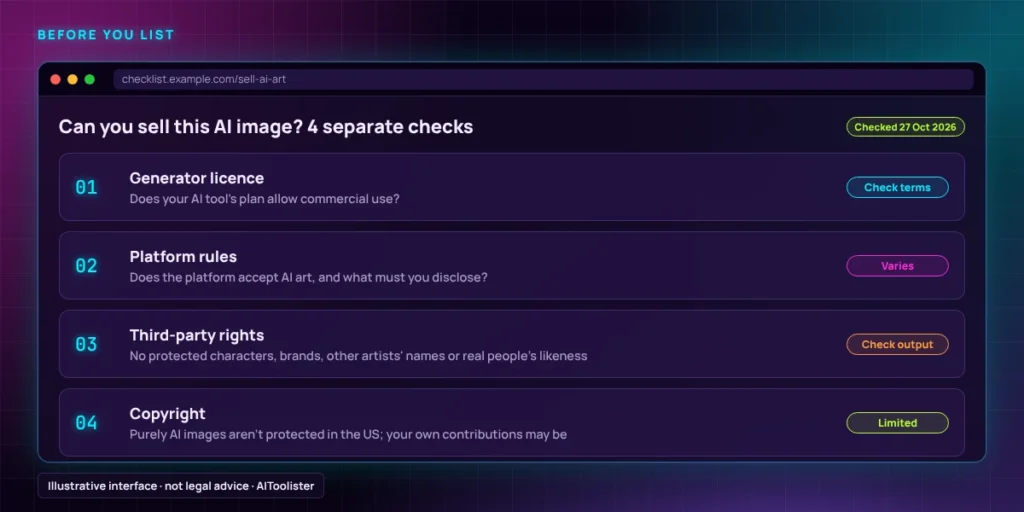
In most cases, yes, but “can I sell it” is really four questions:
- Does your AI generator allow commercial use? Each tool sets its own terms, and some only allow commercial use on paid plans.
- Does the platform accept it? Some marketplaces welcome AI art with a disclosure, some have no published AI-specific rule, and at least one major stock site bans it.
- Does the image infringe anyone else’s rights? Commercial permission from your generator doesn’t clear copyrighted source images, protected characters, trademarks or a real person’s likeness. Check the output and any reference material separately.
- Can you own the copyright? In the US, purely AI-generated images aren’t protected by copyright, which means others may be able to copy them.
These issues are independent. A commercial-use licence from your generator doesn’t mean you own the copyright or that the image is free of third-party rights, and a platform accepting your work doesn’t resolve either. Next, we’ll look at what copyright protection is available.
AI Art and Copyright: What You Can and Can’t Own
This section summarises official positions, not legal advice. Check the rules where you live and sell.
United States
The US Copyright Office’s January 2025 report on copyrightability concludes that “copyright does not extend to purely AI-generated material.” It also says that, with current technology, “prompts alone do not provide sufficient human control” to make you the author of an AI output.
Human contribution can still be protected. The Office says human authors can claim protection for their own work that’s perceptible in an AI output, and for “the creative selection, coordination, or arrangement” of material. That protection covers the human-contributed elements only, and editing an AI image doesn’t automatically guarantee copyright. Whether a particular piece qualifies depends on how much of it reflects your own creative choices.
In practice, if you sell an image you generated with a prompt alone, you may have no copyright to enforce if someone copies it.
United Kingdom
The UK takes a different approach. According to the government’s Report on Copyright and Artificial Intelligence, published on 18 March 2026, copyright protections for computer-generated works created without a human author have existed since 1988. The report proposes removing this specific protection, while copyright would continue to protect works made with AI assistance. That’s a proposal, not a final change, so UK sellers should watch for updates.
Elsewhere
Other countries treat AI-generated works differently. If you sell internationally, the rules in your own country and in your buyers’ countries may both matter. Next, check the terms of the tool that created the image.
Check Your AI Generator’s Terms First
Before you sell anything, read the terms of the tool that made it. Commercial rights vary by tool and plan, so start there before you choose a platform.
Midjourney is a clear example. Its terms say subscribers own the images and videos they create, subject to stated exceptions, even if they later cancel. This describes the rights granted under Midjourney’s terms; it doesn’t guarantee that an image qualifies for copyright protection under the law of your country. Businesses grossing more than $1,000,000 a year need a Pro or Mega plan to use images commercially. Its help page doesn’t say whether you can use images made on a free trial commercially.
Other generators have their own rules on free and paid plans, watermarks and attribution. Our guide to the best free AI image generators compares the commercial-use terms of popular free tools.
Where to Sell AI Art: Platform Comparison
Platforms with documented AI rules
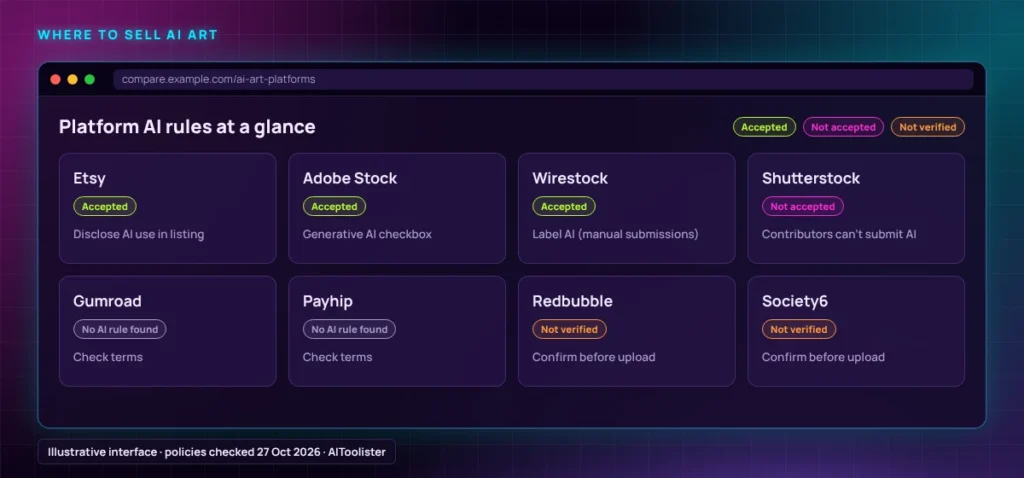
| Platform | Accepts AI-generated images? | Disclosure required | Fees / contributor earnings | Best for | Key restriction |
| Etsy | Yes, as seller-prompted AI creations | Disclose AI use in the listing | $0.20 per listing + 6.5% transaction fee + payment processing | Prints, digital downloads, print-on-demand | Can’t present AI work as handmade; bot-generated listings banned |
| Adobe Stock | Yes | “Created using generative AI tools” checkbox; “People and Property are fictional” checkbox where it applies | Standard royalty of 33% for photos, vectors and illustrations; licensing terms and minimums vary | Stock licensing | No artist names, real people or brands in prompts, titles or keywords; releases needed for real people or property |
| Wirestock | Yes | For manual submissions, identify AI use in the title, description and keywords | Not verified | Stock licensing | No copyrighted material, brands or celebrity likenesses; permission forms or model releases may apply |
| Shutterstock | No | — | — | — | Contributors can’t submit AI-generated content |
Other storefronts and print-on-demand sites to check
These platforms are worth considering, but their published pages didn’t establish an AI-specific rule when we checked. Treat them as options to investigate rather than confirmed choices, and check each one before uploading.
| Platform | AI rule | Fees | Best for | What we found |
| Gumroad | No AI-specific rule identified in the pages checked | 10% + $0.50 per direct sale, plus card-processing fees; 30% for Discover sales | Digital downloads from your own page | General terms apply |
| Payhip | No AI-specific rule identified in the pages checked | Free plan 5%; Plus $29/mo (2%); Pro $99/mo (0%); PayPal/Stripe fees extra | Digital downloads from your own store | General terms apply |
| Redbubble | AI-specific policy not verified | Not verified | Print-on-demand products | General IP rules apply; up to 60 works a day across all your accounts |
| Society6 | AI-specific policy not verified | Not verified | Print-on-demand products | Sellers are responsible for all rights |
Redbubble’s Community and Content Guidelines don’t explicitly address AI-generated art, and we couldn’t confirm a current Society6 AI policy. Confirm with each platform before uploading. “No AI-specific rule identified” for Gumroad and Payhip means the fee and help pages we checked don’t address AI art, not that every use is approved.
Marketplaces like Etsy bring buyers to you, in return for fees and stricter rules. Your own storefront, through Gumroad or Payhip, gives you more control, but you have to bring the traffic. Stock sites pay a royalty when someone licenses your image, and Adobe Stock and Wirestock accept AI work with labelling. Shutterstock’s contributor policy, updated in July 2025, states that it “will not allow AI-generated content to be submitted by contributors.” Print-on-demand sites handle printing and shipping, but check their AI rules first. If you want the details for one platform, the next section starts with Etsy.
How to Sell AI Art on Etsy
Etsy allows AI art, with conditions. Its Creativity Standards place AI work under “Designed by a seller,” described as “seller-prompted AI creations”: items generated using AI tools based on your own prompts. “AI prompt bundles” are excluded, and Etsy says all items must include a human touch.
On 22 October 2026, Etsy updated its AI use policies. The key points for AI art sellers:
- Disclosure: “Sellers must still disclose when an item is created using AI.”
- No misrepresentation: sellers “cannot misrepresent AI-generated work as handmade or entirely their own creation.”
- Real photos: “Your listing must include at least one unedited photo of the actual item against a real background.” Etsy notes that “different requirements apply to certain items, including print-on-demand, digital, customised, and made-to-order items.”
- No bots: listings generated by bots without human involvement aren’t allowed and may lead to shop removal.
Check the rule for your specific format: a digital printable, a physical art print and a print-on-demand product may have different listing-image requirements, so don’t assume a digital preview or a mockup automatically satisfies every requirement. Etsy’s listing image rules say that for digital downloads with a visual component, such as a printable, you should “include a preview of the actual content buyers will receive.” For print-on-demand items, you can use a stock mockup “if the stock photo’s owner has authorised its use.”
To list AI art on Etsy:
- Choose the right item type (physical print, digital download or print-on-demand).
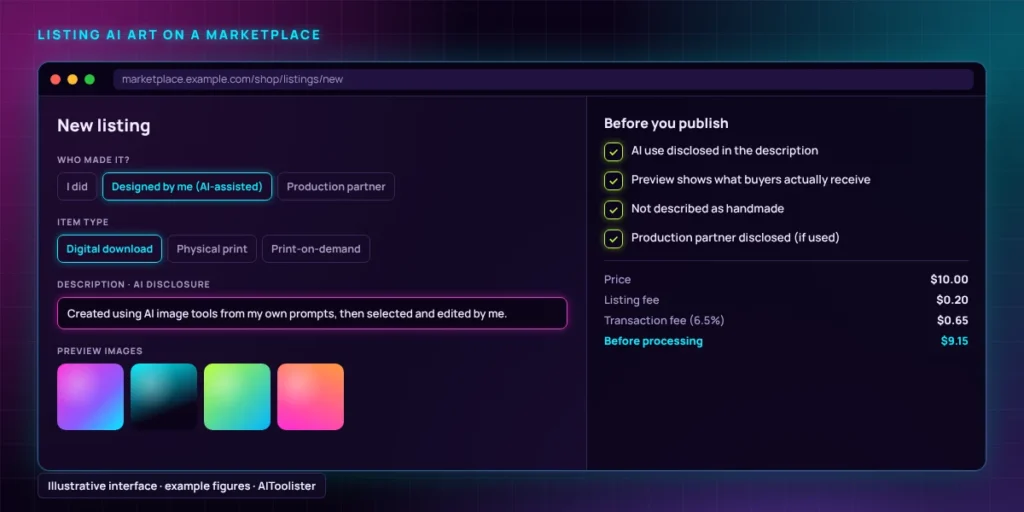
- State in the description that the design was created using AI.
- If a print-on-demand partner makes the product, disclose that a production partner made it and provide accurate shipping information, as Etsy’s Creativity Standards require.
- Add images that meet the requirements for that item type.
- Fees: $0.20 per listing, plus a 6.5% transaction fee and payment processing, which varies by country.
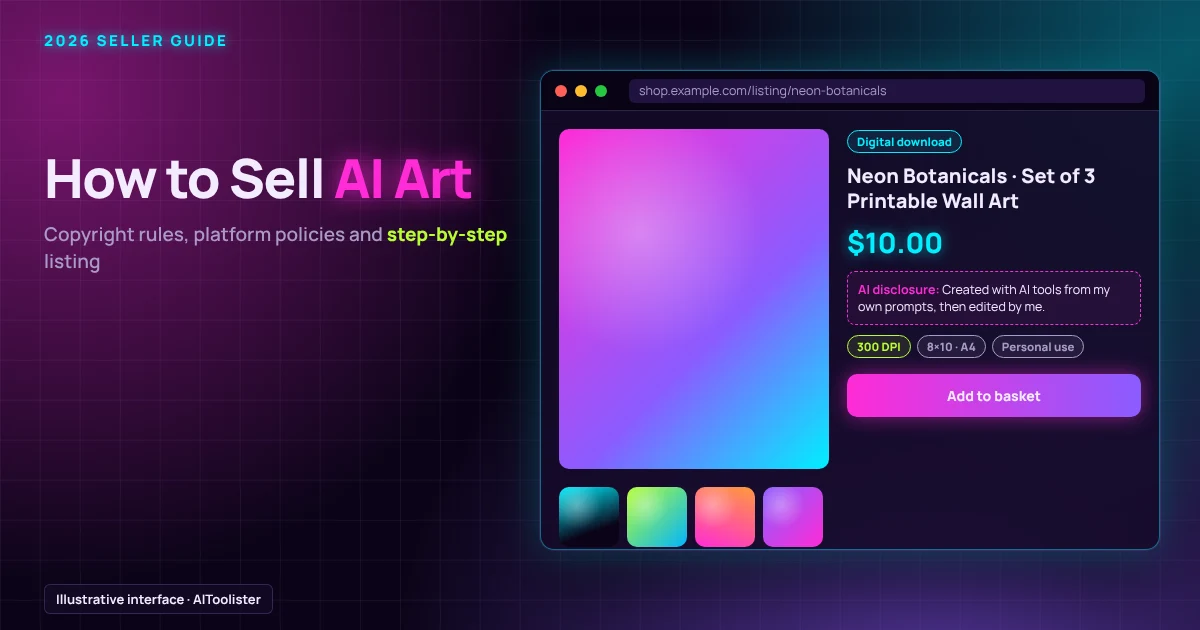
Example listing (hypothetical)
Here’s how a simple digital listing might come together. The details are illustrative, not a real shop.
- What the buyer receives: 3 printable botanical wall-art files, delivered as a digital download (no physical item is shipped).
- Files: high-resolution JPGs sized for common print sizes such as 8×10 in and A4, prepared at 300 DPI for those sizes.
- AI disclosure in the description: “These designs were created using AI image tools from my own prompts, then selected, edited and colour-corrected by me.”
- Buyer permissions: “For personal printing and display only. Not for resale or commercial use.” This describes what the buyer may do; it doesn’t claim exclusive copyright in the design.
- Fees on a $10 sale: the $0.20 listing fee plus a 6.5% transaction fee ($0.65) totals $0.85 before payment processing, which depends on your country and isn’t included here. That leaves $9.15 before processing, taxes and any advertising costs.
How to Start Selling AI Art: Step by Step
- Pick a format. Digital downloads such as printable wall art, print-on-demand products, stock licences or custom commissions each suit different platforms.
- Confirm your rights. Check your generator’s commercial terms for the plan you used, and make sure the image doesn’t copy protected characters, trademarks, other artists’ work or a real person’s likeness.
- Add your own creative input. Selecting, editing, combining and arranging your images makes the work more distinctive and, in the US, can help protect your human contributions.
- Prepare the files. Upscale to the resolution your format needs, and check for visual errors such as distorted hands or text.
- List honestly. Follow each platform’s disclosure rules and describe exactly what buyers receive.
- Price after fees. Work out what you keep after platform, transaction and payment processing fees.
- Promote your work. Marketplaces help, but social media and your own audience usually matter. Our guide to the best AI tools for content creators covers tools for creating promotional content.
What Sells, and Realistic Expectations
Are people buying AI art? Some are, but the market is crowded. People commonly sell AI art as printable wall art, print-on-demand designs, stock images, and custom pieces like portraits.
Because AI tools make images quick to produce, many sellers list very similar work. Standing out usually depends on choosing a specific niche, adding your own creative input and presenting your products well. None of these guarantees sales.
You’ll find plenty of videos claiming large weekly earnings from AI art. A creator’s reported earnings don’t establish what a typical seller earns. Look for verifiable figures, and check whether they account for advertising, subscriptions, production costs, fees and refunds.
Mistakes That Can Get Listings Removed or Accounts Suspended
These come straight from the platforms’ published rules. Consequences range from a rejected submission or removed listing to account suspension, depending on the platform and the problem:
- Using artists’ names, brands or real people. Adobe Stock prohibits them in prompts, titles and keywords, and Wirestock rejects copyrighted material, brands and celebrity likenesses.
- Not disclosing AI use. Etsy requires disclosure, and Adobe Stock requires you to check its generative AI box.
- Passing AI work off as handmade. Etsy prohibits it.
- Automated, bot-generated listings. Etsy removes them and may close the shop.
- Submitting to a platform that bans AI art. Shutterstock doesn’t accept AI-generated contributor content.
FAQ
How can I sell my digital artwork?
Sell it as digital downloads through a marketplace like Etsy or your own storefront on Gumroad or Payhip, license it through stock sites that accept your type of work, or put it on print-on-demand products. For AI-generated work, check each platform’s disclosure rules first.
Do I have to pay taxes if I sell AI art?
In many countries, income from selling art is taxable, but the rules depend on where you live and how much you sell. Check with your country’s tax authority or a qualified tax adviser.
Can you sell AI art on Redbubble?
Redbubble’s published content guidelines didn’t set out an AI-specific rule when we checked. Its general intellectual property rules apply, so you must have the rights to anything you upload. Confirm with Redbubble before selling AI work.
Can you make $10,000 a month selling AI art?
There’s no reliable evidence that this is a typical result. Earnings depend on your niche, the quality of your work, how you promote it and platform fees, and one seller’s reported income doesn’t show what others can expect.
Can you sell Midjourney or ChatGPT images?
It depends on each tool’s terms. Midjourney’s terms say subscribers own their images, with a Pro or Mega plan required for businesses grossing over $1 million a year. OpenAI’s terms assign its rights in ChatGPT output to you, to the extent it has any, and make you responsible for ensuring your content doesn’t violate the law or its terms. Neither contractual right guarantees copyright protection or clears third-party rights. In the US, purely AI-generated output from any tool isn’t protected by copyright, although your own creative contributions to a piece may be.
The Bottom Line
To sell AI art successfully, settle the four questions before you list anything: confirm your generator allows commercial use, choose a platform that accepts AI work and follow its disclosure rules, check that the image doesn’t infringe anyone else’s rights, and understand what copyright you do and don’t have. Then add your own creative input, set realistic expectations, and recheck each platform’s rules regularly, because they’re changing fast.
Sources
Policies, fees and legal positions were checked on 27 October 2026 against these official pages:
- US Copyright Office: Copyright and Artificial Intelligence, Part 2
- GOV.UK: Report on Copyright and Artificial Intelligence
- Midjourney: Using images commercially
- Etsy Creativity Standards, Etsy: Important updates to AI use, Etsy listing image requirements and Etsy Fee Basics
- Adobe Stock generative AI content guidelines and Adobe Stock royalty rates
- OpenAI Terms of Use
- Shutterstock: AI-generated content policy
- Wirestock submission guidelines
- Gumroad pricing and Gumroad’s fees
- Payhip pricing
- Redbubble Community and Content Guidelines
- Society6 community guidelines
Keep Exploring