Ahsan Javaid

Last updated: September 2026
Finding the best AI resume builder in 2026 means choosing the right match for how you actually apply to jobs — not just a template site with a chatbot bolted on. This guide compares 10 AI resume builders on content quality, ATS compatibility, job-description tailoring, workflow fit, and pricing, so you can see which tool actually matches your situation.
An AI resume builder is meaningfully different from a plain template site. A template tool gives you a clean-looking document. An AI resume builder analyzes your content, compares it against a specific job description, suggests stronger language for your experience, and — in the better tools — scores your resume against ATS-readability standards before you submit it.
Quick Answer
If you need one recommendation: Teal offers a genuinely functional free tier and a useful combination of resume building and job tracking for most active job seekers, which is why it’s our starting recommendation. If ATS performance specifically is your concern, Rezi is built around that problem more narrowly and rigorously. If you’re a student or early-career candidate, NovoResume is calibrated for a thin work history. If design matters as much as content, Kickresume is the pick. The rest of this guide breaks down all 10 tools by the same comparison criteria so you can match one to your actual situation.
Quick Comparison
| Teal | Yes — unlimited resumes, job tracking | $29/month ($13/week, $79/quarter also available) | Yes | Yes | Active job seekers |
| Kickresume | Yes — 4 templates, unlimited downloads | From about $10/month (annual); $19–24/month (monthly) | Yes | Yes | Professional design |
| Resume.io | Yes — build/preview; download limited | Roughly $17–26/month, often via a short paid trial | Yes | Partial | Speed and simplicity |
| Enhancv | 7-day trial (watermarked, capped) | About $13.33–24.99/month depending on term | Yes | Yes | Personal branding |
| Rezi | Yes — 1 resume, 3 downloads | $29/month, or $149 one-time (Lifetime) | Yes — ATS-focused | Yes | ATS performance |
| Zety | Yes — build/preview, TXT download only | $5.95/month (annual); $25.95 per 4 weeks (trial-based) | Yes | Yes | Guided building |
| Resume Worded | Yes — one free analysis | $49/month; $19–25/month if paid annually | Yes | Yes | Feedback and scoring |
| Jobscan | Yes — 5 scans/month | $49.95/month (monthly), or $89.95 for 3 months after a 7-day free trial (quarterly) | Yes — deep | Partial | Job-description matching |
| NovoResume | Yes — functional free tier | Roughly $9–10/month, terms vary by plan | Yes | Yes | Students and grads |
| ChatGPT | Yes | $20/month (Plus) | No | Yes — best for custom content | Custom content |
Pricing structures on several of these tools involve trial periods, weekly billing, or promotional rates that differ from the sticker price. Compare the current terms on each vendor’s pricing page before subscribing.
What to Look for in the Best AI Resume Builder
Applicant Tracking Systems are used by most mid-size and large employers to manage application volume — but how any specific ATS parses and ranks a resume varies by vendor and by how the employer has configured it. It isn’t accurate to say every ATS “scores” candidates the same way or filters based on fixed keyword rules. What’s consistently true is narrower and more useful: resumes with non-standard formatting (tables, text boxes, unusual fonts, graphics-based sections) are more likely to be misread by parsing software, and resumes missing language that closely matches a job posting are less likely to surface as a strong match — regardless of whether the underlying experience is actually a good fit. That is why the best comparison should focus on formatting safety, job-description matching, and how clearly each tool shows those tradeoffs.
The AI component in a genuinely useful resume builder covers three functions. Content generation — AI drafts or rewrites experience bullets based on your input, aiming for achievement-focused, action-verb-led language. Keyword and job-description matching — AI compares your resume’s language against a specific posting and flags gaps. Feedback and scoring — AI evaluates format, content density, and ATS-readability and tells you specifically what to fix. These are the comparison criteria that matter most.
Tools that do all three well are worth paying for. Tools that offer only one — usually nice templates with light AI suggestions layered on — are template tools wearing an AI label.
The 10 Best AI Resume Builders in 2026
1. Teal — Best All-in-One AI Resume Builder for Active Job Seekers
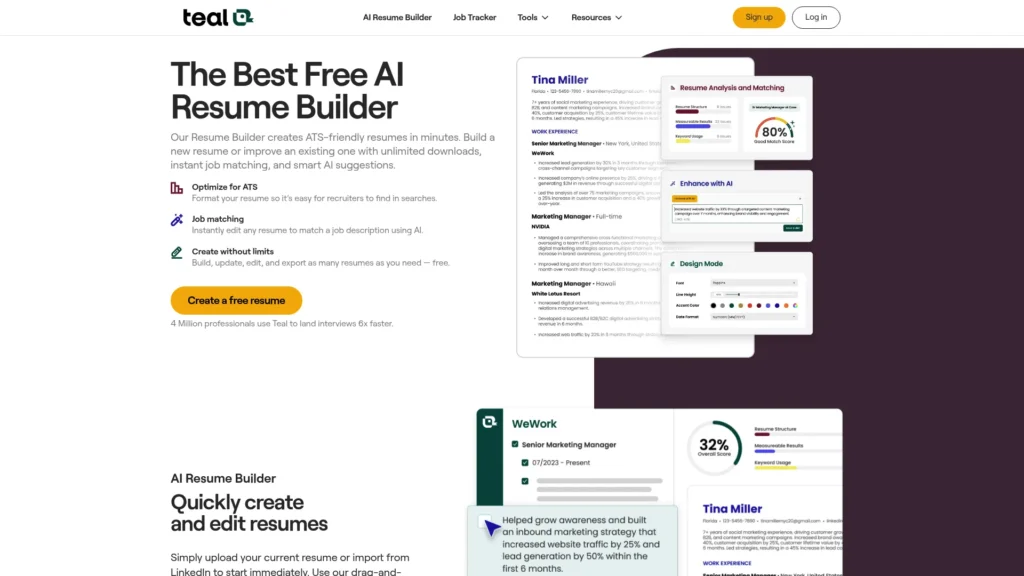
Teal is not just a resume builder — it’s a job search management platform with a resume builder at its core, which is why we recommend it as a starting point for anyone running an active, multi-application search rather than a one-time resume update.
The AI analyzes job descriptions you paste in and produces a Match Score against your current resume, highlighting matched and missing keywords. The AI writing assistant helps turn generic responsibility statements into achievement-focused bullets. What genuinely differentiates Teal is its job tracker: save postings from any site, and Teal ties resume-tailoring suggestions to each saved role, making it realistically manageable to maintain several tailored resume versions rather than a manual chore.
Key Features: job-description keyword matching, achievement-focused bullet rewriting, job tracker for organizing applications, resume scoring, cover letter AI assistance, LinkedIn import, Chrome extension for saving jobs.
AI capabilities: content generation and keyword-gap analysis against pasted job descriptions, with a limited number of free AI credits (roughly 10 bullet rewrites, 2 summaries, 2 cover letters) before requiring an upgrade.
ATS/job-description optimization: yes — Match Score compares resume language to specific postings.
Free plan: genuinely functional — unlimited resume creation and job tracking, basic templates, limited AI credits.
Pricing: Teal+ runs $13/week, $29/month, or $79/quarter; there’s currently no annual plan.
Best for: active job seekers applying to multiple roles who need to maintain several tailored resume versions.
Pros: a genuinely complete job-search ecosystem, combining resume building with job tracking; keyword matching is specific and actionable; the free tier covers real usage, not just a demo. Cons: free-tier AI credits run out quickly for heavy users; no annual billing option, so ongoing cost adds up over a long search; feature breadth can feel like a lot to learn at first. Overall, Teal is best if you want one platform to manage both resume tailoring and job tracking.
2. Kickresume — Best for Professionally Designed AI Resumes
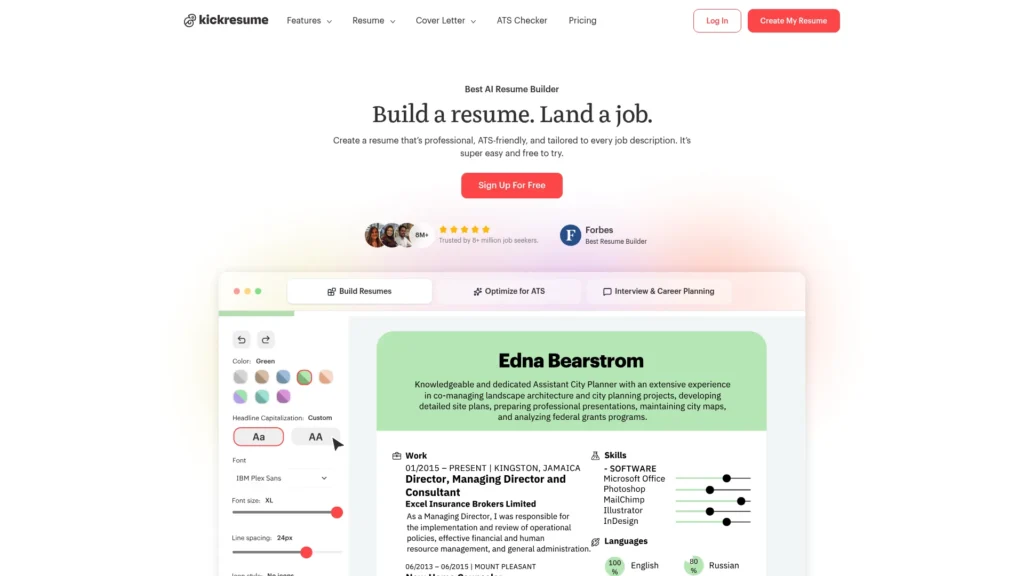
Kickresume‘s template quality is a level above most competitors on this list, and its AI writing is strong enough that the result works on both the visual and content level. The AI content generator drafts full experience sections from your job title and rough notes, and a job-description analyzer scores keyword alignment in real time.
Kickresume also includes a personal website builder that generates a portfolio page from your resume data — genuinely useful for candidates in creative, technical, or marketing fields where a web presence supplements the traditional resume.
Key Features: 40+ professionally designed templates, AI full-section writing, job-description keyword analyzer, real-time ATS score, cover letter generator, personal website builder, LinkedIn/PDF import.
AI capabilities: generates complete experience bullets and summaries from your input; scores content against a pasted job description.
ATS/job-description optimization: yes, with a live ATS score as you edit.
Free plan: unlimited resumes and downloads, but limited to 4 basic templates; the AI Writer and ATS Checker require Premium.
Pricing: Premium runs roughly $10/month billed annually, up to around $19–24/month billed monthly — Kickresume’s pricing varies notably by billing term, so check the current numbers directly.
Best for: professionals in design, marketing, or consulting who want a resume that’s both ATS-aware and visually distinctive, plus a complete application package.
Pros: stands out for template design quality; AI writing output reads polished; the website builder adds value beyond the resume itself. Cons: the free plan’s best templates and AI features are paywalled; monthly billing is meaningfully more expensive than annual; some visually elaborate templates trade off ATS simplicity. Overall, Kickresume is the strongest choice if design matters as much as content.
3. Resume.io — Best for Simplicity and Fast Professional Output
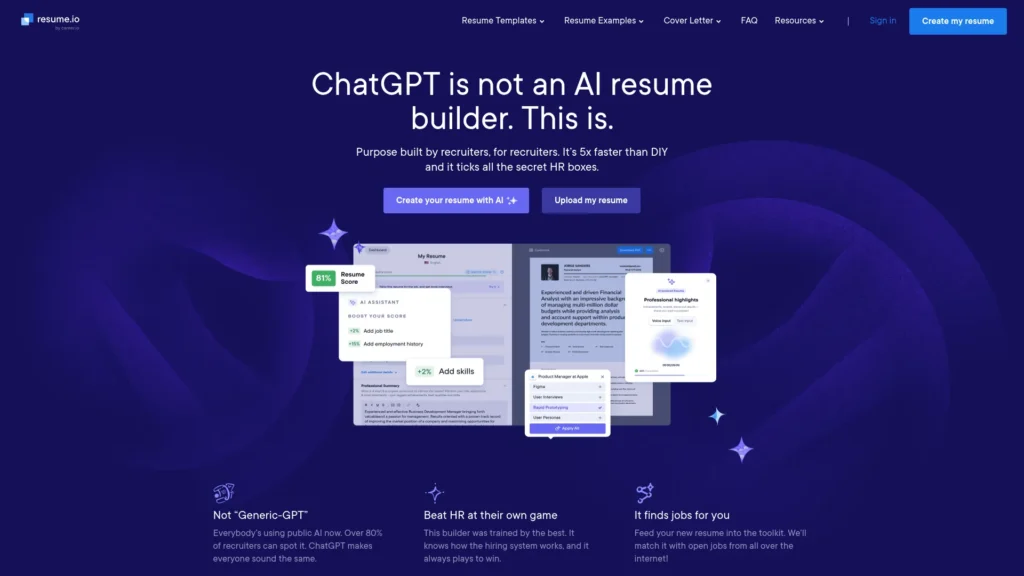
Not every job seeker needs a feature-heavy platform. Resume.io is built for producing a clean, professional resume quickly, with a genuinely low learning curve. You pick a template, fill in sections, and the AI offers pre-written content examples by job title and industry that you can adopt, adapt, or ignore.
Templates are designed with ATS compatibility in mind — single-column layouts, standard headings, no graphics that confuse parsers — while still looking polished to a human reader.
Key Features: guided section-by-section builder, pre-written content suggestions by role and industry, ATS-compatible templates, cover letter builder, multiple export formats, real-time preview.
AI capabilities: primarily suggestion-based (pre-written phrase libraries matched to your stated role) rather than fully generative content writing — lighter AI sophistication than tools like Teal or Rezi.
ATS/job-description optimization: templates are ATS-conscious by design, but job-description-specific matching is limited compared to dedicated ATS tools.
Free plan: you can build and preview a resume for free; downloading is where the paywall sits, and even paid access to some templates has been limited to specific formats at points — confirm current download terms before committing.
Pricing: commonly offered through a short, low-cost trial period that converts to a recurring monthly charge in the high-teens to mid-$20s range; users have reported the recurring rate increasing over time, so check the current offer and cancellation terms carefully before signing up.
Best for: first-time resume builders, career returners, and anyone who wants a solid result fast without a learning curve.
Pros: the fastest path from blank page to finished resume on this list; templates are clean and genuinely ATS-conscious; pre-written suggestions reduce blank-page anxiety. Cons: download access sits behind a paid plan; less AI sophistication than dedicated builders; trial-to-recurring pricing has drawn user complaints about being easy to miss before renewal. Overall, Resume.io is the best fit when you want a quick, polished result with minimal friction.l.
4. Enhancv — Best for Personal Branding and Standing Out
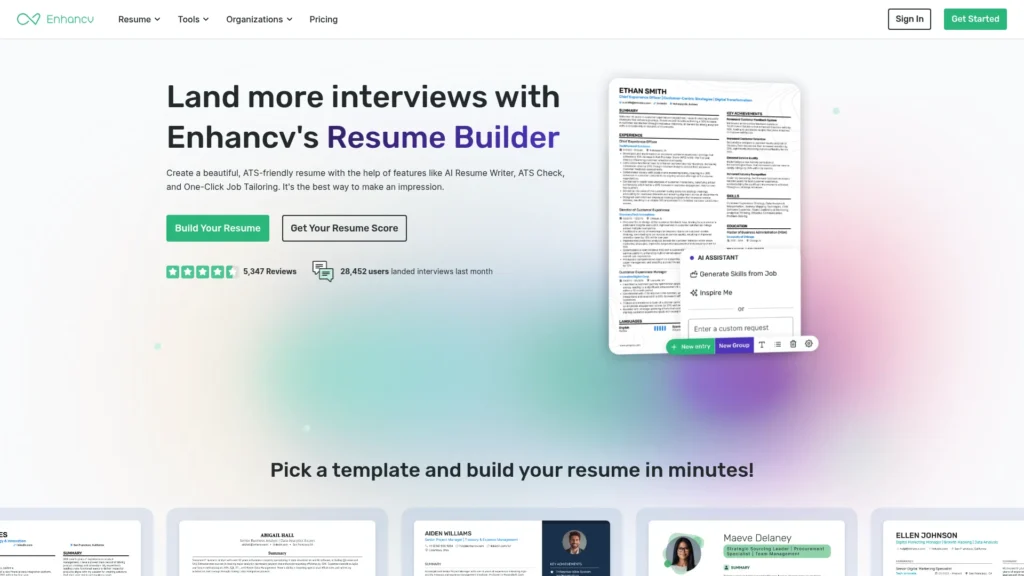
For roles or company cultures where personality and distinctive presentation matter alongside qualifications, Enhancv is built specifically for that. Its templates include sections beyond the standard work history — visually emphasized key achievements, personal values, and narrative elements — and its AI helps write these sections in a way that reads as personal rather than generic.
It also covers the standard optimization work: keyword matching, achievement-focused bullet writing, and ATS scoring.
Key Features: personal branding sections beyond the standard resume structure, AI narrative and achievement writing, ATS scoring, keyword optimization, cover letter builder, template styles from traditional to creative.
AI capabilities: generates both narrative/personal-branding content and standard achievement bullets.
ATS/job-description optimization: yes, though Enhancv’s own published ATS guidance is worth reading directly — it notes that standard fonts and well-structured layouts tend to parse correctly, while content embedded in graphics is more likely to be lost, which is a reasonable general caution rather than a guarantee tied to any specific template.
Free plan: a 7-day trial with a watermark and a capped number of items rather than an ongoing free tier.
Pricing: roughly $24.99/month billed monthly, down to about $13.33/month on a semiannual term; note that DOCX export isn’t available at any tier per Enhancv’s own plan documentation — check current export formats if that matters to you.
Best for: candidates applying to startups, creative agencies, or mission-driven organizations where culture fit and personal narrative are explicitly part of the evaluation.
Pros: produces genuinely distinctive resumes; AI handles both narrative and standard achievement content; strong template range. Cons: the most visually elaborate templates may not be the safest choice for large, ATS-heavy corporate applications; the free trial is short and capped rather than an ongoing free tier; pricing is meaningfully higher at monthly billing than on longer terms.
5. Rezi — Best for ATS Optimization and Keyword Matching
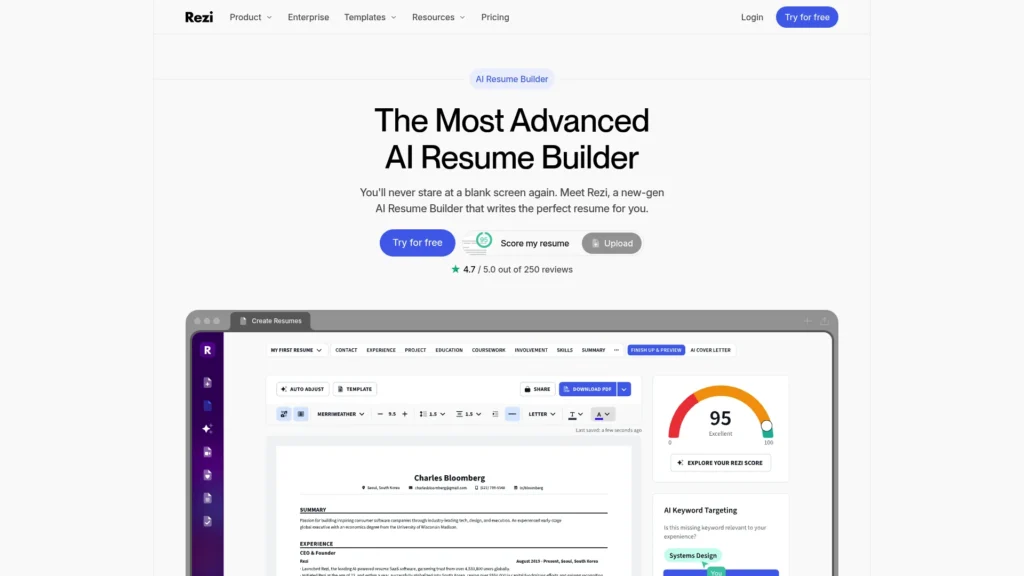
If ATS performance is your top priority, Rezi focuses on that problem. Its AI evaluates your resume against pasted job descriptions with more granularity than several competitors — checking not just for missing keywords but formatting characteristics that can cause parsers to misread a section, and scoring individual bullets against a framework built around action verbs, specific contributions, and measurable impact.
Key Features: ATS-focused analysis, achievement-based bullet scoring, real-time content score with specific guidance, job-description keyword extraction, ATS formatting rules enforcement, tailored resume generation from a master document, cover letter builder.
AI capabilities: scores and suggests rewrites for individual bullets against a structured achievement framework; extracts and matches keywords from a specific job description.
ATS/job-description optimization: this is Rezi’s core focus — deeper and more specifically built around ATS mechanics than general-purpose builders.
Free plan: 1 resume, limited AI features, 3 PDF downloads.
Pricing: Pro is $29/month; a Lifetime option is available for $149 one-time, which is worth comparing against the cumulative monthly cost of a long job search.
Best for: job seekers applying to large companies with rigorous automated screening, or anyone who’s been submitting applications without responses and suspects formatting or keyword mismatch is the cause.
Pros: one of the more ATS-focused options on this list; bullet scoring provides structured guidance for strengthening achievement-focused language; the Lifetime option is a real value for a long search. Cons: visual output is less polished than design-focused tools like Kickresume or Enhancv; the ATS-first approach can occasionally produce bullets that feel formulaic; the free plan’s AI access is limited.
6. Zety — Best for Guided Step-by-Step Resume Building
Zety has been one of the most widely used resume builders for years, and what keeps it relevant in 2026 is the quality of its guided experience — specific prompts and pre-written examples at each step, aimed at someone who’s never written a formal resume before.
Key Features: guided step-by-step building with contextual tips, pre-written content examples by role and industry, AI resume checker with explanatory feedback, extensive template library, cover letter builder, multiple export formats.
AI capabilities: suggestion-based content drafting tied to job title and industry, plus an AI-assisted resume check that explains issues rather than just flagging them.
ATS/job-description optimization: the resume checker evaluates against general ATS-readability standards; it’s less built around matching a specific job posting than tools like Jobscan or Rezi.
Free plan: you can build and preview for free; the free plan’s download option is limited to plain text (TXT) — PDF and Word exports require a paid plan.
Pricing: Zety’s current structure centers on a 14-day trial priced at $1.95 that auto-renews at $25.95 billed every 4 weeks unless canceled, or an annual plan at $5.95/month ($71.40 billed upfront). This is a meaningfully different structure from a flat monthly subscription, so read the renewal terms carefully before starting the trial.
Best for: first-time resume writers, recent graduates, and anyone who finds a blank page paralyzing.
Pros: stands out for its beginner-friendly guided experience; explanatory feedback helps you understand changes, not just apply them; the annual rate is genuinely inexpensive if you commit upfront. Cons: the free plan’s TXT-only download is a real limitation for most applications; the trial-to-recurring billing structure requires attention to avoid an unwanted renewal at the higher 4-week rate; AI sophistication is lighter than dedicated ATS or content tools.
7. Resume Worded — Best for AI Resume Scoring and Feedback
Resume Worded is primarily a resume analyzer, not a builder — you bring an existing resume for a detailed, actionable assessment rather than starting from a template. The AI scores your resume across ATS compatibility, content quality, achievement language, and formatting, with specific line-by-line feedback rather than generic advice.
Its job-specific analysis is a particular strength: paste a job description, and it identifies exactly which requirements your resume addresses well, partially, or not at all.
Key Features: detailed AI scoring across multiple dimensions, line-by-line feedback, job-description matching analysis, LinkedIn profile scoring, tailored suggestions per role, cover letter analysis.
AI capabilities: scores existing resume content and provides specific, itemized improvement suggestions rather than generating a resume from scratch.
ATS/job-description optimization: strong — the job-specific matching analysis is detailed and actionable.
Free plan: limited to essentially one analysis; full access to the AI writer, detailed reports, and LinkedIn review requires Pro.
Pricing: Pro runs $49/month billed monthly, roughly $33/month billed quarterly, and roughly $19–25/month if paid annually — the entry monthly price is considerably higher than the figure sometimes quoted for this tool, so confirm the current billing terms directly before assuming the lower annual-equivalent rate applies.
Best for: professionals with an existing resume who want detailed diagnostic feedback rather than a full rebuild — particularly candidates who already write reasonably well but want to understand specifically why applications aren’t generating responses.
Pros: offers detailed, line-by-line feedback; job-description matching is thorough; LinkedIn profile scoring is a genuinely useful add-on. Cons: it’s not a resume builder in the traditional sense — you need existing content to analyze; the free plan offers only one analysis; monthly pricing is high relative to comparable tools unless you commit to an annual term.
8. Jobscan — Best for Matching Resumes to Specific Job Descriptions
Jobscan does one thing and does it in considerable technical depth: compares your resume directly against a specific job posting and tells you precisely how well it matches. Paste both in, and you get a match-rate score with a breakdown of hard skills, soft skills, missing keywords, job-title alignment, and formatting compatibility.
Key Features: direct resume-to-job-description match scoring, hard/soft skills and keyword gap analysis, ATS compatibility check with specific formatting feedback, job-title optimization, LinkedIn optimization tool, cover letter matching analysis.
AI capabilities: the matching and gap analysis is Jobscan’s core function; it’s less built for generating original written content than tools like Teal, Rezi, or ChatGPT.
ATS/job-description optimization: this is Jobscan’s specific strength — its analysis reflects how ATS systems parse and score resumes in more technical detail than general resume builders attempt.
Free plan: 5 scans per month, with no watermark and no expiration on the free tier itself.
Pricing: Premium runs $49.95/month billed monthly. A quarterly offer is also available at $89.95 for three months, preceded by a 7-day free trial.
Best for: job seekers tailoring applications to specific roles who want a systematic, data-driven approach — particularly useful for technical and corporate positions with detailed job descriptions.
Pros: offers particularly precise job-description matching analysis; the free tier’s 5 monthly scans are genuinely usable, not just a teaser; LinkedIn optimization is a useful additional feature. Cons: the most expensive tool on this list at monthly billing; it’s an analysis tool first, with limited template and design options; heavy users will exceed the free scan limit quickly.
9. NovoResume — Best for Students and Entry-Level Job Seekers
Students and recent graduates face a specific problem most resume tools aren’t built for: they don’t have the work history that standard resume frameworks assume. NovoResume is built around that reality — its templates and AI guidance emphasize education, projects, internships, and transferable skills rather than assuming years of professional achievement.
Key Features: templates designed for limited professional experience, AI content suggestions calibrated for student and entry-level profiles, skills-based and education-forward formatting, internship and project section emphasis, one-page optimization guidance.
AI capabilities: content suggestions calibrated to translate academic, project, and part-time work experience into professional-reading language.
ATS/job-description optimization: covers standard ATS-readability formatting; less specialized for deep job-description matching than tools like Jobscan or Rezi.
Free plan: a functional free tier with core building features.
Pricing: reports on NovoResume’s current pricing structure vary — some describe a subscription around $9–10/month, while others describe one-time premium purchases without recurring billing. Confirm the current structure directly on NovoResume’s pricing page before signing up, since this is one detail we could not pin down with full confidence from available sources.
Best for: students, recent graduates, and anyone with limited professional work history who needs to present potential and transferable skills effectively.
Pros: one of the more affordable options on this list at any pricing structure; genuinely calibrated for entry-level and student resumes rather than a generic template repurposed for that audience; one-page optimization guidance helps avoid padding. Cons: less sophisticated ATS optimization than tools built primarily for experienced professionals; a smaller template library than larger competitors; limited usefulness once you have substantial professional experience to organize.
10. ChatGPT — Best for Custom AI-Written Resume Content
ChatGPT is not a dedicated resume-building platform. It doesn’t provide the dedicated resume templates, job-description matching workflow, or ATS scoring found in purpose-built resume builders — but it’s a flexible tool for generating genuinely personalized resume content, for a job seeker who knows how to prompt it well.
Given your actual job title, specific responsibilities, real achievements, and a target job description, ChatGPT produces experience bullets, summaries, and skills language tailored to your specific situation rather than drawn from a pre-written template bank. The workflow that works best pairs ChatGPT for content generation with a purpose-built tool — Teal, Rezi, or Resume.io — for formatting and ATS scoring.
Key Features: custom experience bullet writing from your specific input, professional summary generation, job-description keyword incorporation, skills suggestions by role, cover letter writing, iterative refinement through conversation, no template constraints.
AI capabilities: offers highly personalized content generation, depending entirely on how specific you are.
ATS/job-description optimization: ChatGPT can incorporate job-description language into content you request, but it has no built-in ATS scoring or formatting checker — pair it with a dedicated tool for that step.
Free plan: yes, and it’s sufficient for most resume content generation tasks.
Pricing: Plus is $20/month for higher usage limits and access to more capable models; most resume-writing use cases don’t require it.
Best for: job seekers comfortable using AI conversationally who want maximally personalized content, especially those with unusual career paths that don’t fit template-generated language well.
Pros: stands out for personalized output; no template constraints; iterative conversation lets you refine language progressively; the free plan is fully functional for this use case. Cons: no templates, formatting, or ATS scoring — you need a second tool for final output; quality depends heavily on how much detail and specificity you provide; effective use requires knowing how to prompt it well.
Best Free AI Resume Builder
For a genuinely usable free experience rather than a stripped demo, Teal and NovoResume stand out — both let you build and export a complete resume without hitting a hard paywall on the core function. Jobscan‘s free 5 scans a month is real, ongoing value if job-description matching specifically is what you need. ChatGPT‘s free plan handles content generation well. The most common limitation across free tiers generally is download format or volume, not the ability to build a resume at all — check each tool’s specific free-plan boundary before assuming full access.
Best AI Resume Builder for ATS Optimization
Rezi and Jobscan both focus on this problem, but from different angles: Rezi optimizes your resume’s content and formatting against ATS best practices, while Jobscan measures how well your resume matches a specific posting after the fact. Using Rezi to build and Jobscan to verify against a real job description is a reasonable combination if ATS performance is your central concern.
Best AI Resume Builder for Students
NovoResume is the clearest starting point — it’s calibrated specifically for candidates without a substantial work history, at one of the more affordable price points on this list. Pair it with ChatGPT’s free plan to help translate coursework, projects, and part-time work into professional-reading language.
Best AI Resume Builder for Career Changers
Career changers need to reframe transferable experience in language that reads as relevant to a new field — a content challenge more than a formatting one. ChatGPT for drafting that reframing, combined with Teal or Rezi for job-description keyword matching against the new field’s postings, is a reasonable combination for identifying the specific language gap between your background and the target role.
Best AI Resume Builder for Executives and Professionals
Resume Worded‘s detailed diagnostic feedback and Jobscan‘s precise job-description matching are both worth considering here, where application precision often matters more than speed. Enhancv is worth considering specifically at organizations where leadership narrative and personal positioning are part of the evaluation.
AI Resume Builder vs. ChatGPT
The two aren’t really competitors — they solve different parts of the same problem. Purpose-built AI resume builders (Teal, Rezi, Jobscan, and the rest) bring templates, ATS-readability formatting, and job-description-matching analysis that ChatGPT doesn’t have built in. ChatGPT offers more flexible, personalized content generation than most template-based tools, especially for candidates with unusual career paths that don’t map cleanly onto standard resume language.
The workflow that gets the most out of both: draft content with ChatGPT, working through your actual achievements and the language of your target job description, then move that content into a purpose-built tool for ATS-safe formatting and a final compatibility check. Using ChatGPT alone means no formatting or ATS verification. Using a template tool alone often produces more generic content than a detailed conversation with ChatGPT.
What AI Resume Builders Can and Cannot Do
Being direct about this matters more than another confident claim: AI resume builders make good resumes better and weak resumes less weak. They don’t turn a thin experience record into a strong one, and none guarantee an interview response, no matter how well you optimize.
These tools can help with clearer language, cleaner formatting, and closer alignment with what a specific job posting asks for. What happens after your resume reaches a human recruiter still depends entirely on whether your experience and accomplishments are compelling for that role. No AI tool changes the substance of a candidate’s background.
There’s also a real risk worth naming: a resume over-optimized for keywords without genuine substance behind it can pass initial screening and then underdeliver in front of a recruiter who expected more than the resume promised. The goal is a resume that accurately and clearly represents your actual strongest self — not a document engineered to get further than your real qualifications support.
One more practical note: resumes contain real personal and employment information. Read a tool’s privacy policy before entering sensitive details, particularly regarding whether your data may be used to train AI models. For ChatGPT specifically, avoid putting highly sensitive information — financial details, full home address, identification numbers — directly into prompts.
Frequently Asked Questions
What is the best AI resume builder? It depends on what you need most. Teal offers a strong combination of a functional free tier, job tracking, and resume tailoring for active searches. Rezi focuses heavily on ATS performance. Kickresume stands out for visual polish. NovoResume is calibrated specifically for students and early-career candidates.
What is the best free AI resume builder? Teal and NovoResume both offer genuinely usable free tiers that let you build and export a complete resume, not just preview one. Jobscan’s 5 free scans a month provide real ongoing value for job-description matching specifically. ChatGPT’s free plan handles resume content generation well.
Are AI resume builders worth it? For most job seekers, yes, with realistic expectations. These tools genuinely improve formatting, achievement language, and job-description alignment, and reduce the time needed to produce a well-optimized resume. What they don’t do is guarantee interviews regardless of your underlying experience — the return is highest for candidates who have good experience but have been presenting it poorly.
Can I use ChatGPT to write my resume? Yes, for content specifically — professional summaries, experience bullets, skills language tailored to a target role. ChatGPT isn’t a dedicated resume builder and doesn’t offer the templates or ATS-scoring workflow of purpose-built resume platforms, so most job seekers get the best results by pairing it with a purpose-built resume builder for the final formatted, ATS-checked document.
Is ChatGPT a resume builder? Not in the traditional sense. It’s a content-generation tool that can write strong resume language when given detailed, accurate input, but it doesn’t produce a formatted document, check ATS compatibility, or offer templates the way a dedicated resume builder does.
Do employers check whether a resume was written by AI? There’s no universal, reliable way for an employer to detect AI-assisted resume content, and AI-assisted drafting is now common enough that it isn’t inherently suspicious on its own. What matters more to employers is whether the content is accurate and specific to you — a resume that reads as generic or contains claims you can’t substantiate in an interview is a bigger risk than the fact that AI helped draft the language.
Are AI-generated resumes ATS-friendly? Only if the tool you’re using specifically builds for ATS-readable formatting — plain structure, standard section headings, no tables or graphics that confuse parsing software. AI-generated content alone doesn’t guarantee ATS compatibility; that depends on the template and formatting choices, which is why several tools on this list separate “AI writing quality” from “ATS formatting compliance” as distinct features.
Can AI tailor a resume to a job description? Yes — this is one of the more reliable things these tools do well. Paste in a specific job posting, and tools like Teal, Rezi, and Jobscan will identify which keywords and requirements from that posting are reflected in your current resume and which are missing, so you can decide how to address the gap in your own language.
What should I look for in an AI resume builder? Whether it covers all three useful AI functions — content generation, job-description keyword matching, and specific scoring feedback — rather than just one dressed up as “AI-powered.” Also check the free plan’s actual limits (can you download, or only preview?), whether pricing is a flat subscription or a trial that converts to a higher recurring rate, and whether the templates are genuinely ATS-safe or primarily built for visual impact.
Conclusion
The tools on this list aren’t interchangeable, and the honest recommendation depends entirely on your situation. Teal suits an organized, multi-application search. Rezi suits candidates whose priority is ATS performance specifically. Kickresume suits candidates who want design quality alongside optimization. NovoResume suits students and early-career candidates. Jobscan suits precise, job-description-specific tailoring. ChatGPT suits candidates who want highly personalized content and are willing to pair it with a formatting tool.
Start with whichever free plan matches your actual situation, spend an hour building or optimizing your resume with it, and compare the result honestly against what you had before. The real value of these tools is removing the presentation barriers — weak language, poor formatting, missing keywords — that keep a genuinely qualified candidate from getting read. They can’t create the substance behind your application. That part is still entirely yours.
Keep Exploring