Ahsan Javaid
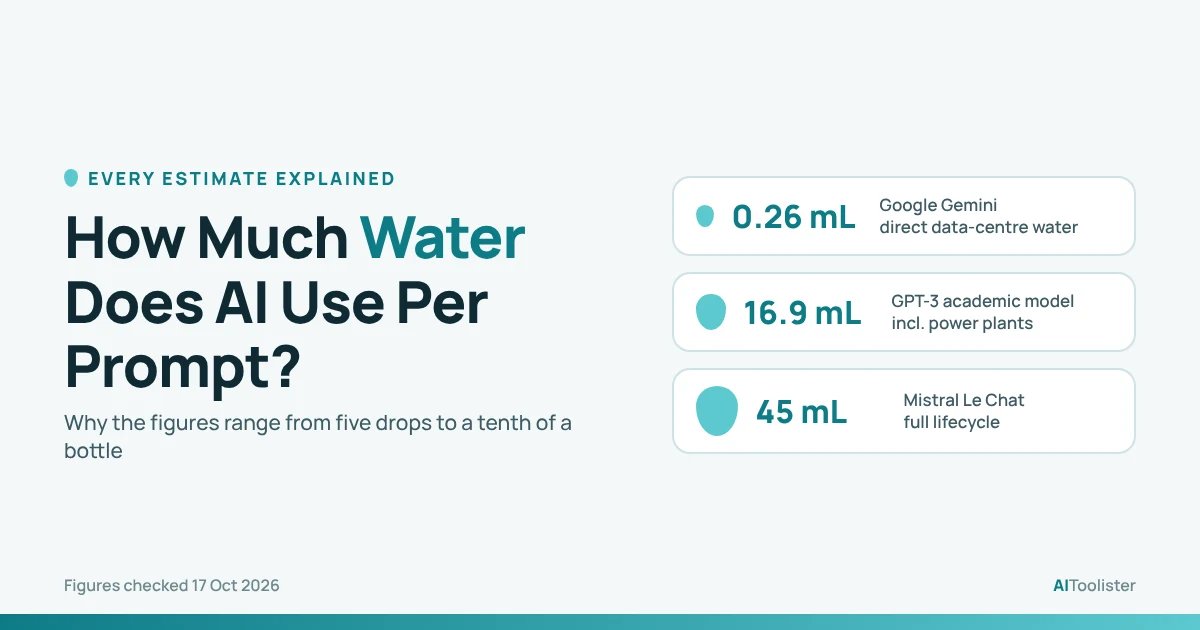
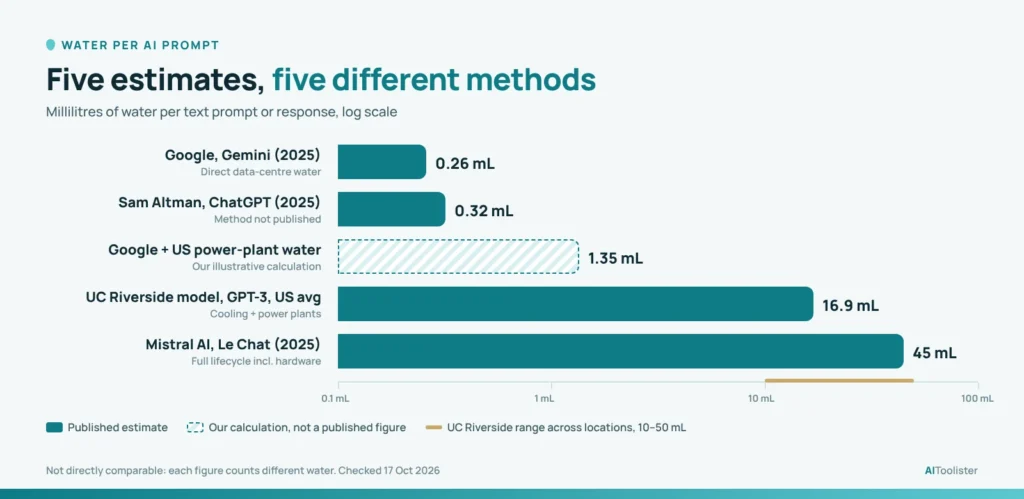
Published estimates for one AI text prompt range from about 0.26 millilitres to around 50 millilitres of water: roughly five drops at the low end and a tenth of a small water bottle at the high end. That is not a single agreed-upon range that applies to every prompt. Each estimate measures something different: some count only the water a data centre consumes directly; others add the water power plants use to generate the electricity; and some model older, less efficient AI systems.
Below, every major estimate is compared side by side, with why they differ and how they stack up against everyday water use. Figures checked 17 October 2026.
How Much Water Does AI Use Per Prompt? The Short Answer
There is no single figure, but three numbers cover most of what you will read:
- 0.26 mL: Google’s estimate for a median Gemini text prompt, counting direct data-centre water consumption.
- About 1.35 mL: an illustrative calculation adding US-average power-plant water to Google’s energy figure.
- About 17 mL: the US-average estimate for a medium-length response from GPT-3, an older OpenAI model, in an academic study that counts both cooling and power-plant water.
The first two describe a 2025 Google model on Google’s own servers; the third models a 2020-era system. They are not three attempts to measure the same thing.
AI Water Use Per Prompt: Every Major Estimate Compared
| Source | AI model | Water per prompt | What it counts | How it was produced |
| Google (August 2025) | Gemini Apps, median text prompt | 0.26 mL | Direct data-centre water consumption | Company estimate from its own fleet data |
| OpenAI CEO Sam Altman (June 2025) | ChatGPT, average query | About 0.32 mL | Not stated | Company claim, no method published |
| Google figures plus US power-plant water | Gemini Apps | About 1.35 mL | Direct water plus electricity generation | Illustrative US-grid calculation (ours) |
| Mistral AI (July 2025) | Le Chat, 400-token response | About 45 mL | Full lifecycle of inference, including server manufacturing | Lifecycle assessment with Carbone 4 and ADEME, reviewed by consultancies Resilio and Hubblo |
| UC Riverside and UT Arlington study, US average | GPT-3, medium-length response | About 16.9 mL | Cooling plus electricity generation | Academic model |
| Same study, range across locations | GPT-3, medium-length response | About 10 to 50 mL | Cooling plus electricity generation | Academic model |
Google’s figure comes from its technical paper on AI’s environmental impact: 0.24 watt-hours and 0.26 mL of water per median Gemini Apps text prompt. The energy figure is a broad, full-stack measurement. The paper defines the water figure as “the water consumed for cooling machines and associated infrastructure in data centers”, so it does not include water used at power plants.
The 1.35 mL row is our own illustrative calculation, not a measured Gemini result. It multiplies Google’s 0.24 watt-hours by the US-average electricity water factor of 4.52 litres per kilowatt-hour from Lawrence Berkeley National Laboratory’s 2024 report on US data centres (about 1.09 mL), then adds Google’s 0.26 mL. It combines two different accounting approaches, so it is not Google’s own estimate and should not be read as one. A real figure would depend on the grids Google’s data centres actually draw from.
Mistral AI’s figure is the only one that covers a full lifecycle. Its July 2025 assessment, run with consultancy Carbone 4 and France’s environment agency ADEME, puts the marginal impact of a 400-token Le Chat response at 45 mL of water, including the water used to manufacture servers. That wider boundary is the main reason it is so much higher than Google’s figure.
Why Do the Estimates Range From 5 Drops to a Full Bottle?
Five things explain almost all of the difference.
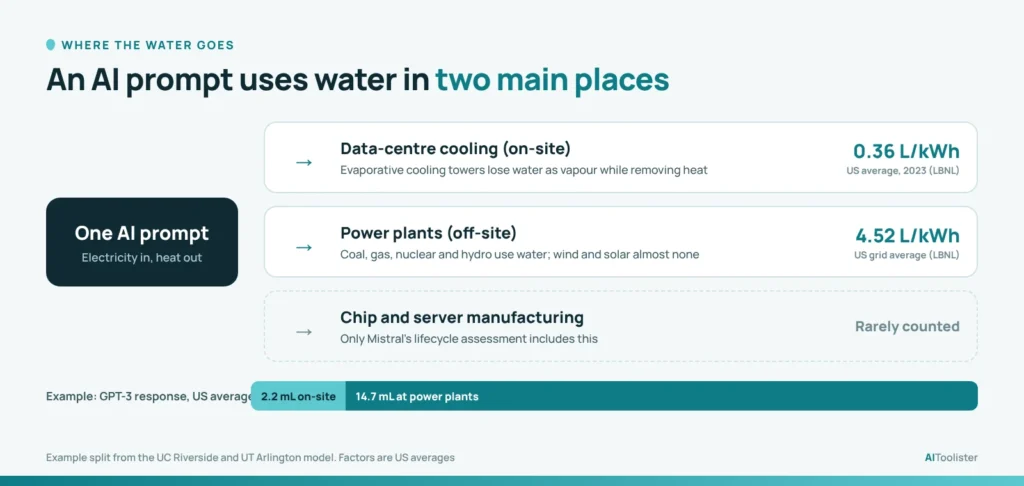
1. What water is counted. This is the biggest factor. Cooling a data centre uses some water, but the power plants supplying its electricity often use much more. In the UC Riverside model, a US-average GPT-3 response used about 2.2 mL on site and 14.7 mL at power plants. Leave out the power plants and the figure shrinks dramatically.
2. Which model. The academic estimate models GPT-3. Newer models run on more efficient chips and software. Google reports that energy per median Gemini prompt fell 33-fold over the 12 months to May 2025. That figure applies to Gemini only and does not mean every AI model’s water use fell by the same amount.
3. How long the answer is. A one-line reply uses far less computing than a long essay or a “reasoning” model that works through a problem step by step. The academic study assumed up to about 800 words of input and 150 to 300 words of output.
4. Measured or modelled. Google’s figure comes from data on its own servers. The academic figure comes from outside researchers working with public data and assumptions about energy use, efficiency and location. Both are legitimate, but they are different kinds of evidence.
5. Per prompt or per conversation. The widely shared claim that AI “drinks a bottle of water” comes from the same study’s finding that 500 mL covers roughly 10 to 50 medium-length GPT-3 responses. It was never a per-prompt figure.
The academic figures come from the paper Making AI Less “Thirsty” by Pengfei Li, Jianyi Yang, Mohammad A. Islam and Shaolei Ren.
Where AI’s Water Actually Goes: Cooling vs Power Plants
An AI prompt uses water in two places.
Data-centre cooling (on-site water). Servers turn almost all the electricity they use into heat. Many data centres remove that heat with evaporative cooling towers, which work like giant misters: water evaporates, carrying heat away, and that water is lost to the local supply. Other cooling systems use little or no water but need more electricity, especially in hot weather. Lawrence Berkeley National Laboratory estimates the average US data centre used just over 0.36 litres of water per kilowatt-hour in 2023.
Electricity generation (off-site water). Coal, gas and nuclear plants use water for steam and cooling, and hydroelectric reservoirs lose water to evaporation. Wind and solar use almost none once built. That is why the same prompt can have a very different water footprint depending on the local grid.
Per-prompt estimates generally measure water consumed (lost, usually to evaporation) rather than water withdrawn and later returned. Only Mistral’s lifecycle assessment includes the water used to manufacture servers and chips; the others leave it out.
How Much Water Does ChatGPT Use?
OpenAI’s only public figure comes from CEO Sam Altman’s June 2025 blog post, “The Gentle Singularity”: an average ChatGPT query uses about 0.34 watt-hours and “about 0.000085 gallons of water; roughly one fifteenth of a teaspoon”, or about 0.32 mL. OpenAI has not published its method, so it is unclear whether that includes power-plant water, and it cannot be compared like for like with Google’s figure.
You may also have seen that a 100-word ChatGPT email uses 519 mL of water, “more than a bottle”. That figure comes from a September 2024 Washington Post analysis carried out with the UC Riverside researchers, based on GPT-4. It counts cooling and power-plant water and uses older efficiency assumptions, so it is a modelled high-end scenario rather than a measurement of today’s ChatGPT.
Neither OpenAI nor Anthropic publishes enough data to compare assistants on water. If you are choosing between them on other grounds, our ChatGPT vs Claude comparison covers features and pricing.
Does Generating an AI Image or Video Use More Water?
Yes, considerably more, although no AI company publishes a water figure for image or video generation. The best available data measures energy, not water.
- Images: a study by researchers at Hugging Face and Carnegie Mellon University, presented at the ACM FAccT conference in 2024, found that image generation used about 2.91 watt-hours per image on average, around 12 times Google’s text figure.
- Video: In tests reported by MIT Technology Review, an open-source model, CogVideoX, used about 3.4 million joules (roughly 944 watt-hours) to make one five-second clip. That is more than 700 times the energy of a high-quality image.
An illustrative estimate. Applying Lawrence Berkeley National Laboratory’s US-average water factors (0.36 litres per kWh in data centres and 4.52 litres per kWh at power plants) to those two energy figures gives roughly:
| Task | On-site cooling water | Including power-plant water |
| One AI image | About 1 mL | About 14 mL |
| One five-second AI video | About 0.3 litres | About 4.6 litres |
These are our illustrative calculations, not measurements, and they assume US-average data-centre and electricity water factors. The energy figures also come from specific models under specific test conditions, so they do not mean every AI image uses 14 mL or every short video uses 4.6 litres. Treat them as a guide to scale: a short video clip uses hundreds of times more water than a text prompt.
AI Prompts vs Everyday Water Use
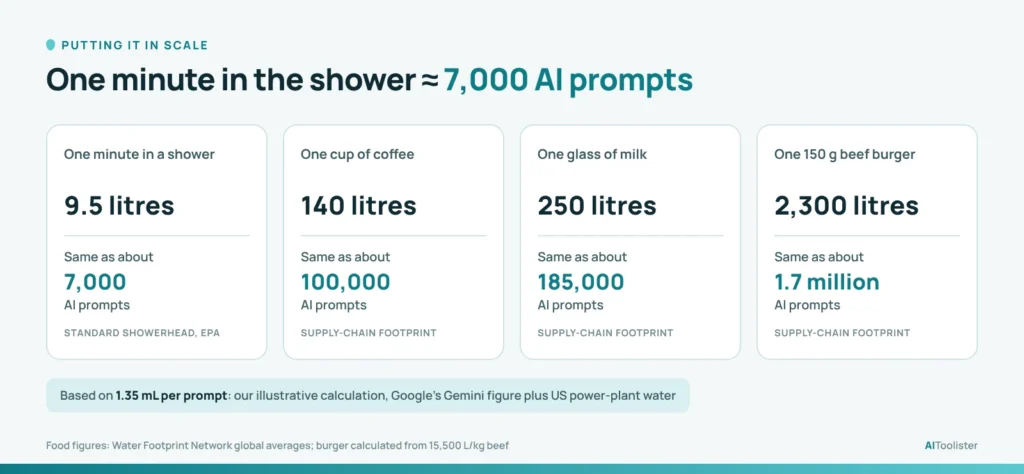
Using the illustrative Gemini figure including power-plant water (about 1.35 mL per prompt), here is how everyday activities compare:
| Activity | Water used | Equal to about this many AI prompts |
| One minute in a shower with a standard showerhead | About 9.5 litres | 7,000 |
| One cup of coffee, including growing the beans | About 140 litres | 100,000 |
| One glass of milk, including producing it | About 250 litres | 185,000 |
| One beef burger patty (150 g), including producing it | About 2,300 litres | 1.7 million |
The shower figure uses the US Environmental Protection Agency’s 2.5 gallons per minute for a standard showerhead. The food figures are supply-chain water footprints from the Water Footprint Network: all the water used to grow and produce the item, mainly in farming, not the water poured into a cup or used to cook. Coffee (140 litres per 125 ml cup) and milk (250 litres per 250 ml glass) are its published global averages. The burger figure is our calculation from its 15,500 litres per kilogram of beef.
Even using the much higher GPT-3 estimate of about 17 mL per response, a one-minute shower uses as much water as roughly 560 prompts.
Why Location and Season Change the Number
The same AI response can use very different amounts of water depending on where and when it runs. In the UC Riverside model, 500 mL covered about 70 GPT-3 responses in Ireland but only about 10.5 in the US state of Washington, mainly because of differences in cooling and the local electricity mix.
Hot, dry climates rely more on evaporative cooling, so summer heat pushes water use up, while a data centre in a cool, wet region can run on outside air for much of the year.
This is why researchers increasingly argue that the important question is not water per prompt, but where data centres are built. A large facility in a drought-prone area can put real pressure on local supplies, even when each individual prompt uses very little.
Is AI Bad for the Environment Because of Its Water Use?
The answer depends on what scale you look at.
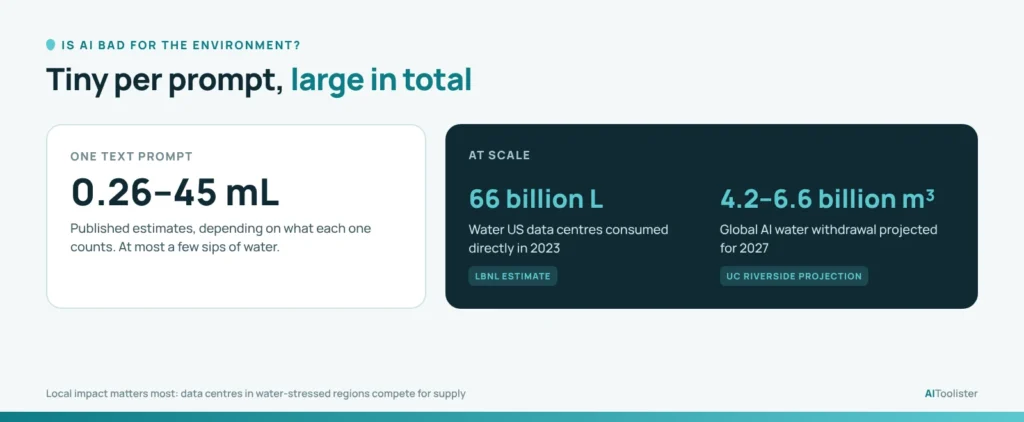
Per prompt, the water is small. Even the higher estimates are a tiny fraction of everyday water use, as the comparison table shows. Skipping a few AI prompts saves far less water than a shorter shower.
In total, it is large and growing. Lawrence Berkeley National Laboratory’s 2024 report estimates US data centres consumed about 66 billion litres of water directly in 2023, before counting power-plant water. The UC Riverside researchers project that global AI demand could account for 4.2 to 6.6 billion cubic metres of water withdrawal by 2027. Lawrence Berkeley National Laboratory’s June 2026 update projects that data centres could use about 11.8% of all US electricity by 2030, and more electricity means more power-plant water.
Locally, it can matter a lot. New data centres in water-stressed regions compete with homes, farms and businesses for the same supply. That is where most real-world disputes about AI and water are happening.
Water is also only part of AI’s footprint; electricity use and carbon emissions are often the bigger concern. Some analysts argue that the US power-plant water figure overstates the impact because it includes evaporation from hydroelectric reservoirs, another reason to check how any number was calculated.
Frequently Asked Questions
Does one AI prompt use a whole bottle of water?
No. The “bottle of water” claim comes from a study estimating that 500 mL covers roughly 10 to 50 medium-length responses from GPT-3, an older model, including power-plant water. A single prompt uses far less.
Does saying “please” and “thank you” to AI waste water?
Each extra message uses a small amount of water and electricity, roughly the same as any other short prompt. Across billions of messages it adds up for the company, but for an individual user it is negligible.
Which AI uses the least water?
There is no fair ranking. Google, OpenAI and Mistral AI have each published a per-prompt water figure, but they measure different things: Google counts direct data-centre water, Mistral counts a full lifecycle including hardware manufacturing, and OpenAI has not explained its method. Until companies report on the same basis, comparisons between AI tools are guesswork.
Will AI’s water use go down?
Water used per prompt is falling as chips, software and cooling get more efficient. Google, for example, reported a 33-fold cut in energy per median Gemini prompt in one year. But total use is still rising, because far more people are using AI, and video and reasoning models need much more computing.
Keep Exploring