Ahsan Javaid
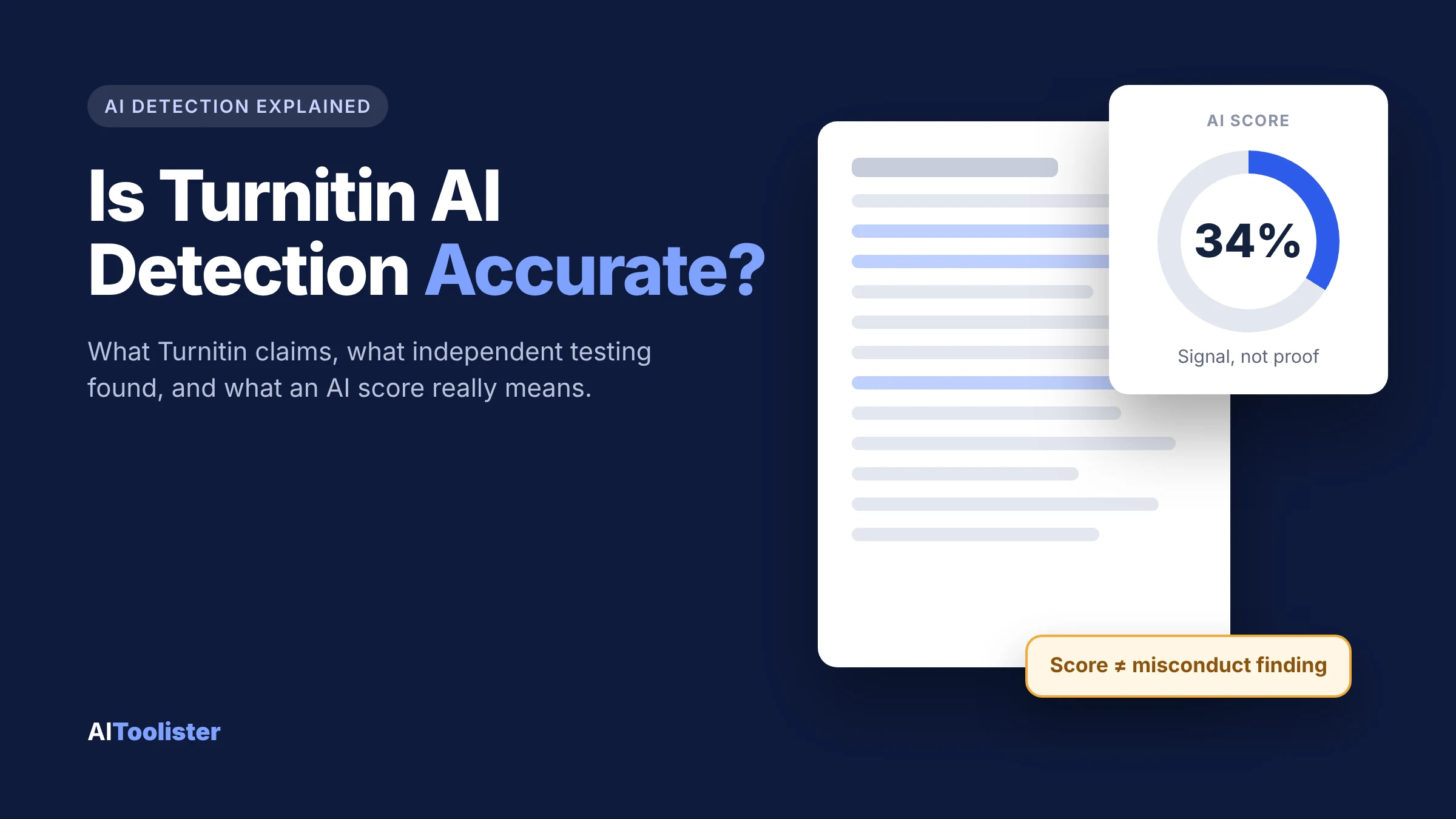
Turnitin’s AI detector is a useful warning light, but it isn’t proof. One independent test from Temple University evaluated an earlier version of Turnitin’s detector. It correctly identified 28 of 30 human-written samples and scored 23 of 30 fully AI-generated samples as 100% AI, but it was less consistent on disguised AI and mixed human and AI writing. Those results don’t measure the accuracy of Turnitin’s 2026 model. Turnitin is cautious too: its own guidance says the score “may not always be accurate” and shouldn’t be the sole basis for action against a student.
This guide covers what Turnitin claims, what outside testing has found, how to read a score like 20% or 25%, and what to do if your work is flagged or if you’re the teacher reviewing the report.
Is Turnitin AI Detection Accurate? The Short Answer
There’s no single accuracy figure for Turnitin AI detection. It’s reasonably accurate on some kinds of writing and unreliable on others, and no accuracy rate, whether Turnitin’s or a researcher’s, can tell you whether one particular essay was written with AI. Treat the score as a clue, not a verdict. In practice, that means the next question is how the detector works and what its score actually measures.
| Situation | What the evidence shows |
| Fully human writing | In Temple University’s test of an earlier model, 28 of 30 human-written samples were correctly identified as human-written |
| Fully AI-generated text | In that test, 23 of 30 AI-written samples scored 100% AI; five received partial scores and two couldn’t be rated |
| AI text rewritten by a paraphraser | Temple’s test of the earlier model identified 19 of 30 disguised AI samples as 100% AI. Turnitin now says its English detector also checks for likely paraphrased or bypassed AI text, but detection isn’t guaranteed |
| Mixed human and AI writing | Temple’s earlier-model test gave mixed scores to only 13 of 30 hybrid samples, and its published breakdown doesn’t account for all 30 |
| Short or non-prose text | Turnitin needs at least 300 words of qualifying prose; poetry, code, bullet points and other non-prose content aren’t reliably assessed |
| Scores from 1% to 19% | Turnitin shows *% instead of an exact percentage or highlights, because false positives are more common in this range |
So treat the score as a reason to look closer, not as a verdict.
How Turnitin’s AI Detector Works
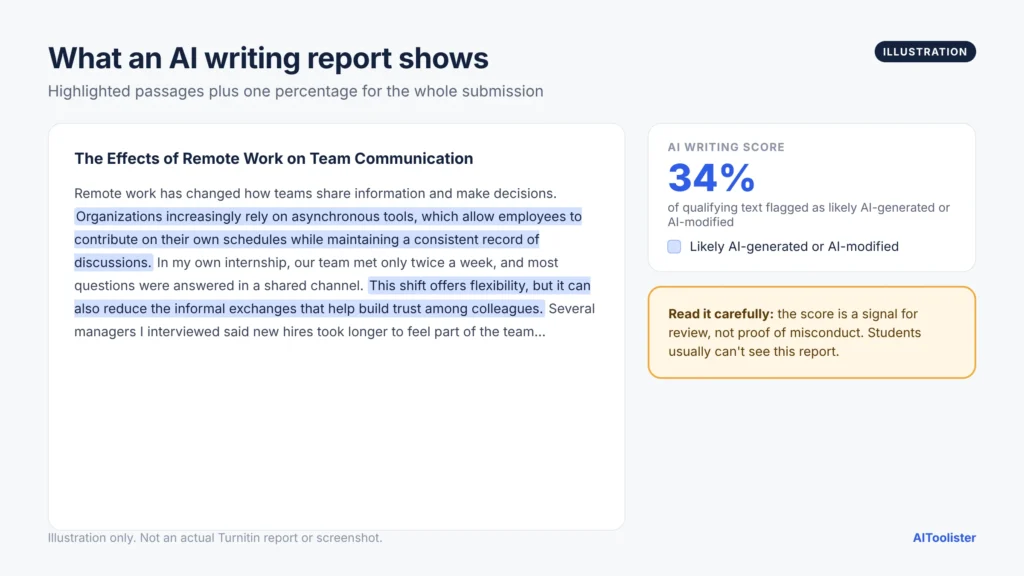
Turnitin scans a submission for “qualifying text”, meaning long-form prose, and estimates how much of it may have been generated by AI, or generated by AI and then modified with an AI paraphrasing or bypasser tool. The percentage is the share of qualifying text the detector identifies as potentially AI-generated or AI-modified. It is not the probability that the student cheated. In its AI detection FAQ, Turnitin says plainly that it “does not make a determination of misconduct.”
Turnitin doesn’t publish the full details of how the model decides. It says it looks for patterns associated with AI writing, tests each update on more than 700,000 papers written before ChatGPT existed, and moved to a single detection model in July 2026. That lack of transparency is one reason some universities are cautious.
What the AI writing report shows in 2026
Since August 4, 2026, the report uses one blue highlight for all likely AI text. That covers text generated directly by AI and AI text that was later changed with a paraphrasing or “bypasser” tool. Before that, reworded AI text appeared in a separate purple category. Older reports keep the two-colour view unless you resubmit the work, so you may still see both.
Detection of paraphrased and bypassed AI text works only on English submissions.
What the detector needs to give a score
According to Turnitin’s file requirements, a submission needs:
- At least 300 words of prose in a long-form format, and no more than 30,000 words
- A .docx, .pdf, .txt or .rtf file under 100 MB
- A language supported by Turnitin’s AI detector. Its report guide lists English, Spanish, Japanese and Arabic; separate release notes document the addition of Turkish, German and Dutch on October 6, 2026. Each language has its own detection model.
Which of these features a school actually has depends on the Turnitin products it pays for and how it has set them up. Not every institution has access to every language or report.
Turnitin says it doesn’t reliably assess non-prose or short-form writing, such as poetry, scripts, code, lists, tables, and annotated bibliographies, so you shouldn’t rely on the report for that kind of content.
[Image 1: Illustration of a Turnitin-style AI writing report. Clearly label it as an illustration unless you use a real screenshot.]
What Turnitin Says About Its Own Accuracy
When Turnitin launched its AI detector in April 2023, the company said it could identify AI writing with 98% confidence. Some media coverage, including BestColleges, reported this as 98% accuracy. That was a launch-era claim concerning the original model, not an independently established accuracy rate for the detector Turnitin uses in 2026.
A month later, Turnitin’s chief product officer published more detailed figures:
- Document level: a false positive rate below 1% for documents with more than 20% AI writing
- Sentence level: a false positive rate of about 4%, most common where human and AI writing sit next to each other
- Detection rate: she told BestColleges the detector found about 85% of AI writing and let roughly 15% through, to keep false positives under 1%
The same update explains why false positives were more common below 20% AI writing. Turnitin later changed the report display so that scores from 1% to 19% appear as *% without an exact percentage or highlights, making those low scores harder to interpret.
In 2026, Turnitin’s FAQ still gives the under-1% document-level figure. It also says the July 2026 single-model update maintains a document-level false positive rate below 1% for submissions with more than 20% AI writing. Its August 2026 post says the detector “remains accurate” but gives no new percentage. We found no publicly available independent audit of the current model in the sources we reviewed.
What Independent Research Has Found
The Temple University test
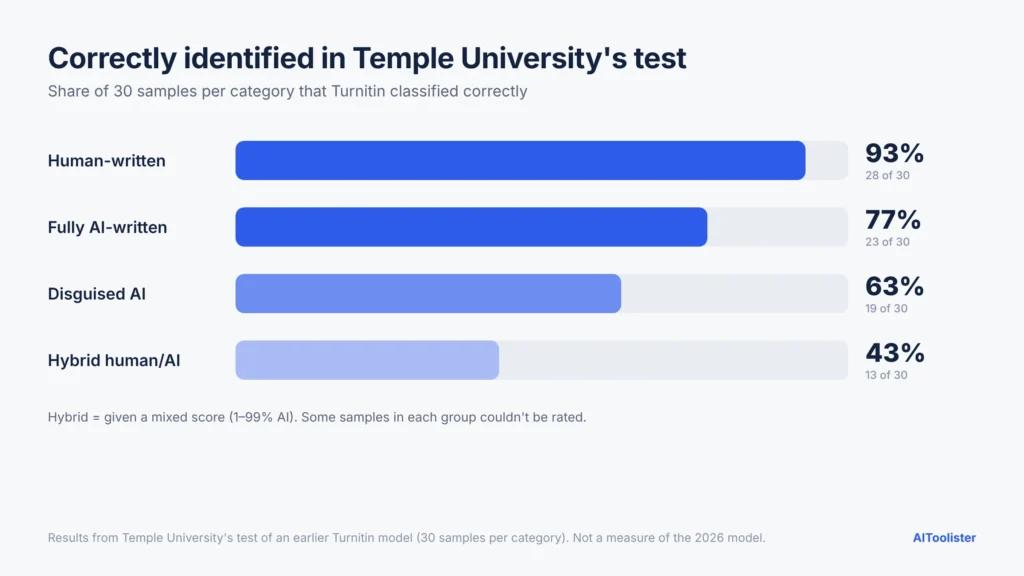
One useful public test comes from Temple University’s teaching centre. Researchers ran 120 texts through Turnitin: 30 student papers written before ChatGPT’s release in November 2022, 30 ChatGPT essays based on real Temple assignments, 30 ChatGPT essays run through spinning or paraphrasing tools, and 30 mixes of human and AI writing.
| Text type | Result in Temple’s test of an earlier model | What else happened |
| Human-written | 28 of 30 correctly identified as human-written (93%) | One received an 11% AI score; one couldn’t be rated |
| Fully AI-written | 23 of 30 scored 100% AI (77%) | Five scored between 52% and 97%; two couldn’t be rated |
| Disguised AI | 19 of 30 scored 100% AI (63%) | Eight scored between 43% and 95%; three couldn’t be rated |
| Hybrid human/AI | 13 of 30 received a mixed score (43%) | Six scored 100% AI, seven scored 100% human and one couldn’t be rated. These published figures cover only 27 of the 30 samples, leaving three unaccounted for |
The hybrid results were the most worrying. Even when the overall score looked plausible, the highlighted sentences often didn’t match the phrases that were actually AI-written.
The researchers concluded that the score is an indicator, not proof. In their sample, a 0% result was a reasonable sign that a paper wasn’t substantially AI-written, but it didn’t prove the paper was entirely human. Keep in mind that the test used an earlier version of Turnitin’s detector and only 30 samples per group, so it isn’t a measure of the 2026 model.
[Image 2: Bar chart of the Temple results. Caption: “Results from Temple University’s test of an earlier Turnitin model (30 samples per category).”]
Why Vanderbilt switched the detector off
In August 2023, Vanderbilt University disabled Turnitin’s AI detector. Its reasoning was simple arithmetic. Vanderbilt submitted about 75,000 papers to Turnitin in 2022. At a 1% false-positive rate, Vanderbilt estimated that around 750 student papers could be wrongly flagged in a year. That was a simplified illustration, applying a 1% rate to about 75,000 submissions, not a measured count or a precise forecast of false flags.
The university also pointed to the lack of detail on how the tool works, concerns about bias against non-native English writers, and student privacy. Other institutions have made similar decisions, though policies vary widely and change often.
Turnitin AI Detection False Positives: Who Is Flagged and Why
A false positive happens when Turnitin labels human writing as AI-generated. Even a low rate matters, because a false flag can lead to an awkward conversation, a formal review, or a lasting doubt about a student’s honesty.
Limits Turnitin itself acknowledges
- Short submissions. Turnitin’s own 2023 research found false positives rose clearly above its 1% target for texts of 150 to 300 words. That’s why it now requires at least 300 words.
- Low scores. False positives are more common below 20%, so those scores show only an asterisk.
- Mixed documents. At sentence level, false positives cluster where human and AI writing meet.
- Non-prose content. Lists, tables, code and poetry aren’t reliably assessed.
Concerns that are reported, not proven.
Students and teachers often say formulaic or heavily polished writing gets flagged more, and some reports suggest neurodivergent students’ writing is flagged unfairly. These accounts deserve attention, but Turnitin hasn’t confirmed that any writing style triggers its detector, and published evidence specific to Turnitin is thin.
Grammarly and other writing tools
What matters here is whether a tool corrected your writing or wrote it. Turnitin’s FAQ says its detector is “not tuned to target” Grammarly’s spelling, grammar and punctuation fixes, and that most of those changes weren’t flagged in its testing. Grammarly’s generative features are a different story. Turnitin says text produced with tools that draft or paraphrase for you “will likely be flagged as AI-generated.”
Non-native English writers
A 2023 Stanford study ran 91 TOEFL essays by non-native English speakers through seven AI detectors. The detectors classified more than half of the essays (61.22%) as AI-generated. That’s a serious finding, but the study tested publicly available detectors, not Turnitin, so it isn’t direct evidence about Turnitin.
Turnitin ran its own study on English language learners in October 2023. For texts of 300 words or more, it found no statistically significant difference in false positives between native and non-native writers. For shorter texts, the gap was larger. That’s Turnitin’s own research, not independent confirmation, but it explains why the 300-word minimum matters.
What Turnitin Misses: False Negatives and AI Humanisers
Accuracy works in both directions. A false negative is AI-written text the detector doesn’t catch, and Turnitin accepts some of those on purpose.
Missed by design. Turnitin has always said it would rather miss some AI writing than wrongly accuse a student. In 2023, that meant letting about 15% of AI text through. Its current FAQ gives an example: a document flagged at 50% AI could actually contain up to 65%.
Humanisers and the arms race. “Humaniser” or bypasser tools rewrite AI text such that it looks less machine-made. In August 2025, Turnitin added detection for AI bypassers, though it works only in English. As detection improves, the tools trying to dodge it improve too, and neither side stays ahead for long.
What this means in practice:
- For teachers: a low score doesn’t prove a text is fully human, so 0% isn’t a clean bill of health.
- For students: a humaniser won’t reliably get AI text past Turnitin, and using one may break your school’s rules on its own.
How to Read a Turnitin AI Score: Is 20% or 25% Bad?
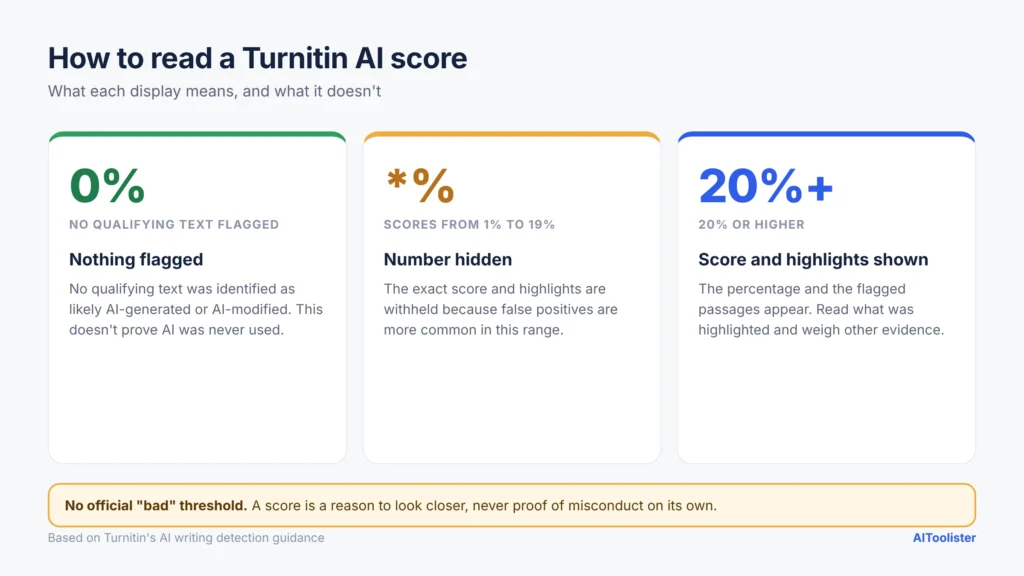
A Turnitin AI score shows how much of the qualifying text the detector thinks is likely AI-generated or AI-modified. It is not a grade, a probability of cheating, or a finding of misconduct. Here’s what each display means:
| What you see | What it means |
| 0% | The detector found no qualifying text it considers likely AI-generated or AI-modified. This doesn’t prove AI was never used |
| *% (scores from 1% to 19%) | The exact score and highlights are hidden because results in this range carry a higher risk of false positives |
| 20% or higher | The report shows a percentage and highlights text it considers likely AI-generated or AI-modified. This isn’t an official misconduct threshold |
Is 20% bad? Is 25% high? Turnitin doesn’t set an official “bad” threshold. A 20% or 25% score means the detector thinks roughly a fifth or a quarter of the qualifying text looks AI-generated. Whether that matters depends on three things:
- The assignment rules. Was any AI use allowed, such as brainstorming or grammar help?
- What was highlighted. Are the flagged passages your core argument, or formulaic parts such as a methods section or standard definitions?
- Other evidence. Do drafts, version history or a conversation about the work support the score or contradict it?
[Image 3: Graphic guide to reading Turnitin AI scores (0%, *% for 1–19%, and 20% or higher).]
Turnitin vs GPTZero and Other AI Detectors
Turnitin is licensed to institutions; only instructors and administrators see its results, and it says it’s tuned to keep false positives low. GPTZero and similar detectors are open to anyone, so students often use them to check their own work.
Independent comparisons do exist. BestColleges, for example, ran a few samples through both Turnitin and GPTZero in 2023 and found Turnitin’s results more sensible in that small test. That doesn’t show which tool is more accurate today. But most comparisons used older versions of each model, small or controlled samples, or writing that doesn’t look like real coursework. None of them can name a permanent winner, because every detector keeps changing.
One practical point matters more than any ranking: a free checker’s result won’t reliably predict your Turnitin score. Different detectors use different models and often disagree about the same text.
| Detector | Who can use it | Typical use | Main limitation |
| Turnitin | Instructors and administrators at institutions with the feature enabled | Reviewing submitted coursework | Students can’t see the report directly, and results aren’t a finding of misconduct |
| GPTZero | Anyone with access to its service | Self-checks and educator screening | Its result may differ from Turnitin’s for the same text |
| Other detectors, such as Copyleaks and Originality.ai | Depends on the provider and plan | Checking writing for educators, publishers and writers | Results vary by model, version and type of text |
What to Do If Turnitin Flags Your Work
If you wrote the work yourself, a flag is something you can respond to. It isn’t a finding against you. These steps give you the best chance of resolving it calmly:
- Stay calm and don’t admit to something you didn’t do. A flag starts a conversation. It isn’t a ruling, and Turnitin says the score shouldn’t be the only basis for action.
- Ask to see the report. Find out the percentage and which passages were highlighted. Instructors can download the report and share it with you.
- Gather evidence of how you wrote it. Google Docs version history, or Word version history when it’s available, can be especially useful because it shows the work taking shape over time. Outlines, notes, research sources and earlier drafts help too.
- Offer to talk through your work. Explaining your argument, your sources and why you made certain choices is often more convincing than any document.
- Learn your school’s process. Read the academic integrity policy and find out your right to respond and appeal. If you need support, ask an academic advisor, the student union or an ombuds office.
For future assignments, write in a place that saves version history, keep your drafts, and check whether grammar or AI tools are allowed before you use them. If AI use is permitted, disclose it the way your instructor asks.
How Teachers Should Use Turnitin’s AI Score
Use the score as a reason to look closer, not as a conclusion. Turnitin takes the same position: the score is data to weigh alongside your own judgment and your institution’s policy, not a determination of misconduct.
Before acting on a flag:
- Read the highlighted passages. Do they differ from the student’s usual voice, or are they formulaic sections such as definitions, methods or quotations?
- Look for other signs. Made-up or incorrect citations, a student who can’t explain their own argument, or a big gap between in-class writing and submitted work can tell you more than a percentage.
- Check the writing process. Ask for drafts or version history when it’s available.
- Have a conversation before any referral. Many cases are settled once a student explains their process.
Prevention works better than detection. Set clear AI rules for each assignment, explain how students should disclose AI use when it’s allowed, and build in process steps, such as drafts, short reflections, or in-class writing. Vanderbilt’s guidance is a useful example of this approach. If you’re looking for tools that save time on planning and feedback, see our guide to the best AI tools for teachers.
Frequently Asked Questions
Does Turnitin detect AI and plagiarism at the same time?
Yes, if your institution has AI detection switched on. Turnitin produces two separate results: a similarity score that looks for matching text in other sources, and an AI writing score that estimates how likely the text is AI-generated. AI highlights don’t appear in the Similarity Report.
Can Turnitin detect ChatGPT, Claude and Gemini?
The models Turnitin currently lists for its English detector include versions of OpenAI’s GPT models (including GPT-4o and the GPT-5 family), Google’s Gemini, and Anthropic’s Claude, as well as LLaMA, Mistral, DeepSeek, Grok and tools built on them. The list is model-specific and changes over time; the current version is in its AI detection FAQ. Being on that list doesn’t mean every passage gets caught. Edited and mixed text stays harder to detect.
Is Turnitin’s AI checker free for students to use?
No. Students can’t use a standalone version to check their own work. Turnitin licenses it to institutions, and its FAQ says students can’t see the AI writing indicator or report, though instructors can share a PDF of the report. Free detectors from other companies use different models, so they won’t predict your Turnitin result.
Can Turnitin give a 100% AI score to human-written work?
It’s uncommon in published testing, but it can’t be ruled out. Turnitin says its model may misidentify human-written text, and students have publicly reported high scores on work they wrote themselves, even though none of the 30 human papers in Temple’s test scored above 11% AI. If it happens to you, the evidence steps above are your strongest response.
The Bottom Line
Turnitin’s AI detector is a useful signal, not a reliable judge. In published testing, it has done best on long, clearly human or clearly AI-written text, and worst on short, mixed or reworded writing. If you’re a student, keep a record of how you write, because version history is your best defence. If you’re a teacher, pair the score with drafts, conversation and your own reading before deciding anything.
Keep Exploring