Ahsan Javaid
Last updated: September 2026
Every restaurant owner knows the number, even if they have never written it down: margins in this industry are razor-thin — often in the single digits after rent, labor, food cost, and everything else takes its cut. A restaurant does not fail because of one bad decision. It fails because of dozens of small decisions, made every single day, that quietly add up — like a food cost percentage that crept up two points over six months, a Tuesday night schedule that overstaffs every week without anyone noticing, or a menu item nobody realized was losing money on every plate sold.
Most owners are too busy running the floor, managing staff, and putting out fires to sit down and analyze the data that would actually catch these problems. That is where AI tools for restaurants are becoming the difference between owners flying blind on their numbers and owners who can see exactly where the money is leaking before it becomes a crisis. This guide covers ten tools that target the biggest places restaurants lose money and time — forecasting, food cost, labor, guest relationships, online sales, marketing, and reputation — without pretending any of them can fix a restaurant with a fundamentally weak concept or bad food.
Quick Comparison
| Nory | AI-powered restaurant operations and forecasting | AI assistants for forecasting, scheduling, and supplier ordering | Custom pricing, contact sales |
| Toast IQ | POS-connected restaurant intelligence | Conversational AI assistant grounded in your own Toast sales, labor, and menu data | Core assistant included with Toast POS; Custom Agents, Toast IQ Inventory, and Toast IQ Grow are separate paid additions |
| ClearCOGS | Demand, prep, ordering and labor forecasting | AI forecasting engine predicting demand by menu item | From $150 per location per month; bulk pricing available for 15+ unit enterprise customers |
| SevenRooms | Guest experience, CRM and reservations | Voice AI (24/7 call handling), AI Responses, AI Feedback Summary | Pricing not publicly disclosed, contact SevenRooms for a quote |
| MarketMan | Inventory and food-cost management | Real-time food cost tracking, AI recipe costing, AI ordering on higher tiers | Demo available; from $199 per month |
| Owner.com | Direct ordering and restaurant marketing | AI-powered email and text marketing campaigns | No free trial; Flex at $249 per month plus a 5% order fee, or Flat Rate at $499 per month |
| Popmenu | Restaurant website and marketing automation | AI-crafted menu descriptions, emails, and social content | Demo available; from $179 per month, AI phone answering is a paid add-on |
| Birdeye AI | Reviews and reputation management | BirdAI drafts review responses and benchmarks competitors | Demo available; from $299 per month |
| ChatGPT | General-purpose AI assistant for restaurant operators | General-purpose writing and communication assistant | Free tier available; $20 per month for Plus |
| Canva AI | Restaurant marketing and design | AI design suggestions through Magic Studio | Free tier available; $144 per year for one person on the Pro plan, billed annually |
Pricing changes and several vendors don’t publish full rates without a demo — confirm current terms directly before budgeting.
Whole-Restaurant Operations and Forecasting
This is where most confusion happens, because Nory, Toast IQ, and ClearCOGS can all sound similar from a distance. They solve overlapping but genuinely different problems, so it’s worth being precise about what each one does best.
Nory — Best for AI-Powered Restaurant Operations and Forecasting
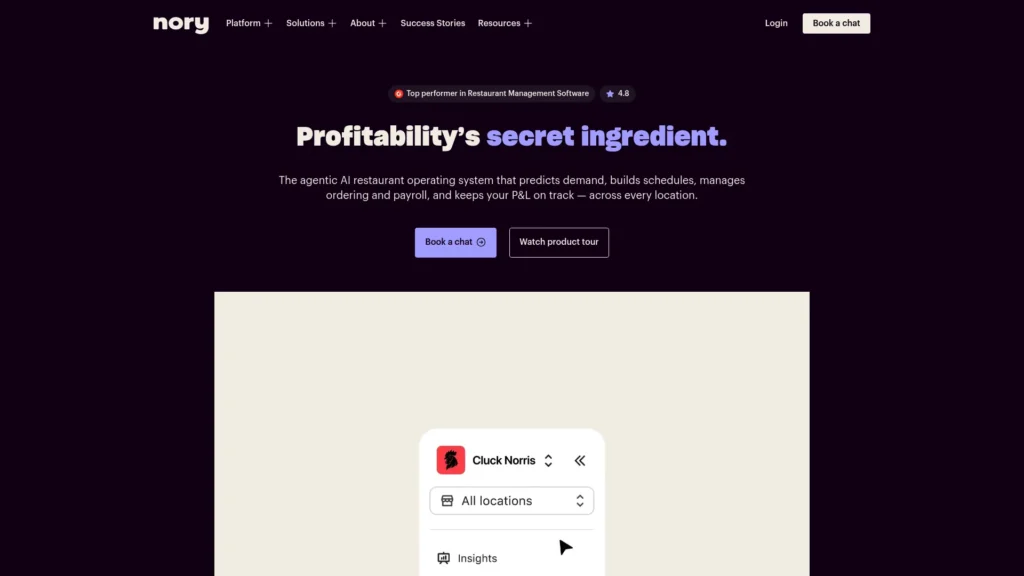
Nory positions itself as an AI-native restaurant operating system: a set of AI assistants — currently covering forecasting, scheduling, and supplier ordering, with more planned — working inside a single platform that also handles workforce management, inventory, payroll, and business intelligence. Its main appeal is that it works more like a co-pilot than a dashboard, learning a restaurant’s specific patterns and recommending day-to-day decisions like how many staff to schedule for a given shift or what to order for the week ahead.
Nory reports that its customers typically see 10 to 20 percent reductions in labor costs and roughly 50 percent reductions in food waste — these are vendor-reported figures from Nory’s own funding announcements, not independently audited, so treat them as directional claims rather than guarantees for your specific restaurant.
What it helps with: consolidating forecasting, scheduling, ordering, and business intelligence into one AI-driven system. Free option: none published — Nory is a contact-sales, demo-based platform. Monthly cost: custom pricing, not publicly disclosed. Best for: restaurant groups wanting one AI-native system instead of several disconnected back-office tools, rather than independents looking for a lighter, single-purpose tool.
Toast IQ — Best for POS-Connected Restaurant Intelligence
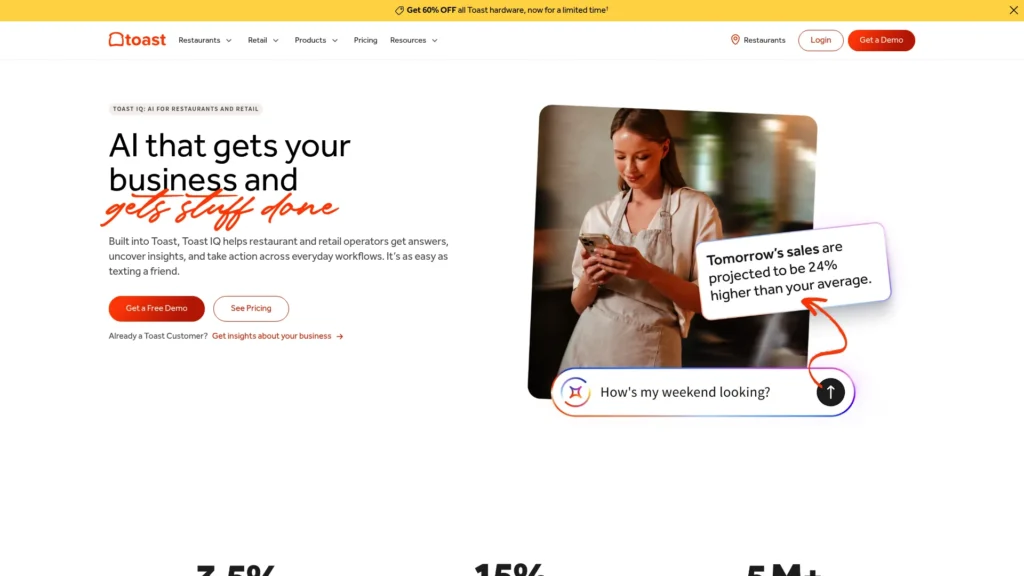
Toast IQ is the current official name for what early users previously knew as Sous Chef, now expanded and rebranded as a full conversational AI assistant. For restaurants already running Toast POS, its value is that it is built natively on your own Toast data — sales, labor, menu, and guest information — so you can ask plain-language questions like which day of the week has the lowest average ticket or which menu items are quietly losing money, and get answers grounded in your actual numbers rather than generic responses. As of 2026, the core Toast IQ assistant can also take direct action, including 86ing a menu item, adjusting stock levels, and editing auto clockouts, all from the same conversational interface.
Not every Toast IQ capability is automatically included in a standard Toast POS subscription, so it is worth being specific about the difference. The core conversational assistant is bundled with Toast POS. Beyond that, Toast IQ Custom Agents — a way to build task-specific AI agents on top of your data — can involve paid credits. Toast IQ Inventory, a newer real-time inventory feature, is currently in limited release to select customers and is a paid add-on, so not every Toast customer can access it today. Toast IQ Grow, launched in spring 2026, is a separate paid package that pairs agentic AI with a human marketer for acquisition and retention campaigns. Treat these as distinct products layered on top of the core assistant, not features that come free with any Toast POS plan.
What it helps with: identifying which menu items and trends are helping or hurting margin, and taking direct action on stock, pricing, and scheduling issues. Free option: the core Toast IQ assistant is included with Toast POS; Custom Agents, Toast IQ Inventory, and Toast IQ Grow are separate, additional-cost products. Monthly cost: Toast POS itself starts with a free Starter Kit plan, Point of Sale is $69/month, and Build Your Own (for larger or more customized setups) is custom-quoted — the additional Toast IQ products above are priced and billed separately from this base POS cost. Best for: restaurants already using Toast POS who want deeper insight and action on data they already generate, rather than restaurants evaluating a new POS system from scratch.
ClearCOGS — Best for Demand, Prep, Ordering and Labor Forecasting
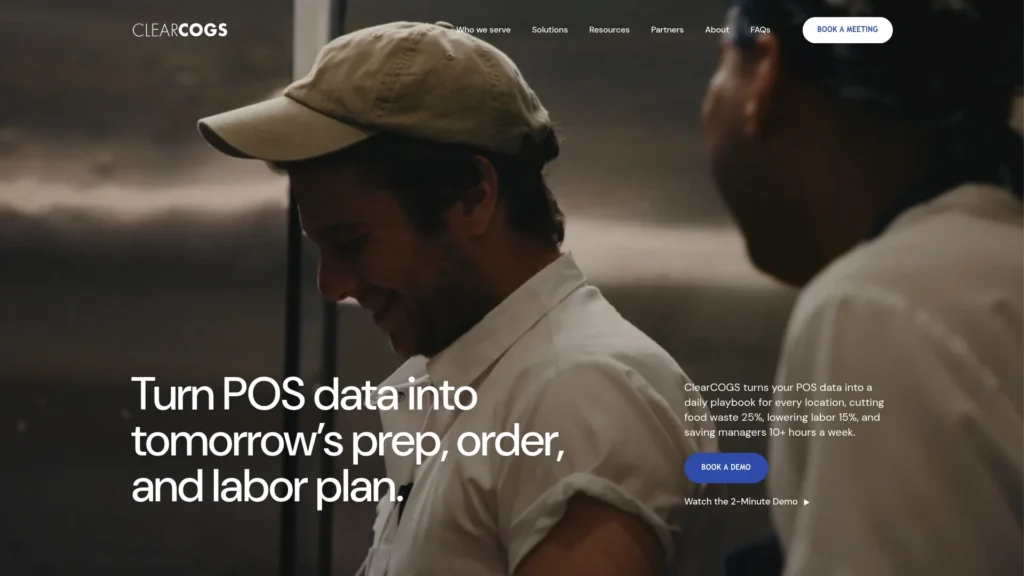
ClearCOGS is a specialist forecasting tool rather than a broad operating system: it pulls data from your existing POS and back-of-house systems, along with external signals like weather and local events, to predict customer demand at the menu-item level. Its main output is practical — prep lists plus purchasing and labor recommendations — aimed at replacing gut-feeling ordering and scheduling that quietly overstaffs slow nights and understaffs busy ones.
What it helps with: turning demand forecasts into specific, actionable prep, ordering, and labor recommendations. Free option: none published — demo-based sales process. Monthly cost: ClearCOGS is priced at $150 per location per month, with bulk pricing available for enterprise customers running 15 or more units. Best for: operations of a range of sizes that already have POS data flowing and want forecasting layered on top without replacing existing systems — the company’s own positioning describes roughly 5 to 20 locations as a particularly strong fit, though smaller operators can use it too. It is a smaller, earlier-stage company than the enterprise vendors on this list, so factor that into a long-term vendor decision.
Food Cost and Inventory
MarketMan — Best for Inventory and Food-Cost Management
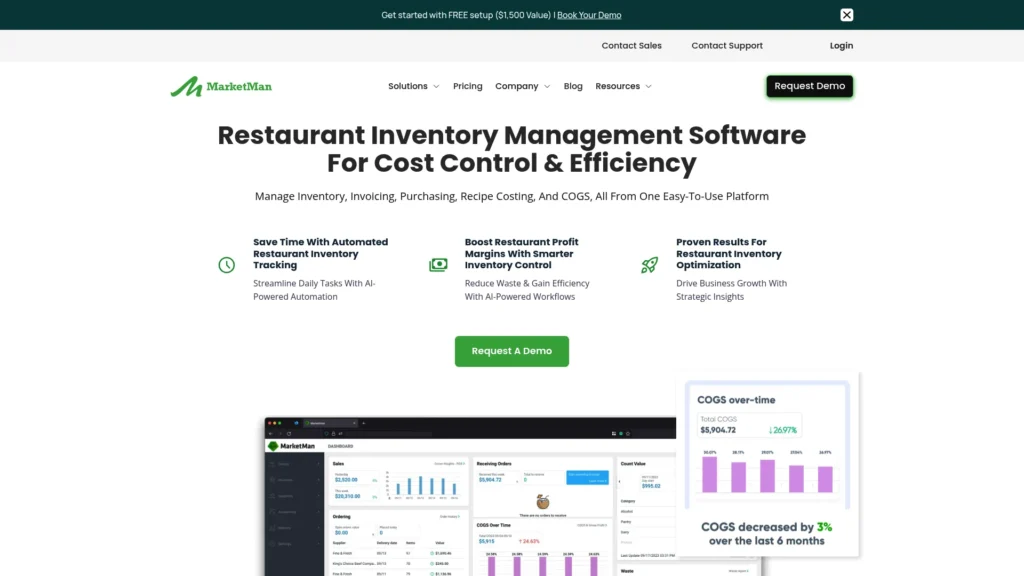
MarketMan is an inventory and purchasing management platform that tracks food cost close to real time rather than relying on the manual monthly counts most restaurants still depend on. Its value is spotting problems early: it analyzes purchasing patterns, recipe usage, and waste data to flag when an ingredient’s cost is trending upward or when usage doesn’t match what sales data suggests—a signal of portion drift, theft, or untracked waste. Higher tiers add AI-powered recipe creation, real-time recipe costing, and automatic COGS calculation, and the top tier adds AI-assisted ordering.
What it helps with: real-time food cost tracking and smarter purchasing decisions. Best for: any restaurant currently relying on manual or infrequent inventory counts. Free option: demo available — no free tier. Monthly cost: Starter is $199/month, Growth (with the AI recipe and COGS features) is $249/month, and Enterprise (with AI Ordering) is custom-quoted.
Guest Relationships and Reservations
SevenRooms — Best for Guest Experience, CRM and Reservations
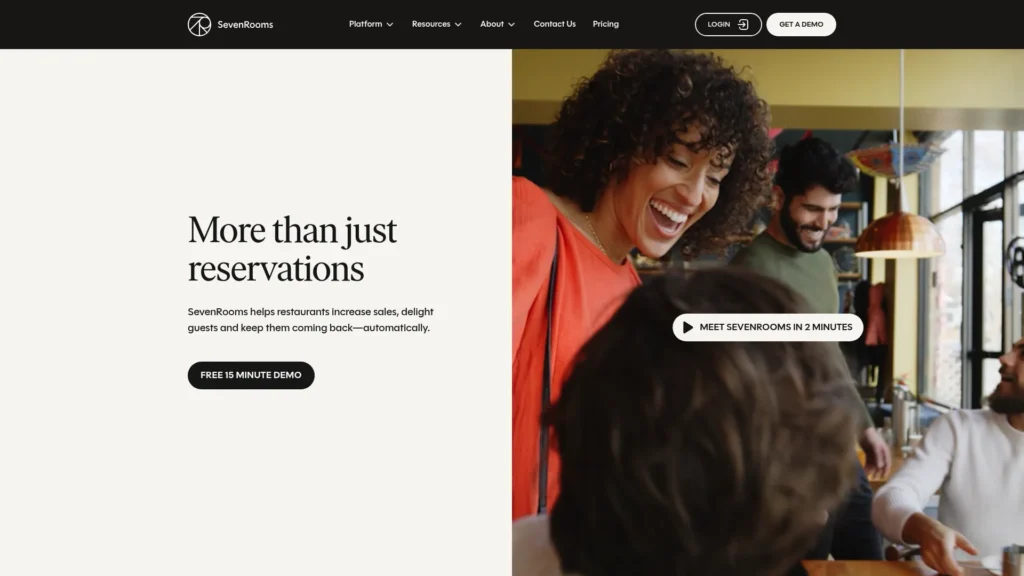
SevenRooms is a reservations, CRM, and guest-marketing platform built to help restaurants recognize and personalize service for guests across every channel — dine-in, delivery, and digital ordering — without paying cover or commission fees on direct bookings. Its main AI feature is SevenRooms Voice AI (built on ElevenLabs’ voice technology), which answers phone calls, manages reservations, and recognizes returning guests around the clock. It also includes AI Responses, AI Feedback Summary, and AI Note Polish, which draft guest communication replies, summarize feedback trends, and clean up staff notes, respectively. The company reports it has handled more than 400,000 calls across 600-plus restaurants since launch, with roughly one in five of those calls coming in after hours.
The reservation-fill and reservation-volume figures SevenRooms cites, including a vendor-reported “up to 25% more reservations” claim tied to Voice AI, come from the company’s own press materials rather than independent audits, so treat them as vendor-reported rather than independently established.
What it helps with: centralizing guest data, automating phone reservations, and speeding up guest communication and feedback review. Free option: not published on SevenRooms’ own site. Monthly cost: pricing not publicly disclosed — contact SevenRooms for a quote. Best for: reservation-driven restaurants where knowing and personalizing service for repeat guests directly affects revenue, rather than restaurants that need a broader online ordering focus.
Online Presence and Ordering
Popmenu — Best for Restaurant Website/Marketing Automation
Popmenu uses AI to generate menu descriptions, builds and maintains a restaurant’s website automatically as the menu changes, and layers AI-crafted email and social content on top. Its main advantage is automation: the platform syncs menu changes across the website and other channels without manual updates in multiple places. Popmenu’s pricing is tiered rather than flat, and several features that used to be included now sit in higher tiers or as paid add-ons — AI phone answering, for instance, is an extra-cost add-on rather than a default feature.
What it helps with: website, menu presentation, and AI-assisted marketing content. Free option: demo available. Monthly cost: Starter is $179/month, Essentials (with AI-crafted content) is $299/month, Premier (the fully AI-powered marketing suite) is $499/month, and Enterprise (multi-location) is custom — each additional location on multi-unit plans adds a separate monthly fee. Best for: restaurants whose website and online presence currently feel outdated or disconnected from their actual menu.
Owner.com — Best for Direct Ordering and Restaurant Marketing
Third-party delivery apps routinely take 15 to 30 percent of an order’s value in commission, which, on already thin margins, can turn a profitable order into a money-losing one. Owner.com builds a restaurant’s own branded ordering website and app, using AI-powered marketing — automated email and text campaigns targeting past customers with personalized offers — to pull customers toward ordering directly instead of through a third-party app.
What it helps with: reducing dependence on commission-heavy third-party delivery apps. Free option: none — no free trial. Monthly cost: two structures are available: Flex at $249/month plus a 5% restaurant fee on each order, or Flat Rate at $499/month with no additional per-order fee. Best for: restaurants with significant delivery and takeout volume currently going through third-party apps, where the math of switching to a flat monthly fee works out favorably against the commission you’re currently paying.
Reputation
Birdeye AI — Best for Reviews and Reputation Management
Birdeye monitors reviews across Google, Yelp, and other platforms in one dashboard. Its AI feature, BirdAI, drafts suggested responses to new reviews — both glowing and critical — that an owner reviews and personalizes before posting, and also provides competitor benchmarking. The platform also automates review request campaigns after a positive interaction, increasing review volume and helping dilute the impact of the occasional bad one.
What it helps with: centralized review monitoring and faster, more consistent responses. Free option: demo available — no free tier. Monthly cost: Starter is $299/month, Growth (which includes the AI assistance) is $349/month, Dominate is $449/month, and Premium for four-plus locations is custom-quoted. Best for: restaurants where online reputation directly drives walk-in and reservation volume.
Everyday Productivity and Content
ChatGPT — Best General-Purpose AI Assistant for Restaurant Operators
Restaurant owners write constantly without realizing it — staff training memos, supplier emails negotiating pricing or addressing a delivery issue, social media captions, email newsletters to regulars, copy for a new seasonal menu announcement. ChatGPT drafts all of this quickly, leaving the owner to add specific details and a personal voice instead of starting from a blank page on an already packed day.
What it helps with: all general restaurant writing and communication tasks. Free option: yes — the free plan handles most of this. Monthly cost: $20/month for the Plus plan.
Canva AI — Best for Restaurant Marketing/Design
A restaurant’s social media presence and printed specials boards say something about quality before a customer ever tastes the food. Canva AI’s templates and AI design suggestions (Magic Studio) let an owner or manager produce professional-looking social posts, specials boards, and promotional graphics without a design background or a designer’s fee.
What it helps with: social media content and in-restaurant promotional materials. Free option: yes — a genuine permanent free tier. Monthly cost: $144/year for one person on the Pro plan, billed annually (about $12/month equivalent).
Distinctions Worth Understanding Before You Buy
Independent restaurant vs. multi-location group. Nory and Fourth-style enterprise platforms are built and priced for multi-unit complexity, with demo-gated, undisclosed pricing that generally only makes sense to negotiate at scale. ClearCOGS is more flexible on size — it publishes a per-location rate and can work for a single location, though the company’s own positioning describes roughly 5 to 20 locations as its strongest fit. A single independent location generally gets more value per dollar from a focused tool like MarketMan or Popmenu than from an enterprise operating system sized for a portfolio.
Front-of-house vs. back-of-house. SevenRooms, Popmenu, and Birdeye AI live on the guest-facing side — reservations, marketing, and reputation. MarketMan, ClearCOGS, and Toast IQ live on the back-of-house side — cost, forecasting, and operational data. Nory and Toast IQ Grow bridge both to some degree.
Operational AI vs. marketing AI. Forecasting demand, optimizing labor, and tracking food cost (Nory, ClearCOGS, Toast IQ, MarketMan) is a fundamentally different problem than writing guest-facing copy or drafting review responses (Popmenu, Birdeye AI, ChatGPT, Canva AI). Don’t expect a marketing-AI tool to fix a cost problem, or an operational tool to fix a reputation problem.
Restaurant-specific platform vs. general-purpose AI tool. ChatGPT and Canva AI are general-purpose tools that happen to work well for restaurant tasks — they have no restaurant-specific data or industry logic built in. Everything else on this list is built specifically around restaurant data and workflows, which is why they can do things (like flagging portion drift or forecasting demand by menu item) that a general-purpose tool cannot.
Existing POS/software ecosystem. Toast IQ only makes sense if you’re already on Toast POS — it’s not a standalone product you can adopt independently. ClearCOGS and Nory are designed to integrate with whatever POS you already run, not replace it. Check integration compatibility with your current POS before committing to any operational tool on this list.
Cost and complexity. The enterprise-oriented tools (Nory, SevenRooms at scale, Fourth) generally require a sales conversation and represent a bigger commitment — in cost, onboarding time, and organizational change — than the more self-serve tools (MarketMan, Popmenu, Birdeye AI, ChatGPT, Canva AI), which publish pricing and can be evaluated and adopted more independently.
Alternatives Worth Knowing About
A few tools didn’t make this year’s Top 10 but remain genuinely useful for specific situations. Apicbase focuses on recipe-level costing and waste-pattern tracking, particularly useful for multi-location operations wanting to verify the same dish performs consistently across kitchens; it’s a custom-quote, demo-based product. Crunchtime forecasts demand and builds labor schedules against that forecast rather than a manager’s gut feeling, with labor-compliance tracking layered in; like Apicbase, it’s priced by location count through a sales conversation. QuickBooks remains a common choice for restaurant bookkeeping, payroll, and tax preparation, with AI features that flag financial anomalies; it’s not restaurant-specific software but a reasonable general accounting tool many operators already use. Fourth is worth knowing about specifically for larger, multi-location restaurant groups: its Restaurant Operations Suite consolidates workforce management, HR/payroll, and inventory with an AI layer (Fourth iQ) for above-store forecasting and recommendations — it’s an enterprise-scale alternative to Nory for groups already running at that size.
Matching Tools to Your Type of Restaurant
Independent single-location restaurants. MarketMan for food cost control, ChatGPT and Canva AI for marketing and communication. This covers the core leverage points without the demo-gated, enterprise pricing that Nory and larger platforms are built for. ClearCOGS is also worth a look even at one location, given its published per-location rate, though it’s most cost-effective once you’re closer to its 5-to-20-location sweet spot.
Multi-location restaurant groups. Nory or ClearCOGS become worth evaluating here, given the forecasting and labor complexity across locations. Fourth is a comparable enterprise alternative for groups already at significant scale. SevenRooms’ cross-location guest data and Birdeye AI’s multi-location reputation management both matter more as location count grows.
Fast casual and high-volume operations. Toast IQ if you’re already on Toast POS and want sales and menu performance insight from data you’re already generating; Owner.com if delivery commission is eating significant margin given high order volume; ClearCOGS for demand forecasting against high and variable traffic.
Fine dining and reservation-driven restaurants. SevenRooms matters most here, given how heavily these restaurants depend on personalized guest relationships and reservation management. Birdeye AI matters more because reservation decisions depend so directly on review reputation, and Popmenu matters for a website and menu presentation that match the quality of the experience being sold.
Being Honest About What AI Cannot Fix
AI cannot save a restaurant with a bad concept or bad food. No tool on this list fixes a menu nobody wants to order from or a location that doesn’t fit the concept. These tools optimize the execution of a business that fundamentally works. They don’t create demand for a restaurant that lacks product-market fit.
It will not fix a toxic kitchen culture or a bad GM. Scheduling software cannot fix a kitchen with high staff turnover because of how people are treated. Reputation management cannot fix consistently bad service caused by poor management. These are leadership and culture problems no software addresses.
The data is only as good as what your staff actually enters. Food cost and inventory tools depend on accurate data entry. If staff isn’t logging waste accurately or inventory counts are sloppy, the AI insights built on that data will be wrong in the same direction. These tools amplify good operational discipline — they don’t create it from nothing.
Questions Restaurant Owners Actually Ask
Can AI actually lower my food cost? Tools like MarketMan provide visibility that helps you identify and fix the specific causes of food cost creep — portion drift, waste patterns, and ingredient price increases that haven’t been reflected in menu pricing. The tool surfaces the problem clearly and quickly. Fixing it still requires action on your part — adjusting portions, retraining staff, or repricing a dish.
Is it worth paying for AI forecasting and scheduling software for a small restaurant? For a single small location, the demo-gated, undisclosed pricing of a platform like Nory is often hard to justify relative to the labor savings available. ClearCOGS is a bit more accessible for a smaller operation since it publishes a per-location rate, though its own positioning points to roughly 5 to 20 locations as the sweet spot where the cost most clearly pays for itself. These tools generally deliver the clearest value for multi-location operations where scheduling complexity and labor spend are large enough that even small percentage improvements translate into meaningful dollars.
Can AI help me get out of the delivery apps? Owner.com is built specifically to pull customers toward direct ordering through targeted marketing and a better-optimized direct ordering experience. It will not eliminate delivery app usage entirely for most restaurants, but it can meaningfully shift volume toward lower-commission direct orders over time.
What is the best free AI tool for a restaurant on a tight budget? ChatGPT’s free plan and Canva’s free plan cover meaningful ground for marketing and communication tasks at zero cost. The forecasting, inventory, guest, and reputation tools on this list generally don’t have functional free tiers, since they’re built around ongoing data processing that costs money to run.
Will AI tell me which menu items to cut? Toast IQ and similar sales analytics tools will clearly show you which items have poor margins relative to sales volume, which is the data you need to make that decision. The final call on whether to cut a beloved but unprofitable item — and how that affects the overall guest experience — is still a judgment call only you can make.
How do I respond to bad reviews without losing my mind? Birdeye AI drafts a suggested response quickly, so you’re not staring at a blank reply box while frustrated. Read the draft, soften or adjust the tone if needed, and post it within a day or two rather than letting it sit. Speed and a calm, professional tone matter more than a perfect response.
Can AI actually replace phone reservations and answering the phone? SevenRooms Voice AI is built specifically for this — answering calls, booking reservations, and recognizing returning guests around the clock, including after-hours calls a host stand would otherwise miss entirely. It handles routine booking well; unusual requests or genuine complaints still tend to need a human.
Conclusion
There’s no universal starting combination that fits every restaurant — the right first tool depends on your primary problem, your size, your existing POS and software ecosystem, and how operationally complex your business already is. A single independent location bleeding money on food cost should start with MarketMan, not an enterprise forecasting platform priced for a five-location group. A growing group already on Toast POS gets more immediate value from Toast IQ than from bolting on a new system. A reservation-driven restaurant where reputation drives covers should prioritize SevenRooms and Birdeye AI over back-of-house forecasting tools that solve a problem they don’t actually have.
Identify the specific place your money or time is actually leaking, then pick the tool built for that leak — not the tool that sounds most comprehensive. AI can tell you your chicken parm bleeds money every time you sell it. It cannot make the kitchen care about portion control, and it cannot replace the owner who walks the floor, knows their regulars by name, and notices when something feels off before a single number proves it. That part of running a restaurant has never been automatable, and it won’t start now.
For more honest AI tool reviews across every professional category, visit aitoolister.com.
Keep Exploring