Ahsan Javaid
Last updated: September 2026
AI dental software now covers far more than reading X-rays. The category spans AI-assisted radiographic diagnostics, CBCT and 3D imaging analysis, clinical documentation and charting, remote orthodontic monitoring, front-desk patient communication, reputation management, and general administrative assistance. Which tool is right depends on the problem a practice is trying to solve — a solo general practice evaluating diagnostic imaging AI has a very different shopping list than a DSO trying to standardize charting across forty locations, or an orthodontic practice trying to reduce in-office monitoring visits. Focus on the differences that matter most to the workflow, since those differences determine which tools belong on a shortlist. Focus on the specific workflow, image type, and practice size before comparing tools.
This guide compares ten of the best AI dental software tools in 2026, organized by what each one does and by the decisions each one helps a practice make. Use it to quickly identify which products deserve a closer look based on your workflow, whether you are a dentist, practice owner, or DSO evaluator. Compare each tool against your main use case, not against every possible feature.
Quick Comparison
| Overjet | AI-assisted dental diagnostics and radiographic analysis | FDA-cleared detection of caries, calculus, bone loss, and periapical findings on 2D radiographs | DSOs and larger practices wanting broad diagnostic and insurance-review AI | Custom pricing, contact vendor |
| Pearl | AI dental imaging and visual diagnostic support | FDA-cleared 2D and 3D pathology detection across 100+ conditions | Practices wanting one AI platform across both standard X-rays and CBCT | Reported starting around $299 per month; confirm directly |
| Videa | AI diagnostics and clinical dental workflows | FDA-cleared detection across 30+ algorithms, plus voice-based clinical documentation | DSOs and, since 2026, private practices wanting broad diagnostic coverage including pediatric cases | Custom pricing, contact vendor |
| Denti.AI | AI imaging, charting, clinical notes and practice automation | FDA-cleared imaging detection plus voice scribe, auto-charting, and AI receptionist on one platform | Practices wanting imaging and documentation AI from a single vendor | Published tiers from $49 per month; DSO packages custom |
| Diagnocat | CBCT and 3D dental imaging analysis | FDA-cleared 3D visualization and segmentation, detecting 30+ conditions | Practices and specialists doing significant CBCT work | Not publicly listed, contact vendor |
| DentalMonitoring | AI-powered remote orthodontic monitoring | FDA De Novo approved image analysis of patient-submitted intraoral scans | Orthodontic practices wanting to reduce in-office monitoring visits | Custom, cap-fee pricing model, contact vendor |
| Weave AI | Patient communication and AI-assisted front-desk workflows | AI receptionist and unified voice/text patient communication | Practices wanting to reduce missed calls and front-desk workload | From roughly $399 per month for Essentials; higher tiers and enterprise custom |
| Birdeye AI | Dental reputation management and patient acquisition | BirdAI-drafted review responses, competitor benchmarking, and Myna, an AI front-office coworker for calls and scheduling | Practices where online reviews and front-desk call volume both affect new-patient acquisition | Not publicly listed, contact vendor |
| DentalWriter | Dental documentation and insurance-related workflows | Automated narrative and claims documentation for medically billable services | Practices billing medical insurance for sleep apnea, TMJ, or oral surgery cases | Not publicly listed, contact vendor |
| ChatGPT | General administrative, brainstorming, drafting and non-clinical productivity | General-purpose large language model | Any practice needing non-clinical writing and brainstorming support | Free tier available; $20 per month for Plus |
Several dental-specific vendors on this list don’t publish full pricing, so compare them on capabilities, intended use, integration fit, and whether the pricing approach matches your budget needs before confirming current terms directly. For buyers, that means focusing on how each tool differs in workflow fit before comparing price alone.
Diagnostic and Imaging AI
These four tools all analyze radiographs or 3D scans to help identify dental conditions. They overlap in purpose but differ meaningfully in regulatory scope, supported image types, and the workflows they best support. Compare those differences first, because they determine which tool is most relevant for a given practice.
Overjet — AI-Assisted Dental Diagnostics and Radiographic Analysis
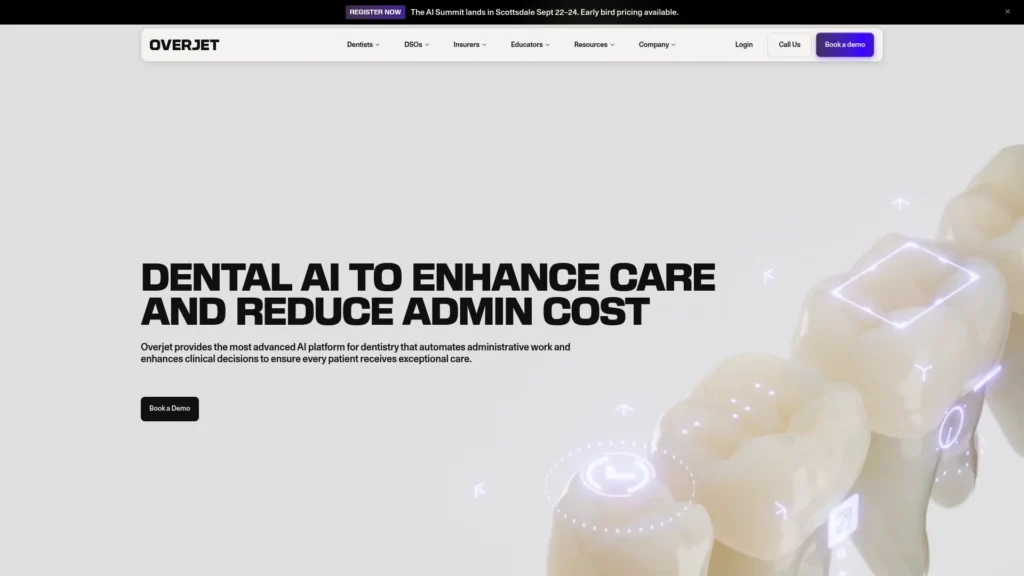
Overjet has built one of the deepest FDA clearance portfolios in dental AI—11 separate 510(k) clearances as of 2026 —covering caries detection, periodontal bone-level measurement, calculus identification, periapical radiolucency assessment, real-time image quality checking, and AI-based image enhancement across more than 40 sensor models. Its IRIS system is built to sit at the front of the imaging workflow: capture the X-ray, get an AI read, and review findings with the patient in the same visit, with quality-check flags (like cone cuts or missed coverage) surfaced before the patient leaves the chair. Overjet also acquired DentalBee, a voice-enabled clinical documentation platform, in December 2025, extending its reach into charting and notes.
Important AI capabilities: caries and calculus detection, periodontal bone-level measurement, periapical radiolucency detection, image quality checking, and image enhancement — all FDA-cleared functions. Strengths: the broadest FDA clearance portfolio of any tool on this list, with strong traction among large DSOs. Limitations: Overjet’s own documentation and charting capabilities are newer, built through the DentalBee acquisition, rather than a mature, long-standing feature — worth confirming directly if that’s a priority alongside imaging. Pricing: not publicly listed; Overjet is positioned toward DSOs and larger practice groups, and you’ll need to contact the vendor for pricing. Buyer takeaway: choose Overjet if your priority is broad, enterprise-grade diagnostic imaging; compare it against other options if documentation maturity matters equally.
Pearl — AI Dental Imaging and Visual Diagnostic Support
Pearl‘s Second Opinion platform holds FDA clearance for both 2D radiograph analysis and, with Second Opinion 3D, CBCT analysis — making Pearl, by its own description, the only dental AI company currently cleared to read both 2D and 3D imaging. The system detects more than 100 conditions chairside and overlays findings directly on the image for patient conversations. Beyond diagnostics, Pearl’s Practice Intelligence layer looks across a patient base to flag untreated disease and recall opportunities, extending the tool’s use into scheduling and treatment-acceptance workflows rather than stopping at the read.
Important AI capabilities: FDA-cleared 2D pathology detection (caries, calculus, periapical radiolucency, restorations, and more) and FDA-cleared 3D/CBCT structure segmentation (dentition, sinus, nerve canal, airway, and related anatomy). Strengths: currently the only platform on this list cleared for both imaging types, which matters for practices that use both standard radiographs and CBCT regularly. Limitations: user reviews are mixed on accuracy consistency — some describe occasional false positives on interproximal decay, so treat AI findings as a starting point for clinical review rather than a final read. Pricing: third-party listings report a flat starting rate around $299/month; confirm current pricing directly with Pearl, since this figure comes from a third-party source rather than Pearl’s own published pricing page. Buyer takeaway: choose Pearl if you want one platform for both 2D and 3D imaging, but verify accuracy and consistency for your workflow.
Videa — AI Diagnostics and Clinical Dental Workflows
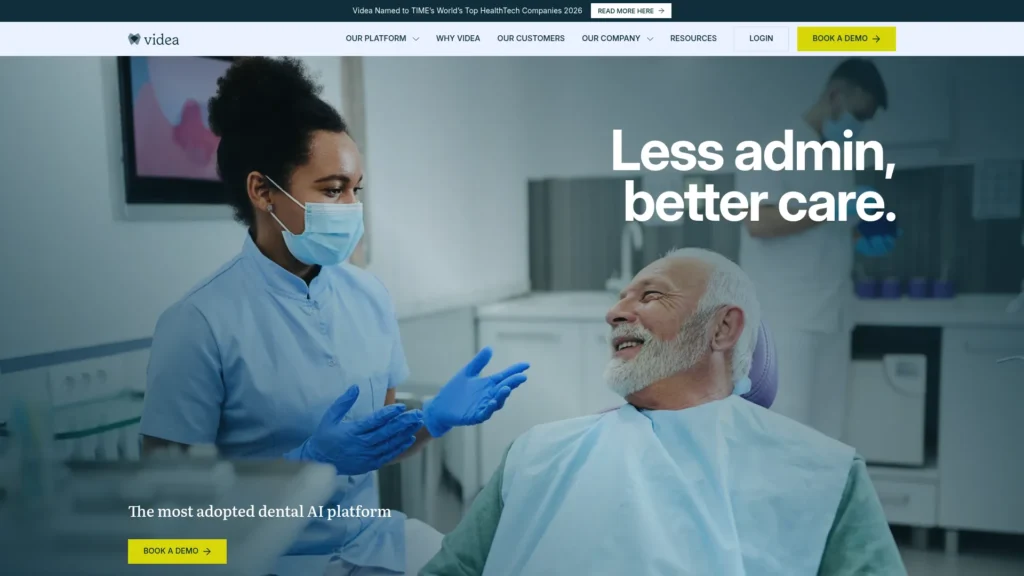
Videa (formerly branded VideaHealth) holds FDA clearance for Videa Dental Assist, which spans more than 30 AI algorithms and covers virtually every common dental disease category, including the first FDA-cleared pediatric dental radiology AI for diagnosing caries in patients as young as three. The company rebranded in 2026 and, for the first time, expanded availability from its original DSO-only footprint to independent private practices. Beyond imaging, Videa has added Voice Notes for clinical documentation and, more recently, Ambient Intelligence, which extracts practice-level insights from patient-provider conversations rather than just producing a note.
Important AI capabilities: broad FDA-cleared detection across caries, periapical radiolucencies, calculus, and pediatric-specific findings, plus voice-based clinical documentation and ambient conversational insights. Strengths: among the widest disease coverage of any FDA-cleared dental imaging AI, with substantial DSO adoption (used by clinicians across eight of North America’s ten largest DSOs) now extending to smaller practices. Limitations: as a recently rebranded, historically DSO-oriented platform, independent practices should confirm current onboarding, support, and pricing structure directly, since these may still be maturing for the smaller-practice segment. Pricing: not publicly listed — contact vendor. Buyer takeaway: choose Videa if broad imaging coverage and workflow automation matter most, but verify support fit for smaller practices. Choose it when broad coverage outweighs smaller-practice simplicity.
Denti.AI — AI Imaging, Charting, Clinical Notes and Practice Automation
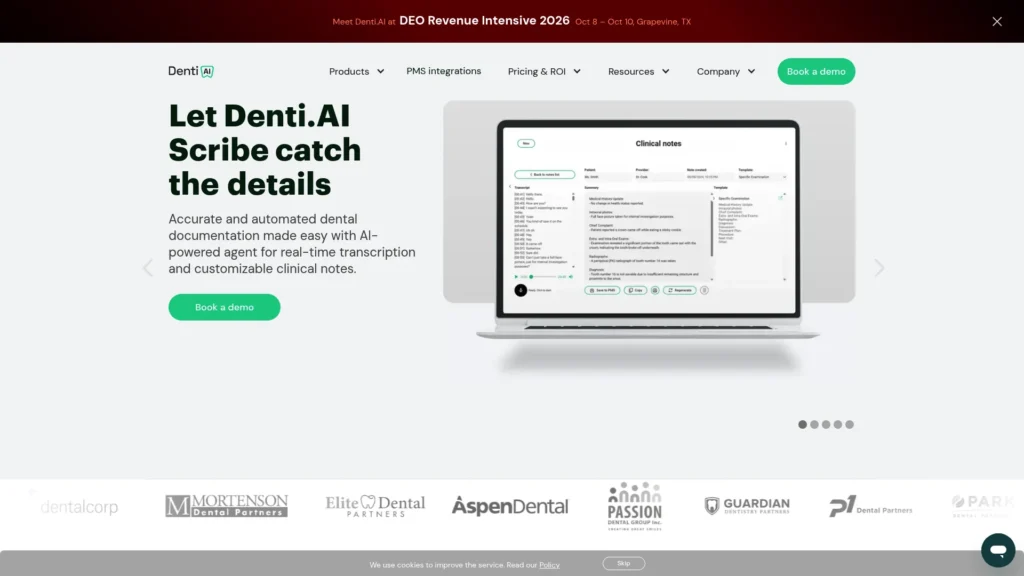
Denti.AI takes a platform approach rather than a single-purpose one: FDA-cleared imaging analysis (Denti.AI Detect, and Detect plus Auto-Chart for automated charting of crowns, fillings, implants, and missing teeth) sits alongside a voice-based clinical Scribe for notes and referral letters, voice-activated perio charting, and a 24/7 AI receptionist — all under one vendor. This breadth is the product’s central pitch: rather than assembling separate imaging, documentation, and front-desk AI tools from different companies, a practice can run all of it through Denti.AI.
Important AI capabilities: FDA-cleared caries, apical radiolucency, and bone-loss detection; automated charting; voice-based clinical note generation across 50-plus languages; voice-activated perio charting; and AI-assisted front-desk communication. Strengths: genuinely published, transparent pricing — unusual in this category — and the broadest single-vendor feature set on this list, which can reduce the number of vendors a practice has to manage. Limitations: a broad platform inevitably trades some depth for breadth in any single area — a practice specifically prioritizing the deepest possible CBCT analysis, for instance, may still want to compare Denti.AI’s imaging capability against a specialist like Diagnocat. Pricing: Denti.AI Detect is $49/month; Detect plus Auto-Chart is $99/month; multi-location DSO packages are custom-quoted. Compare them on feature breadth, pricing transparency, and imaging depth. Use it if consolidating tools matters more than maximum depth in one area.
Diagnocat — CBCT and 3D Dental Imaging Analysis
Diagnocat specializes specifically in CBCT visualization and analysis, and received FDA clearance for its Viewer software in October 2025, making it newly available to U.S. clinics after operating in more than 50 countries. The platform automatically segments teeth, pulp, and maxillofacial anatomical structures from CBCT scans, generates 3D models and STL files, and overlays within existing practice-management systems. It’s compatible with CBCT systems from major manufacturers including Sirona, Vatech, Planmeca, and Carestream.
Important AI capabilities: FDA-cleared 3D image processing and visualization, automatic anatomical segmentation, and detection across more than 30 conditions spanning 2D, panoramic, and CBCT imaging. Strengths: deep specialization specifically in 3D/CBCT workflows, useful for practices doing substantial implant, orthodontic, or oral surgery planning work where CBCT is central. Limitations: as a recently FDA-cleared entrant to the U.S. market (relative to Pearl’s and Overjet’s longer U.S. regulatory track record), practices may want to ask about U.S.-specific customer support and integration maturity during evaluation. Pricing: not publicly listed — contact vendor for a demo and quote. Buyer takeaway: choose Diagnocat if CBCT depth is your priority; compare support and integration carefully before adopting. Choose it when CBCT depth is the deciding factor.
Remote Orthodontic Monitoring
DentalMonitoring — AI-Powered Remote Orthodontic Monitoring
DentalMonitoring holds FDA De Novo approval — a distinct and generally more rigorous regulatory pathway than the 510(k) clearance most other tools on this list carry, used when the FDA creates a new device category rather than comparing against an existing one — for AI-based remote monitoring of orthodontic treatment. Patients use a smartphone with the company’s proprietary ScanBox attachment to submit intraoral scans between in-office visits; the software’s image-processing algorithms analyze treatment progress and flag issues for the orthodontist to review. The FDA’s clearance documentation is explicit that the software is intended as a diagnostic aid, not a stand-alone basis for clinical decision-making — the orthodontist remains responsible for interpreting findings and directing care. The platform is indicated for patients over age 6 and reports results only on permanent teeth. Compare it on regulatory pathway, monitoring workflow, and patient scope.
Important AI capabilities: FDA-cleared image analysis of patient-submitted intraoral scans, automated progress tracking, and patient notification workflows. Strengths: the largest, most established platform specifically for this use case, used by more than 8,000 registered dental professionals to support over 2 million patients globally, with a large historical image library informing its models. Limitations: it requires patient compliance with regular scan submission and the proprietary hardware attachment, and — per its own FDA clearance language — findings are an aid to, not a replacement for, the orthodontist’s clinical judgment. Pricing: DentalMonitoring introduced a cap-fee pricing structure with its DM End-to-End offering in 2026; exact current rates aren’t publicly listed and require contacting the vendor.
Patient Communication and Front-Desk Workflow
Weave AI — Patient Communication and AI-Assisted Front-Desk Workflows
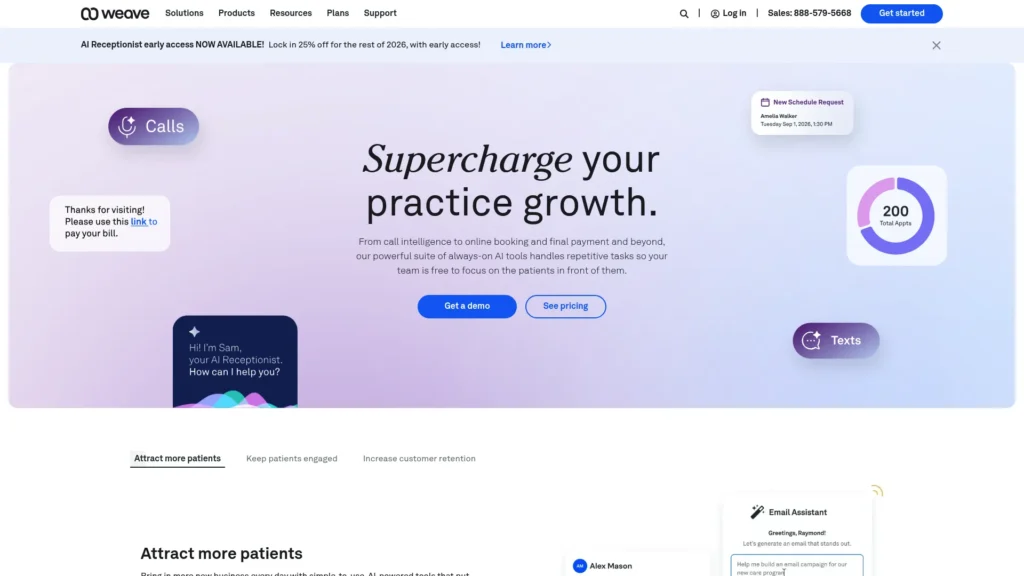
Weave AI replaces a practice’s phone system with a unified communication platform: two-way texting, automated appointment reminders, online scheduling, review requests, and text-to-pay, with an AI receptionist (built on technology from Weave’s 2025 acquisition of TrueLark) that can text a patient back automatically after a missed call — including outside business hours — to offer an available appointment slot. The platform is endorsed by ADA Member Advantage after the association’s own vetting process, and integrates with major dental practice-management systems to support scheduling and insurance-eligibility verification alongside communication.
Important AI capabilities: AI receptionist for missed-call follow-up and after-hours scheduling, unified voice and text patient communication, and automated reminder and review-request workflows. Strengths: ADA-endorsed, broad practice-management integration, and a genuinely comprehensive front-desk communication platform rather than a narrow point solution. Limitations: Weave replaces your phone system entirely, which means porting numbers and installing new hardware — a bigger operational change than adding a lighter-weight, add-on tool. Pricing: Essentials starts around $399/month for core phone, texting, and reminder features; Pro starts around $599/month with scheduling, payments, and additional automation; multi-location and enterprise pricing is custom.
Reputation and Patient Acquisition
Birdeye AI — Dental Reputation Management and Patient Acquisition
Birdeye monitors patient reviews across Google, Yelp, and other platforms from one dashboard. Its AI feature, BirdAI, drafts suggested responses to new reviews — both positive and critical — for a practice manager to review and personalize before posting, and also provides competitor benchmarking. The platform automates review-request campaigns after positive patient interactions, increasing overall review volume and helping dilute the impact of an occasional negative one.
In September 2026, Birdeye expanded well beyond reputation management with the general release of Myna, an AI front-office coworker built specifically for healthcare and dental practices. Myna answers patient calls around the clock, books and confirms appointments, runs recall campaigns, manages intake and waitlists, verifies insurance, and responds to patient questions across voice, text, chat, and email. Birdeye reports that Myna books meaningfully more appointments than an unanswered-call baseline, though that’s a vendor-reported figure from Birdeye’s own launch materials rather than an independently audited result. For a practice evaluating Birdeye specifically for reputation work, this front-office expansion is worth knowing about, since it puts Birdeye in more direct comparison with front-desk tools like Weave AI.
Important AI capabilities: AI-drafted review responses and competitor benchmarking (BirdAI), automated review-request campaigns, and — as of September 2026 — Myna, an AI coworker handling calls, scheduling, recalls, intake, and insurance verification. Strengths: centralizes reputation monitoring across multiple review platforms, speeds up response time meaningfully, and now extends into front-desk automation rather than staying limited to reputation alone. Limitations: Myna is a newly released product as of this writing, so practices evaluating it specifically should ask for current customer references and confirm feature maturity rather than assuming day-one parity with more established front-desk AI tools. Pricing: not publicly listed for either the reputation-management tiers or Myna — contact Birdeye directly for current pricing.
Documentation and Insurance Workflows
DentalWriter — Dental Documentation and Insurance-Related Workflows
DentalWriter, made by Nierman Practice Management, is cloud-based documentation software built specifically for dental practices that bill medical insurance for services like sleep apnea oral appliance therapy, TMJ/TMD treatment, and certain oral surgery procedures—a workflow standard dental practice-management software typically isn’t built to support. Practices use customizable questionnaires and exam forms to capture the clinical criteria medical insurers require, and the software auto-generates narrative SOAP-format reports, referral letters, and claim documentation from that structured input, along with dental-to-medical procedure code cross-referencing.
It’s worth noting directly: the publicly available information about DentalWriter describes it as intelligent, template-driven automation rather than confirming a specific generative AI or machine-learning model behind its report generation. If the modern-AI capability (versus structured automation) of a documentation tool specifically matters to your evaluation, that’s worth clarifying directly with the vendor.
Important capabilities: structured intake questionnaires that generate narrative reports, referral letters, and claim documentation for medically billable dental procedures, along with dental-to-medical coding support. Strengths: deep, long-standing specialization in a workflow (medical billing for dental sleep and TMJ services) that general dental software largely ignores. Limitations: it’s a narrow specialist tool for a specific billing niche, not a general clinical documentation or charting platform. Pricing: not publicly listed — contact vendor.
General-Purpose Assistance
ChatGPT — General Administrative, Brainstorming, Drafting and Non-Clinical Productivity
ChatGPT isn’t dental-specific software, but it’s genuinely useful for the writing and thinking tasks that surround running a practice: drafting staff communications, brainstorming a marketing campaign, writing job postings, or working through a non-clinical operational question. It has no dental-specific training, no FDA clearance, and no role in diagnosis or clinical documentation involving actual patient records.
A specific and important caution: practices should not enter identifiable patient information into a standard consumer ChatGPT account. OpenAI does offer HIPAA-eligible products and configurations — including options covered under a business associate agreement (BAA) — for regulated healthcare use, so handling protected health information with OpenAI’s technology isn’t categorically off the table. It does mean an ordinary consumer ChatGPT subscription is the wrong tool for that job: PHI needs a properly configured, eligible deployment with a signed BAA and the practice’s own data-handling policies in place, not the standard consumer product most people use for everyday tasks. Confirm current eligible products and configuration requirements directly with OpenAI before considering any workflow involving patient data.
Important capabilities: general drafting, brainstorming, research, and administrative writing support. Strengths: free tier available, broadly capable, and useful for the non-clinical workload every practice carries. Limitations: not built for dentistry, not a source of clinical or diagnostic support, and not appropriate for identifiable patient data unless deployed through an eligible, properly configured, BAA-covered product rather than a standard consumer account. Pricing: free tier available; $20/month for the Plus plan.
How to Choose AI Dental Software
Clinical vs. administrative need. Start by naming the actual problem: is it about catching more pathology on radiographs, reducing documentation time, filling the schedule, managing reviews, or something else? Clinical and administrative AI tools solve fundamentally different problems, so be precise about which one you’re evaluating before comparing vendors.
Practice size and specialty. A solo general practice, a multi-location DSO, and an orthodontic-only practice have different needs. DentalMonitoring is largely irrelevant outside orthodontics; Overjet, Videa, and Pearl lean toward larger practices and DSOs given their pricing and support models; Denti.AI’s published pricing may suit smaller practices better than vendors requiring a sales conversation for every quote.
Existing practice-management system. Imaging and documentation AI tools generally need to integrate with your current PMS and imaging software. Confirm compatibility before committing — an AI tool that doesn’t talk cleanly to your existing systems adds friction rather than removing it.
Imaging compatibility. For CBCT-specific tools like Diagnocat and Pearl’s 3D capability, confirm compatibility with your specific CBCT hardware manufacturer.
Workflow integration and staff training. Any new AI tool changes a workflow your team already has muscle memory for. Ask vendors directly about onboarding time and what training is provided — this varies significantly across the tools on this list.
Data privacy and security. Ask any dental AI vendor directly about their data handling, encryption, and compliance posture for protected patient information, and request documentation rather than taking a general claim at face value.
Regulatory status. FDA clearance matters specifically for software making or materially assisting a diagnostic or treatment decision — which is why Overjet, Pearl, Videa, Denti.AI’s imaging products, Diagnocat, and DentalMonitoring all carry it. It’s not a requirement for every category of dental software on this list: administrative, communication, reputation-management, and general-purpose tools like Weave AI, Birdeye AI, DentalWriter, and ChatGPT don’t require FDA clearance because they don’t make or directly assist clinical diagnostic decisions.
Pricing and ROI. Published pricing is inconsistent across this category — some vendors list clear rates, others require a sales conversation for every quote. Ask for a specific quote based on your practice size before assuming a headline figure applies to you.
Vendor support. For clinical AI tools especially, ask what ongoing support looks like once the product is live, not just during the sales process.
What AI Dental Software Cannot Do
Every diagnostic tool on this list is explicitly designed and regulatorily positioned to assist a qualified dental professional’s judgment, not replace it. FDA clearance for a diagnostic AI tool means the software met a specific regulatory bar for safety and effectiveness on a defined task — it does not mean the tool makes independent diagnoses, and none of the vendors covered here claim that it does. A dentist remains responsible for interpreting findings, confirming them against clinical exam and patient history, and making the actual diagnosis and treatment decision.
The same caution applies to claims about accuracy, patient outcomes, and ROI more broadly: figures a vendor reports from its own clinical trials or customer base are useful data points, but they reflect that vendor’s own testing conditions and reported experience rather than independently guaranteed results for every practice. Evaluate vendor-reported statistics as directional evidence to weigh alongside your own trial or reference checks, not as a guarantee of what will happen in your specific practice.
Administrative and communication AI tools carry a different but equally real limitation: they automate tasks and surface information faster, but they don’t replace the judgment calls — how to handle a specific difficult patient conversation, whether a review response needs a manager’s personal touch, how to price a treatment plan — that still require a person.
Conclusion
There’s no single best AI dental software tool, because the category spans genuinely different problems. A practice choosing based purely on the broadest FDA clearance list might reasonably land on Overjet or Videa; one prioritizing a single platform across imaging, charting, and front-desk work might prefer Denti.AI; a CBCT-heavy specialty practice might look hardest at Diagnocat or Pearl’s 3D capability; and an orthodontic practice’s evaluation starts and largely ends with DentalMonitoring for the specific problem of remote monitoring.
Match the tool to the specific workflow problem you’re trying to solve, verify FDA clearance and pricing directly with the vendor rather than relying on secondhand figures, and treat every diagnostic AI output as a second set of eyes for a qualified dentist to review — not a replacement for one.
Keep Exploring