Ahsan Javaid
Last updated: September 2026
Not every real estate investor has the same problem. A wholesaler needs off-market leads. A buy-and-hold investor needs to know if the rent covers the mortgage. A short-term rental investor needs occupancy and ADR data for a specific zip code. A commercial investor needs ownership and entity data that residential tools don’t carry.
The best AI tools for real estate investors reflect that split. Rather than ranking nine tools as if they compete head-to-head, this guide groups them by the job they actually do — finding deals, analyzing them, valuing property, and handling the research and writing that surrounds every transaction — so you can match the tool to your workflow instead of buying software that solves a problem you don’t have.
Each tool below was checked for a genuine, current AI or machine-learning capability rather than being included on reputation alone — lead scoring, automated valuation models, generative assistants, and predictive seller-likelihood scores all count; a rebranded spreadsheet or static database does not. Pricing and plan details reflect what each vendor publishes as of this update. Still, subscription software changes its packaging often enough that it’s worth confirming current terms before you commit a budget line to any of them.
This guide focuses specifically on investors. If you’re looking for tools built around listings, showings, and client management instead, see AIToolister’s guide to the best AI tools for real estate agents.
Quick Comparison
| PropStream | Off-market deal finding | Wholesalers, buy-and-hold, flippers | Motivated-seller lists, comps, skip tracing | $99/mo | 7-day trial + 50 free leads |
| DealMachine | Driving for dollars | Wholesalers, local investors | Mobile lead capture, AI lead scoring | $99/user/mo | 7-day free trial |
| BatchLeads | High-volume lead generation | Wholesalers, high-volume investors | List stacking, AI-scored leads | $119/mo | 7-day trial, 100 free leads |
| Mashvisor | Rental property analysis | Buy-and-hold investors | Traditional and STR rental underwriting | $49.99/mo (Lite, annual) | No published free trial |
| AirDNA | Short-term rental data | STR investors | Revenue and occupancy forecasting, AI underwriting reports | $34/mo billed annually ($125/mo monthly) | Yes — free plan with limited Rentalizer |
| HouseCanary | Property valuation | Flippers, buy-and-hold | AVM, forecasting, AI assistant | $19/mo ($190/yr annual) | No free tier; low-cost entry plan |
| Reonomy | Commercial property intelligence | Commercial investors | Ownership data, entity resolution | From $400–500/mo | No free tier; free trial available |
| RentCast | Rental data and rent tracking | Landlords, buy-and-hold | Rent estimates, comps, rent alerts | Free / $12–19/mo Pro | Yes — free plan, up to 5 properties |
| ChatGPT | Research, writing, productivity | Every investor | Offer letters, market summaries, analysis | $20/mo (Plus) | Yes — free tier |
Pricing changes; verify current figures on each vendor’s site before budgeting.
Finding Off-Market Deals
PropStream
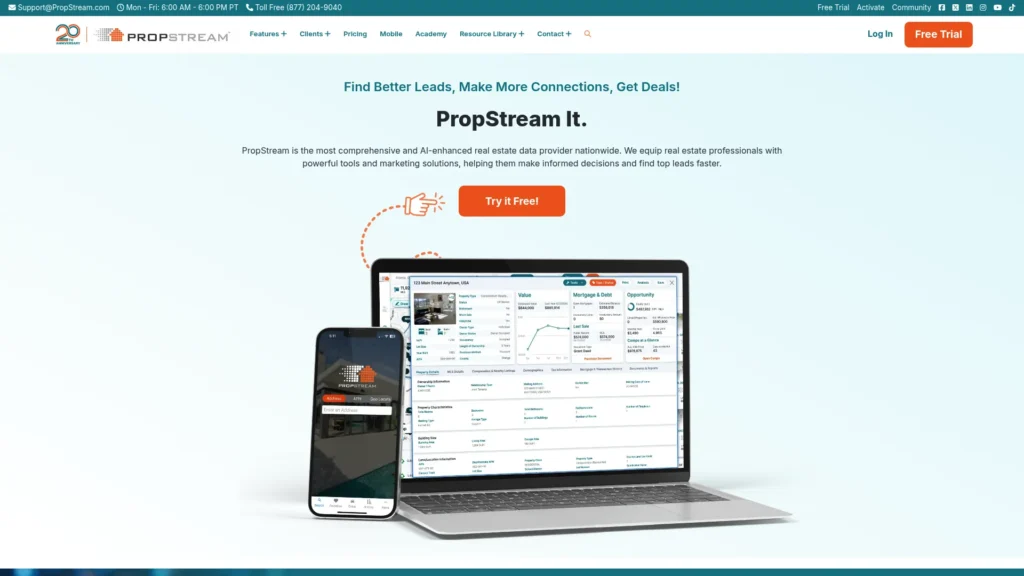
PropStream aggregates ownership records, mortgage data, tax delinquency filings, foreclosure notices, and other public records for more than 160 million U.S. properties, then lets you filter that data down to owners who are statistically more likely to sell. Investors most often use pre-foreclosure, absentee ownership, vacancy, and probate filters because they tend to surface sellers willing to negotiate.
The AI layer includes an AI Search feature that turns a plain-language request into a filtered property search, a PropStream Intelligence Assistant that answers questions about a specific property and estimates cash flow or ARV on request, and a Foreclosure Factor score that predicts foreclosure risk from the underlying data. There’s also an AI-driven property condition score built from photo analysis, useful for flagging deferred-maintenance properties before you drive out to see them. The platform also includes rehab, fix-and-flip, and rental ROI calculators in the same workflow, so you can run a lead from a motivated-seller filter through a basic profitability check without exporting to a separate spreadsheet.
Best for: wholesalers, buy-and-hold investors, and flippers sourcing off-market deals in any U.S. market. Starting price: $99/month (Essentials plan), with higher tiers adding team seats and included skip tracing. Free option: a 7-day trial with 50 free leads. Limitation: the platform is only as accurate as the public records behind it — verify ownership, liens, and tax status directly before making an offer, particularly in counties where records update slowly.
DealMachine
Driving for dollars — physically scouting neighborhoods for distressed properties — has always been effective and always been tedious to run consistently. DealMachine turns the process into a mobile workflow: photograph or scan a property, and the app pulls owner information, generates a mailing address, and adds it to your lead list in under a minute.
The AI assistant, named Alma, helps analyze captured properties and can draft outreach scripts. DealMachine also runs an AI-powered dialer with AI voicemail drops, so the same lead pipeline that starts with a photo can move into a calling campaign without switching tools. Pricing moved to a per-user, credit-based model in 2026: a Basic plan and a Pro plan, each priced per user with a monthly allotment of data credits for revealing and exporting contact records.
Best for: investors targeting specific neighborhoods who want local scouting paired with organized outreach. Starting price: $99 per user/month (Basic), $149 per user/month (Pro) for additional data credits and features. Free option: 7-day free trial. Limitation: the per-credit model means heavy skip tracing or exporting can add cost beyond the base subscription — model your expected usage before committing to a plan.
BatchLeads
BatchLeads takes a data-first approach: rather than finding properties one at a time, it’s built for investors who want to pull large lists, filter aggressively, and work through them systematically. It covers a similar property database to PropStream (roughly 150+ million records) with 140-plus filters for motivated-seller criteria.
The AI feature to know is BatchRank, which scores leads by combining multiple motivated-seller signals — a property that’s both tax-delinquent and pre-foreclosure ranks above one that only meets a single criterion. Skip tracing is bundled into the subscription rather than charged separately at the entry tier, which matters for investors running volume outreach.
Best for: wholesalers and investors running high-volume, systematic lead generation rather than one-off property searches. Starting price: $119/month (Growth plan, limited AI access); full AI features require the Professional tier at a higher price point. Free option: 7-day free trial with 100 free leads. Limitation: SMS marketing isn’t native — most workflows pair BatchLeads with a separate texting tool.
Analyzing Rental and Short-Term Rental Deals
Mashvisor
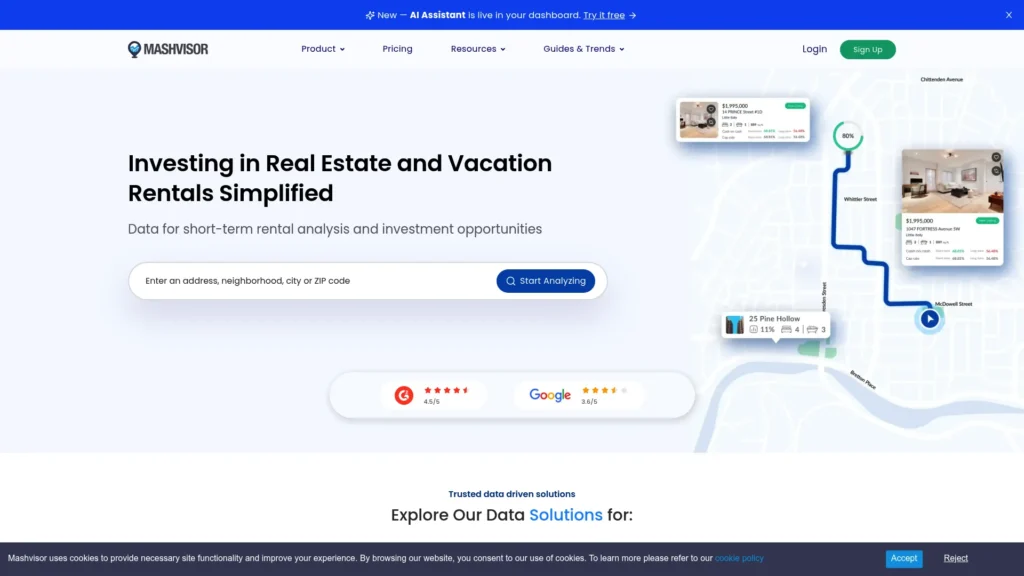
Mashvisor answers a specific question fast: does this property make sense as a rental? Enter an address and purchase price, and it pulls comparable rental data — both traditional long-term rentals and Airbnb/VRBO short-term data — to produce projected rental income, cap rate, and cash-on-cash return.
The Property Finder tool uses filters and machine learning to surface investment candidates that match your budget and strategy across an entire market, rather than requiring you to evaluate one address at a time. Neighborhood-level scoring lets you compare a specific property against the market average, so you can see whether a deal is strong in isolation or strong relative to everything else available in that zip code.
Best for: buy-and-hold investors deciding between a traditional or short-term rental strategy on a single-family or small multifamily property. Starting price: $49.99/month for Lite, $74.99/month for Standard, and $99.99/month for Professional, all billed annually (quarterly billing runs higher). Free option: none published — Mashvisor’s pricing page doesn’t list a free trial or free tier. Limitation: data depth varies by market — thin-inventory areas produce less reliable comps than high-transaction-volume metros.
AirDNA
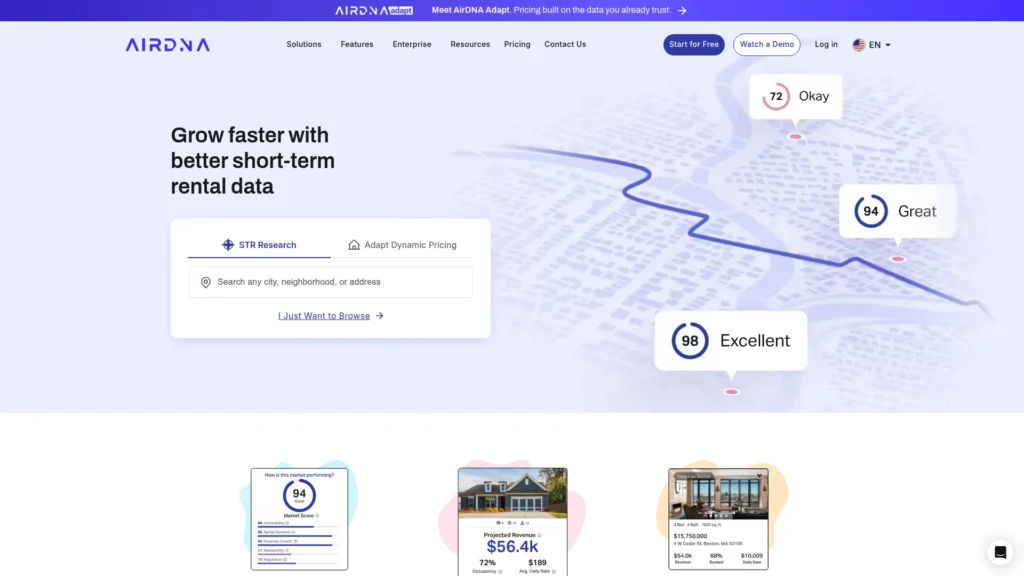
AirDNA is the deeper option specifically for short-term rental analysis. Its MarketMinder dashboard tracks average daily rate, occupancy, and revenue trends across more than 120,000 markets worldwide, and its Rentalizer tool projects annual STR revenue for a specific address using nearby comparable listings — the calculation most investors reach for before making an offer on a potential Airbnb.
The Match Score feature rates a property’s STR investment potential against local market benchmarks, and its Market Research plan includes AI-powered Rentalizer Agent reports — automated underwriting summaries for a specific property, built for faster deal screening than manually reading a market dashboard.
Best for: investors specifically evaluating or operating short-term rental properties. Starting price: $34/month billed annually ($400/year), or $125/month billed monthly, for the Market Research plan. Free option: yes — a free-forever plan with limited Rentalizer results and market insights. Limitation: individual listing performance can diverge from AirDNA’s modeled estimates, especially in markets with limited STR inventory.
Valuation and Market Intelligence
HouseCanary

HouseCanary’s core product is an automated valuation model built on machine learning trained across millions of transactions, producing property valuations, rental estimates, and market forecasts. For fix-and-flip investors specifically, a condition-adjusted valuation feature lets you input current property condition and get an adjusted value estimate rather than relying on comps alone.
CanaryAI, the platform’s generative AI assistant, is included even on the entry-level plan and answers property and market questions conversationally. HouseCanary also produces forward-looking price forecasts by market — useful when deciding between two target areas or timing a purchase — though these are modeled projections, not guarantees, and should be treated as one input among several.
Best for: flippers who need ARV estimates, and buy-and-hold investors evaluating unfamiliar markets. Starting price: $19/month for the Basic plan billed monthly, or $190/year if billed annually (about 17% cheaper); Pro runs $79/month or $790/year and adds more valuation reports and API access. Free option: none — but the Basic plan is inexpensive relative to the deal sizes it informs. Limitation: AVM accuracy varies by market — treat any automated valuation as a starting estimate, not a substitute for comps you’ve reviewed yourself.
Commercial Property Intelligence
Reonomy
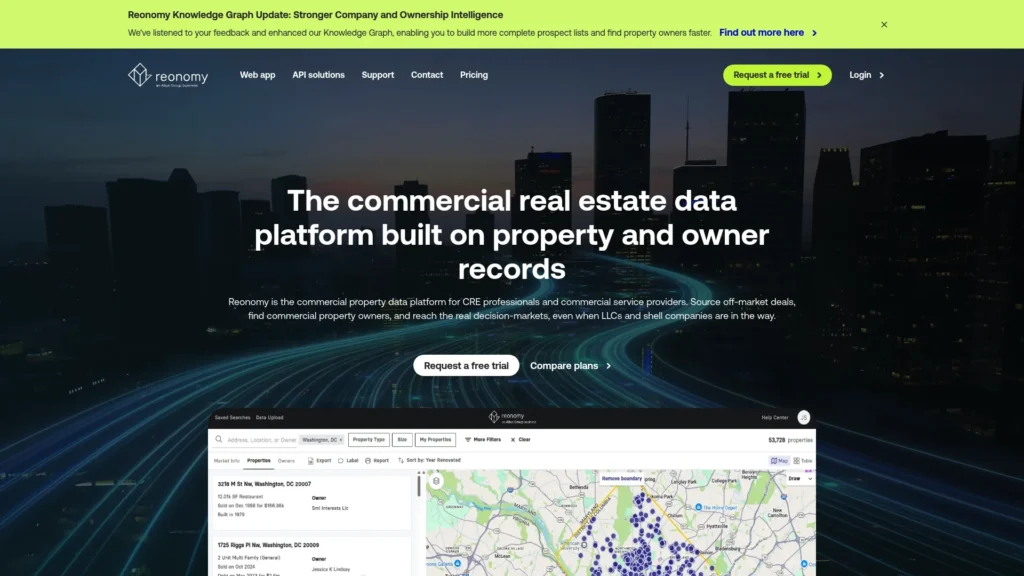
Commercial real estate runs on sparser, less standardized data than residential, and Reonomy is built specifically for that gap. It covers more than 55 million commercial properties with ownership records, transaction history, and — notably — LLC-piercing entity resolution that connects a property held under a corporate entity back to the actual owner.
The platform’s machine learning models generate a “likely to sell” score for property owners based on ownership tenure, transaction history, and other signals, which helps prioritize outreach among a large universe of commercial owners. As of mid-2026, Reonomy moved to self-serve pricing — previously it required a sales call and custom quote, but it can now be purchased directly online on monthly or annual terms.
Best for: commercial investors in office, retail, industrial, or larger multifamily assets. Starting price: from roughly $500/month on a monthly plan, or around $400/month billed annually. Free option: no free tier, though a free trial is available. Limitation: at this price point, the subscription is hard to justify for investors doing only one or two commercial deals a year — it earns its cost through active, repeated sourcing.
Rental Data and Portfolio Tracking
RentCast
RentCast’s core function is a rent estimate built as an automated valuation model — enter an address, and it returns a projected market rent based on comparable active and historical listings, with an attached confidence score. That single number often determines whether a rental deal actually works.
Beyond the rent estimate, RentCast lets you save properties to a portfolio and set up rent alerts that flag when market rents in your area have moved meaningfully since you last checked — useful for landlords deciding whether it’s time to raise rent on an existing unit. The free plan covers up to five properties; the Pro plan raises that limit substantially and adds more comps per lookup and branded PDF reports.
Best for: buy-and-hold investors and landlords who want rent data and light portfolio tracking without committing to a paid subscription upfront. Starting price: free for basic use; Pro plans run from roughly $12–19/month depending on annual or monthly billing. Free option: yes — a genuinely usable free plan, not just a trial. Limitation: RentCast is built for long-term rental data; it offers little for short-term rental investors, who should look to AirDNA or Mashvisor instead.
Research, Writing, and Productivity
ChatGPT
The least obvious tool on this list is also one of the most used, once investors start relying on it. Real estate investing generates a steady stream of writing and thinking tasks that aren’t directly about property data but still eat up real time: offer letters, seller outreach messages, market summaries pulled together from public information, tenant communication, and documentation for lenders or partners.
ChatGPT doesn’t know the specific property you’re analyzing unless you give it that context — it has no independent access to comps, ownership records, or rental data. What it does well is take the context and numbers you provide and turn them into organized analysis, first drafts, or a structured way to pressure-test your assumptions before you commit to a deal.
Best for: every real estate investor, for the research and writing tasks that surround — but aren’t — the core data analysis. Starting price: $20/month for the Plus plan. Free option: yes, a free tier handles most of this writing and thinking work adequately. Limitation: treat it as a thinking and drafting partner, not a data source — pair it with a purpose-built tool like Mashvisor, PropStream, or RentCast for anything that needs current, verified numbers.
Choosing AI Tools by Investment Strategy
Wholesalers and off-market investors: PropStream or DealMachine for finding motivated sellers; BatchLeads if you’re running volume outreach across hundreds of leads a month rather than dozens. ChatGPT covers the outreach writing across all three.
Fix-and-flip investors: speed and accuracy on the numbers matter most, since renovation costs and ARV carry real uncertainty. PropStream or DealMachine for sourcing distressed properties, HouseCanary for a condition-adjusted valuation and ARV estimate, ChatGPT for contractor and buyer communication.
Buy-and-hold investors: PropStream for off-market sourcing, Mashvisor for underwriting the rental numbers before you make an offer, RentCast for ongoing rent tracking once you own the property. This combination covers deal-finding through to portfolio monitoring.
Short-term rental investors: AirDNA for market-level occupancy and revenue data, Mashvisor if you want to compare a specific property’s traditional-rental and STR potential side by side before deciding on a strategy.
Commercial investors: Reonomy for ownership and entity data that residential tools don’t carry, paired with whichever general research tool — ChatGPT included — you already use for market summaries and lender documentation.
Investors managing a growing portfolio across several of these categories generally end up running two or three tools rather than one, matched to where the actual bottleneck sits: deal flow, underwriting speed, or portfolio oversight.
Investors just getting started: it’s reasonable to delay the data subscriptions until you’ve closed a first deal and can see where your own process breaks down. RentCast’s free plan and ChatGPT’s free tier cover a meaningful amount of research and analysis at no cost while you’re still learning what a good deal looks like in your target market. Add a paid tool once you know specifically what’s slowing you down — sourcing, underwriting, or outreach.
The Honest Limits of AI in Real Estate Investing
Every tool on this list works with data, and data has boundaries worth naming plainly.
AI doesn’t know your specific market the way a local agent, contractor, or property manager does. A comp tells you what similar properties sold for — not whether the block has a noise or flood issue that affects future value. Treat AI-generated numbers as a starting point for due diligence, not a conclusion.
Output quality depends entirely on input quality. A motivated-seller list is only as good as the public records behind it. A rent estimate is only as reliable as the comparable listings it’s drawn from. When a number looks off, it usually is — verify before acting on it.
No tool replaces seeing the property. Satellite imagery doesn’t show highway noise. A “likely to sell” score doesn’t know a seller is mid-probate with legal complications that will delay closing by months. AI tools tell you where to look. They don’t replace looking.
Automated valuations carry a real error margin. Every AVM on this list — PropStream’s, HouseCanary’s, RentCast’s — is a statistical estimate built from comparable sales or listings, not an appraisal. Accuracy tends to be reasonable in markets with high transaction volume and standard property types, and considerably less reliable in thin markets or on properties with unusual characteristics. Treat any single AVM figure as a range, not a precise number.
Used this way — as inputs to a decision you’re still making yourself — these tools give individual investors access to data and analysis that used to require an institutional budget. Used as a replacement for judgment, they’ll produce confident-sounding numbers that are occasionally very wrong.
Frequently Asked Questions
What is the best AI tool for real estate investors? There isn’t one best AI tool for every real estate investor. PropStream is built primarily for off-market sourcing and property intelligence; Mashvisor focuses on rental investment analysis; AirDNA specializes in short-term rentals; HouseCanary focuses on valuation and property analytics; and Reonomy serves commercial real estate investors. The right starting point depends on which part of your process — sourcing, underwriting, or portfolio tracking — needs the most help.
Can AI actually find off-market properties? AI tools like PropStream, DealMachine, and BatchLeads identify property owners statistically more likely to sell — based on tax delinquency, foreclosure filings, vacancy, and similar signals — but they surface leads, not closed deals. Converting a lead into a transaction still requires outreach, negotiation, and a workable offer.
Can AI accurately analyze a real estate investment? AI-driven analysis tools like Mashvisor, HouseCanary, and RentCast produce rental income projections, valuations, and return calculations based on comparable data and modeling. They’re a meaningfully faster and often more consistent starting point than manual spreadsheet analysis, but automated valuations carry real uncertainty — validate any AI-generated number against comps you’ve reviewed yourself before making an offer.
What AI tools help rental-property investors specifically? Mashvisor for underwriting a deal before you buy, RentCast for ongoing rent estimates and portfolio tracking after you own the property, and AirDNA if the strategy includes short-term rentals.
Are there free AI tools for real estate investors? RentCast’s free plan covers rent estimates and light portfolio tracking for up to five properties. ChatGPT’s free tier handles most investor writing and research tasks. Several deal-finding platforms — including PropStream, DealMachine, and BatchLeads — offer free trials rather than permanent free tiers.
Can ChatGPT analyze a real estate deal on its own? Not independently — it has no built-in access to property records, comps, or rental data. Give it the numbers, and it can help model scenarios, draft offer letters, and pressure-test assumptions. For the underlying data, purpose-built tools like Mashvisor or HouseCanary remain necessary.
Conclusion
Every real estate investment decision comes down to the same question: do the numbers justify the risk? AI tools don’t answer that question. They make sure you’re asking it with better information than you’d have otherwise.
The right combination depends on where your process actually breaks down. If deal flow is the bottleneck, start with PropStream or DealMachine. If you can find deals but aren’t sure the numbers work, Mashvisor, AirDNA, or HouseCanary close that gap. If you already own property and want to track its performance, RentCast handles that with a genuinely usable free tier. And regardless of strategy, ChatGPT can also fill the research and writing role that surrounds many deals.
Match the tool to the bottleneck, verify the numbers it gives you, and keep the judgment — local knowledge, contractor relationships, reading a seller’s situation — that no AI tool on this list is built to replace.
For more independent AI tool reviews across real estate, business, and professional categories, visit aitoolister.com.
Keep Exploring