Ahsan Javaid

Last updated: September 2026
The best AI marketing tools in 2026 fall into a handful of jobs: running a full marketing and CRM platform (HubSpot), producing on-brand content (Jasper), doing SEO research, optimization, and AI-search visibility (Semrush, Surfer SEO), driving email and SMS revenue (Klaviyo), managing social (Sprout Social), creating personalized customer-facing sales and ABM assets (Mutiny), scaling paid social (Smartly.io), optimizing copy for large communication programs (Persado), and handling everyday writing and research (ChatGPT). No single tool wins across all of them, so this guide organizes the ten picks by marketing function and explains who each one fits, what it costs, and where it falls short.
If you read one section, read “How to Choose an AI Marketing Tool” below. The right pick depends more on channel mix, team size, existing software, and data volume than on the longest feature list.
Quick Comparison
| HubSpot AI | All-in-one marketing and CRM | Breeze Assistant and agents for content, prospecting, and customer support | Free tools available | Marketing Hub Starter base price $20/month; Professional roughly $800–$890/month, plus onboarding |
| Jasper AI | On-brand content at volume | Brand Voice, campaign generation, SEO mode | 7-day trial; no free plan | Pro $59/seat/month billed annually ($69 monthly); Business custom |
| Semrush AI | SEO and competitive research | Copilot recommendations, AI Visibility Toolkit | Limited free account; 7-day trial | Pro $139.95/month; Semrush One bundles from $199/month |
| Klaviyo AI | Email and SMS for e-commerce | Predictive lifetime value, churn risk, next order date | Free up to 250 active profiles | Email plan from about $20/month, scaling with profiles |
| Sprout Social AI | Social publishing, inbox, and analytics | AI Assist for post and reply drafting, sentiment analysis | 30-day trial | Standard $199/seat/month billed annually |
| Mutiny | GTM agent for customer-facing assets and workflows | AI agent that creates personalized ABM campaigns, business cases, deal rooms, and decks | Free plan listed | Free; Business $50/month; Enterprise from about $40,000/year (verify current pricing) |
| Smartly.io | Paid social at enterprise scale | Creative automation and budget optimization | None; sales-led | Custom pricing; contact sales |
| Persado | Agentic content production for regulated brands | Generates, optimizes, performance-scores, and governs marketing content with brand and regulatory guardrails | None published | Enterprise pricing; contact vendor |
| Surfer SEO | AI visibility and search content optimization | AI visibility tracking, Content Editor, AI-assisted content creation | No free plan; 7-day money-back guarantee | Discovery $49/month; Standard $99/month; higher tiers available |
| ChatGPT | Flexible everyday marketing work | General-purpose writing, research, and analysis | Yes — functional free plan | Plus $20/month |
Pricing changes often in this category; several vendors sell only through sales, and some now bill by seats, profiles, or usage credits. Confirm current terms on each vendor’s site before budgeting.
Where AI Fits in Digital Marketing
AI tools for digital marketing are strongest where work is repetitive, high-volume, or data-heavy. Compare them below by function.
- Content: Jasper for brand-consistent drafting; ChatGPT for briefs, variations, and summaries.
- SEO and AI-search visibility: Semrush for keyword and competitor research; Surfer SEO for optimizing content and tracking brand visibility in AI answers.
- Email and SMS: Klaviyo for behavior-based segmentation and predictions.
- CRM and automation: HubSpot for connecting marketing, sales, and service data.
- Social media: Sprout Social for publishing, inbox management, and reporting.
- Advertising: Smartly.io for creative testing and budget allocation across paid social channels.
- Personalization and GTM content: Mutiny for creating personalized, customer-facing assets such as ABM campaigns, business cases, and deal rooms; Persado for generating, optimizing, and governing on-brand content in regulated industries.
- Analytics: Built into most of the above (Semrush Copilot, HubSpot reporting, Klaviyo predictive analytics), but only as good as the data behind them.
How to Choose an AI Marketing Tool
Start from the constraint, not the tool. Six questions narrow the list quickly:
- Which channel drives your revenue? Compare tools by main channel: organic search points to Semrush and Surfer. E-commerce email points to Klaviyo. B2B pipeline and account-based work point to HubSpot, and possibly Mutiny. Large paid social budgets point to Smartly.io.
- How big is the team? Compare tools by team size: solo marketers and teams of two or three get the most from ChatGPT plus one specialist tool; per-seat tools like Sprout Social and Jasper’s higher tiers get expensive as headcount grows.
- What does your existing stack look like? Compare tools by fit with current systems: HubSpot is most valuable when it replaces disconnected tools; Klaviyo is strongest alongside a Shopify or similar e-commerce store; Klaviyo and Mutiny both work best when data and context flow in from your other systems.
- What is your budget, including scaling costs? Compare tools by how their pricing grows: several entry prices climb quickly, with Klaviyo billed by active profiles, HubSpot by seats and marketing contacts, and Sprout Social by seat.
- What integrations do you need? Check native connections to your CRM, e-commerce platform, ad accounts, and CMS before committing. Surfer’s Jasper integration and Klaviyo’s e-commerce integrations show how integrations shape each tool’s value.
- Do you have enough data? Compare tools by the data they need: predictive and personalization features, such as Klaviyo’s predictions, need meaningful customer history to be useful, and Mutiny’s output depends on the CRM, call, and brand context you give it.
The 10 Best AI Marketing Tools in 2026
1. HubSpot AI — Best for All-in-One Marketing and CRM
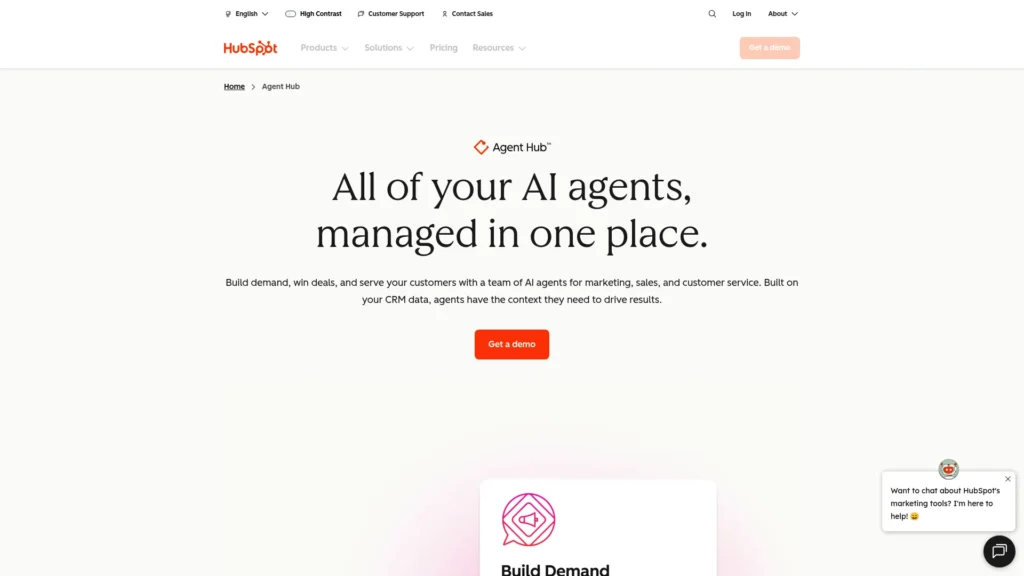
HubSpot combines a CRM with marketing, sales, service, and content tools, so its AI works from one shared set of customer records rather than several disconnected exports. Its AI layer, Breeze, includes an assistant that helps draft content and summarize CRM records, plus AI agents for tasks such as customer support, prospecting, and content creation.
Best marketing uses: drafting emails, landing pages, and social posts; scoring and segmenting contacts; connecting campaign activity to pipeline and revenue reporting. Best for: teams that want one platform for marketing and CRM, especially B2B teams that need to tie campaigns to revenue.
Strengths: the free tools give small teams a real starting point, and consolidating CRM, email, and reporting reduces data reconciliation between tools. Limitations: the more capable AI features sit on Professional and Enterprise tiers and consume monthly AI credits, so the entry tiers offer a lighter version of “HubSpot AI” than the name suggests. Costs also rise with seats and marketing contacts, and Professional tiers have required an onboarding fee.
Pricing: free tools are available. Marketing Hub Starter has a base price of $20 per month, though promotional or new-customer discounts may reduce it. Marketing Hub Professional is approximately $890 per month on monthly pricing or $800 per month with annual billing, with onboarding as an additional cost, and Enterprise is priced considerably higher. Pricing, seats, contacts, and promotions can change, so confirm current terms on HubSpot’s pricing page.
2. Jasper AI — Best for On-Brand Content at Volume
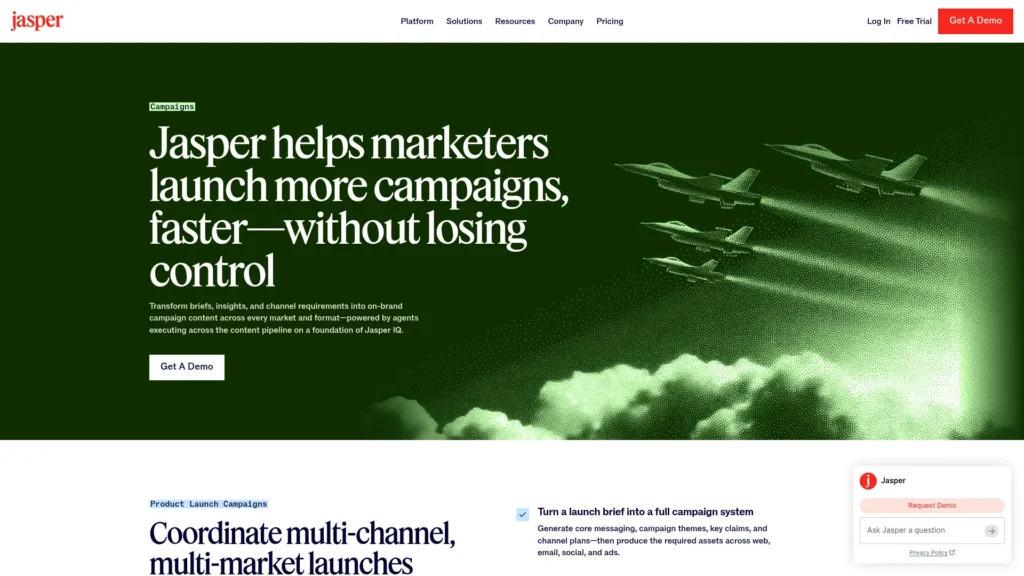
Jasper is a marketing-focused AI writing platform. Its central feature is Brand Voice: you provide examples and reference material, and Jasper applies that voice, plus knowledge about your products and audiences, across drafts, emails, ads, and campaign assets. The platform also offers a collaborative Canvas for campaign planning, a browser extension, and a template library, and it integrates with Surfer SEO for search-optimized long-form content.
Best marketing uses: producing consistent copy across several channels or brands, campaign asset generation from a single brief, and long-form content workflows that pair with an SEO tool. Best for: agencies and content teams that need consistent voice across many pieces of content.
Strengths: brand and knowledge settings reduce the generic-sounding output that general assistants often produce without careful prompting, and multi-brand support suits agency workflows. Limitations: it is a paid, per-seat product with no permanent free plan, and results depend on the quality of the brand voice and reference material you supply. For occasional or low-volume writing, a general assistant may be sufficient.
Pricing: a 7-day free trial is available. Jasper’s Pro plan is listed at $59 per seat per month billed annually ($69 monthly), and Business is custom-priced. Jasper has restructured its plans, and its older Creator tier still appears in some listings, so check the current plan list before comparing.
3. Semrush AI — Best for SEO and Competitive Research
Semrush is a large SEO and marketing research platform covering keyword research, site audits, competitor analysis, backlinks, advertising research, and content tools. Its AI features include Copilot, a dashboard assistant that analyzes your projects and surfaces recommendations such as keyword opportunities, traffic drops, and technical issues, and the AI Visibility Toolkit, which tracks how brands appear in AI-generated answers across platforms like Google AI Overviews and ChatGPT.
Best marketing uses: finding what competitors rank for, planning content around keyword gaps, monitoring visibility changes, and tracking brand presence in AI search. Best for: SEO-led teams and agencies whose success metrics depend on organic search.
Strengths: broad research coverage across SEO, paid search, and content in one platform, and Copilot reduces manual dashboard checking. Limitations: it is one of the pricier tools here, the interface has a learning curve, and full value requires regular use. Smaller teams may not need its breadth.
Pricing: a limited free account and a 7-day trial are available. The classic SEO Toolkit lists Pro at $139.95 per month ($117.33 billed annually), with Guru and Business above it. Semrush has also introduced Semrush One bundles, which add AI Visibility features and start at $199 per month, and its plan lineup has been shifting, so confirm which plans are currently sold.
4. Klaviyo AI — Best for E-Commerce Email and SMS
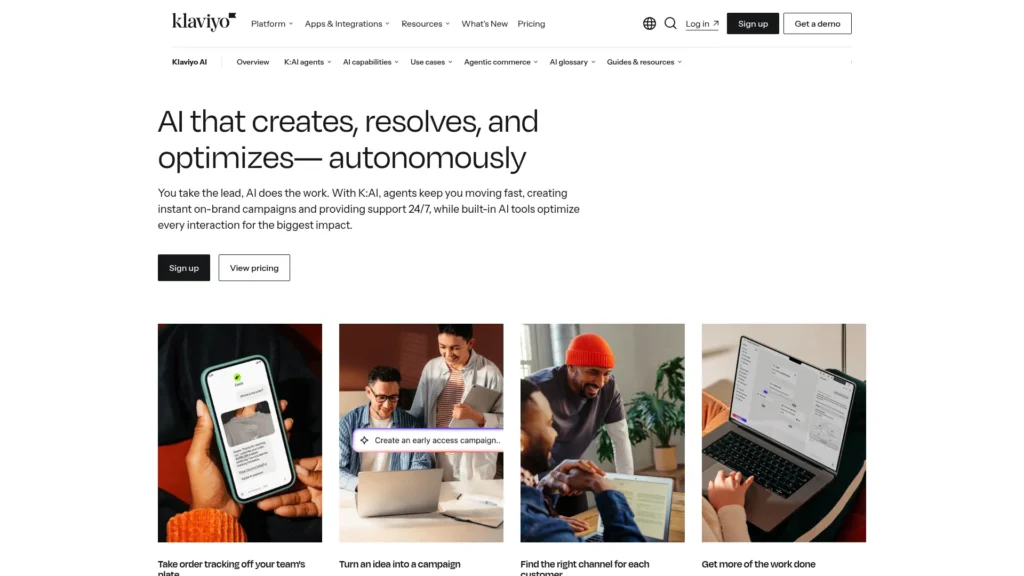
Klaviyo is an email and SMS platform built around customer behavior and purchase data. Its AI features include predictive analytics, such as predicted customer lifetime value, churn risk, and expected next order date, along with AI-assisted segments and content generation. These predictions inform segmentation and timing for flows like abandoned cart, win-back, and post-purchase messages.
Best marketing uses: behavior-triggered flows, segmenting by predicted value or churn risk, and combining email and SMS under one customer profile. Best for: e-commerce businesses with meaningful purchase history, particularly stores on Shopify and similar platforms where its integrations are strongest.
Strengths: the predictive features and behavioral automation are built directly into the product, and the free plan lets small stores start without a commitment. Limitations: pricing scales with active profiles (and since early 2025, dormant contactable profiles count toward the total), so costs can climb with list size. Predictive features depend on enough historical data, and the platform fits e-commerce better than B2B or service-business email programs.
Pricing: the free plan covers up to 250 active profiles with 500 email sends and $5 of mobile messages per month. The Email plan starts at about $20 per month and Email + SMS at about $35, both scaling with the number of active profiles and messaging requirements.
5. Sprout Social AI — Best for Social Publishing and Analytics
Sprout Social is a social media management platform combining publishing, a unified inbox, reporting, and (on higher tiers) sentiment and engagement tools. Its AI Assist features help with tasks like enhancing post drafts on Professional and above, with reply assistance and inbox sentiment on Advanced. Social listening and premium analytics are sold as separate add-ons.
Best marketing uses: managing publishing and engagement across many profiles, monitoring brand mentions, and reporting on social performance. Best for: mid-size and larger teams for whom social is a strategic channel and where workflow management matters more than basic scheduling.
Strengths: strong workflow and reporting for teams handling high social volume. Limitations: pricing is per seat, so team growth multiplies costs, and social listening is an add-on without a published price, so budget for a sales conversation if listening is your reason for buying. Simpler scheduling tools may be enough for small or low-volume social programs.
Pricing: a 30-day trial is available. Plans are Standard at $199 per seat per month, Professional at $299, and Advanced at $399 (billed annually), with Enterprise custom-priced.
6. Mutiny — Best for GTM Assets and Workflow Automation
Mutiny rebuilt its product as an agent-first GTM platform in April 2026, so older descriptions of it as a website-personalization tool no longer reflect the current product. Mutiny now positions itself as an AI agent that helps sales and marketing teams create customer-facing work without waiting on design, content, or ops support, and automates deal workflows.
Best marketing uses: personalized ABM campaigns, business cases, deal rooms, pitch decks, pricing proposals, meeting recaps, competitive comparisons, and other personalized customer-facing assets, along with GTM workflow automation such as follow-ups and meeting prep. Best for: B2B sales and marketing teams that need to produce account-specific content at a pace design and enablement teams can’t match.
Strengths: it targets customer-facing content and the routine work around it, rather than only data gathering or CRM updates, and it covers both marketing and sales use cases. Limitations: it is a B2B-focused product, the output depends on the CRM, call, and brand context you provide, and content that goes to buyers still needs human review. Because the product changed substantially in 2026, treat reviews and case studies from earlier years with caution.
Pricing: Mutiny’s published plans include a free tier, a Business plan listed at $50 per month, and Enterprise plans starting at around $40,000 per year, though directory listings have shown different figures and pricing can change. Verify current plans and per-user terms with Mutiny before budgeting.
7. Smartly.io — Best for Enterprise Paid Social
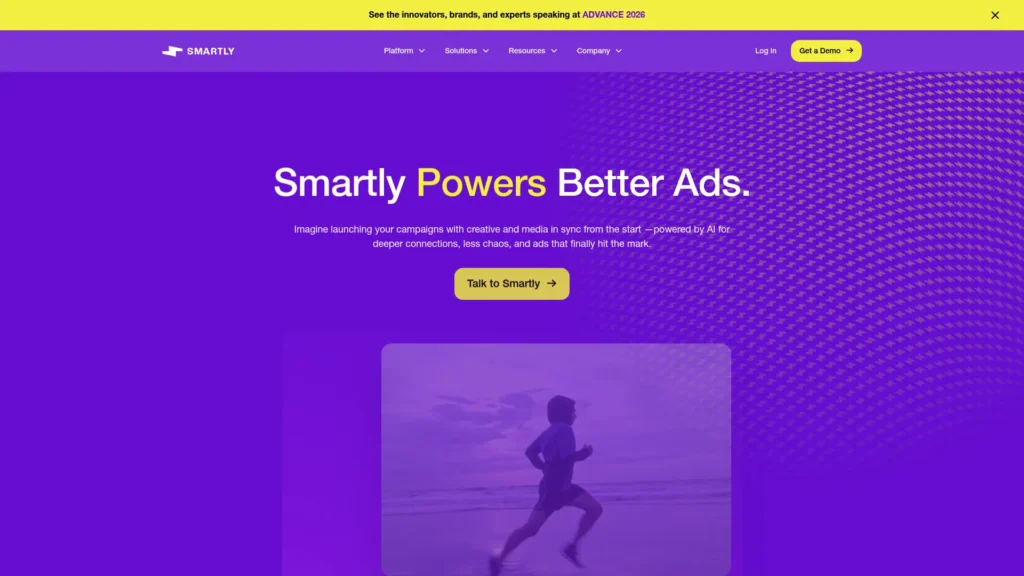
Smartly.io is an enterprise advertising platform built around three areas: creative production and automation, media management and budget optimization, and cross-campaign reporting. It supports paid campaigns across major social platforms and other channels and includes AI tools to generate and test creative variations and reallocate budgets based on performance.
Best marketing uses: high-volume creative testing, catalog and dynamic ads, and managing paid campaigns across several platforms from one interface. Best for: performance teams and agencies running large paid social budgets where manual campaign management has become the bottleneck.
Strengths: consolidates creative automation and media optimization in one system. Limitations: it is sales-led with no public price list or self-serve tier, reported pricing is tied to media spend with sizable minimums, and implementation takes time, so it suits large budgets rather than small advertisers.
Pricing: custom. Contact Smartly.io; publicly reported figures vary and should be treated as directional only.
8. Persado — Best for Regulated-Brand Content Production
Persado now positions itself around agentic creative and content production for regulated brands, particularly in industries such as financial services, insurance, and lending, where brand and compliance controls matter. According to the company, its platform generates, optimizes, performance-scores, and governs marketing content across channels while applying brand and regulatory guardrails. It grew out of a focus on message language and performance, and that heritage remains part of the offering, now within a broader content-production and governance workflow.
Best marketing uses: producing and optimizing on-brand content across channels such as email, web, SMS, and push, and paid ads; testing and scoring message variations, including subject lines, headlines, and short-form messages; and keeping large volumes of content within brand and regulatory requirements. Best for: enterprise marketing teams in regulated or compliance-sensitive industries that produce content at scale and need governance built into the workflow.
Strengths: pairs content generation and performance-oriented optimization with brand and compliance controls, rather than generating text without those guardrails. Limitations: it is an enterprise platform with sales-led buying and implementation, which makes it impractical for small teams, and its value depends on content volume and how well your brand and compliance rules are defined. Any performance results are vendor-reported and depend on your audience and testing setup.
Pricing: sales-led and order-form based, with no standard public self-service price. Contact the vendor for a quote.
9. Surfer SEO — Best for AI Visibility and Content Optimization
Surfer SEO has expanded beyond its traditional role as an SEO content-optimization tool and now positions itself as an AI Visibility Platform. It still covers established SEO and content work: it analyzes the pages ranking for a target keyword, its Content Editor scores drafts against that competitive analysis, and its AI features assist with content creation. Content auditing and topical mapping help plan and improve existing coverage. What is new is the emphasis on tracking how a brand appears in AI-generated answers alongside traditional search results. Surfer also integrates with tools such as Google Docs, WordPress, and Jasper.
Best marketing uses: briefing writers, optimizing drafts before publishing, auditing existing pages for gaps, planning topical coverage, and monitoring brand visibility in AI answers. Best for: content and SEO teams and agencies that publish regularly and want one workflow for search optimization and AI-search visibility.
Strengths: ties writing directly to what is currently ranking and adds AI-answer visibility tracking to the same workflow. Limitations: it does not replace a full SEO suite (it is not built for backlink analysis or deep technical audits), and its plan structure has changed several times, so older pricing pages may be out of date. Its value depends on using it consistently across content.
Pricing: no free plan; it offers a 7-day money-back guarantee. Published plans include Discovery at $49 per month and Standard at $99 per month, with higher tiers for larger requirements. Plans change, so verify live pricing, billing terms, and limits on Surfer’s pricing page.
10. ChatGPT — Best for Everyday Marketing Tasks
ChatGPT is a general-purpose assistant rather than a marketing platform, and it earns its place for the many small tasks that don’t justify a specialist tool: drafting creative briefs, generating headline and subject-line options, summarizing research, preparing reports and presentations, drafting email sequences, and researching how competitors position themselves.
Best for: solo marketers and small teams who need flexible assistance across many tasks, and larger teams that want a general tool alongside specialist platforms.
Strengths: no setup or integration required, and the free plan is usable for a wide range of daily work. Limitations: it has no built-in access to your ad platforms, analytics, or CRM data unless you provide that information; output quality depends heavily on the prompt and context you supply; and it doesn’t replace tools where platform data and automation matter. Always review and fact-check output before publishing.
Pricing: free plan available; Plus is $20 per month.
Best AI Marketing Tools for Small Business
Small businesses rarely need more than two or three tools, and the right ones depend on the primary channel. A practical starting pattern:
- Start with the free layer: ChatGPT’s free plan for drafting and research, HubSpot’s free tools for CRM and basic email, and Klaviyo’s free plan if you run an e-commerce store with a small list.
- Add one specialist for your main channel: Semrush or Surfer SEO if organic search drives growth, Klaviyo’s paid plan as an e-commerce list grows, or Jasper if content production is the bottleneck.
- Skip enterprise tools for now: Persado and Smartly.io generally assume large spend or communication volumes, and Sprout Social’s per-seat pricing is hard to justify for a low-volume social program. Mutiny is worth a look only if you sell B2B and produce account-specific sales or ABM content; its published free tier makes a low-risk trial possible.
As a rough illustration at current list prices, ChatGPT Plus ($20 per month) plus Semrush Pro ($139.95 per month, billed monthly) plus HubSpot’s free tools comes to about $160 per month, before any HubSpot upgrades.
Which Free AI Marketing Tools Are Worth Using
Not every “free” option is equal. Of the tools here:
- Genuinely usable free access: ChatGPT (free plan), HubSpot (free tools), and Klaviyo (free up to 250 active profiles).
- Limited free access: Semrush offers a restricted free account, useful for occasional checks rather than an active SEO program.
- Trial only: Jasper (7 days) and Sprout Social (30 days); Semrush also offers a 7-day trial.
- Free plan listed: Mutiny publishes a free tier, though its Business and Enterprise plans are paid.
- No free access published: Smartly.io, Persado, and Surfer SEO (which offers a 7-day money-back guarantee instead).
Sample Stacks by Situation
- Organic search is the main channel: Semrush for research, Surfer SEO for optimizing content, and Jasper or ChatGPT for drafting. Jasper and Surfer integrate, but only add Jasper if content volume justifies the cost.
- E-commerce email and retention drive revenue: Klaviyo, with ChatGPT for copy support. HubSpot is an alternative when you need CRM integration or don’t sell through a supported e-commerce platform.
- B2B pipeline: HubSpot for CRM and campaigns, Semrush or Surfer for content, and Mutiny if your sales and marketing teams need personalized, account-specific assets such as business cases and deal rooms.
- Paid social at scale: Smartly.io if budgets and creative volume justify it; otherwise native ad-platform tools plus ChatGPT for creative variations.
- Regulated or compliance-heavy marketing (such as financial services or insurance): Persado for governed content generation and optimization alongside your marketing automation platform.
- Solo marketer or very small team: ChatGPT, HubSpot’s free tools, and one specialist plan chosen for your main channel.
What AI Marketing Tools Cannot Fix?
AI improves execution speed and consistency. It does not fix weak positioning, an unclear value proposition, a product that doesn’t match what the market wants, or messaging aimed at the wrong audience. Content tools produce more content faster, but more content built on a broken strategy is still broken. Predictive and personalization tools amplify the quality of the data they receive, so an unqualified list or thin traffic data leads to weak results. The marketers who get the most from these tools define their audience, message, and success metrics first, then use AI for execution. Strategy and judgment stay human.
Frequently Asked Questions
What are the best free AI tools for marketing? ChatGPT’s free plan, HubSpot’s free tools, and Klaviyo’s free plan (up to 250 active profiles) are the most useful free options on this list, covering writing and research, CRM and basic email, and small e-commerce email programs, respectively. Semrush’s free account is limited to occasional use. Jasper and Sprout Social offer trials rather than free plans.
Which AI tool is best for marketing? It depends on the function. HubSpot suits teams that want marketing and CRM together, Semrush and Surfer SEO suit organic search, Klaviyo suits e-commerce email and SMS, Jasper suits high-volume on-brand content, and ChatGPT suits flexible everyday tasks. Choose based on your main channel and constraint rather than looking for one tool that covers everything.
What are the best AI marketing tools for small businesses? For most small businesses, ChatGPT plus HubSpot’s free tools are a low-cost starting point, with Klaviyo’s free plan added for small e-commerce stores. If search drives growth, add Semrush or Surfer SEO. Enterprise-oriented tools such as Persado, Smartly.io, and Sprout Social’s higher tiers usually assume larger budgets and volumes, while Mutiny is mainly relevant to B2B teams producing account-specific sales and ABM content.
How do I choose the right AI marketing tool? Start with your main revenue channel, then consider team size, existing software, budget as you scale, integrations, and data volume. Confirm current pricing and free-trial terms, and test on a real campaign before committing, since several tools here charge by seat, profile, or usage credits that grow with your business.
Which AI agent is best for marketing teams? No single agent is best; it depends on the job. Among the tools covered here, HubSpot offers Breeze agents for content, prospecting, and customer support on higher tiers, with usage credits; Jasper offers agents on its Business plan; and Mutiny positions itself as an AI agent for creating personalized customer-facing assets and automating GTM workflows. Evaluate agents on the tasks you need automated, how much human review they require, and how they connect to your data.
What can AI do for digital marketing? AI can draft and adapt content, surface SEO opportunities, segment audiences and predict customer behavior, personalize messages and web experiences, test creative and reallocate ad budget, monitor social conversations, and summarize performance data. It works best as an accelerator for defined tasks, with people setting strategy and reviewing output.
Conclusion
The right AI marketing tools address your specific constraint, whether that’s content volume, organic traffic, email revenue, social workload, customer-facing sales and ABM content, or ad management. Most teams need a flexible assistant like ChatGPT plus one or two specialist tools tied to the channels that drive the most value, not the full list. Enterprise tools like Persado and Smartly.io, and Mutiny’s higher tiers, make sense only when volume and budget justify them.
Start with one problem, run the tool on real work, and compare results against metrics you already track before adding anything else.
About the AIToolister Editorial Team
This article was researched and published by the AIToolister Editorial Team. Our reviews are based on vendor documentation, published pricing, product materials, and independent sources, and we compare tools by use case, features, pricing, ease of use, integrations, and fit for different teams. We do not claim hands-on testing of every product unless we say so explicitly, and we update articles as pricing and features change.
For more AI tool reviews and marketing technology comparisons, explore the full library at aitoolister.com.
Keep Exploring