
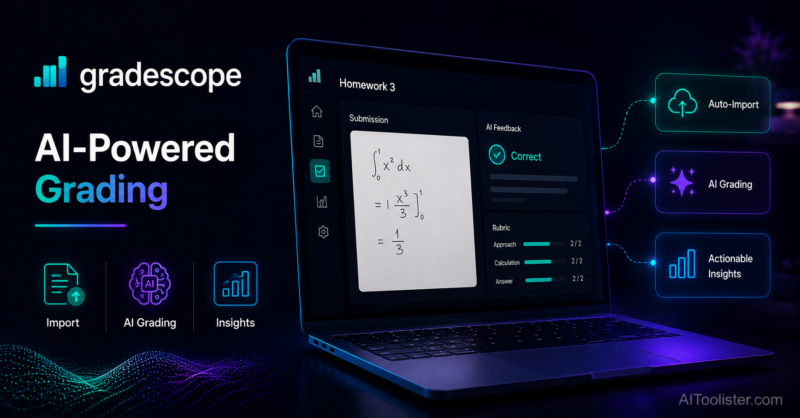
Grading a stack of two hundred handwritten problem sets one paper at a time is a fundamentally different task than grading twenty, and most grading tools weren't built with that scale in mind. Gradescope was designed specifically for large higher-education courses, using AI to group similar answers together so an instructor can grade an entire group of matching responses at once instead of repeating the same judgment call two hundred separate times.
What is Gradescope?
Gradescope is an online assessment platform, owned by Turnitin, that lets instructors administer, grade, and provide feedback on a wide variety of assignment types, including scanned handwritten exams, bubble sheets, problem sets, and programming assignments. Its core differentiator is AI-assisted grouping of similar student answers, letting instructors grade once per group of matching responses rather than individually reviewing every single submission, while the final grade decision remains with the instructor rather than being fully automated. Gradescope is used heavily in STEM higher education courses, particularly for structured, rubric-based grading at scale, and is sold through Turnitin at the department or campus level rather than to individual instructors directly.
Key features
AI-Assisted Answer Grouping
Automatically groups similar student answers together across a large set of submissions, letting instructors grade an entire group at once rather than repeating judgment calls submission by submission.
Scanned Exam and Handwritten Work Support
Grades handwritten exams, problem sets, and bubble sheets from scanned paper submissions, a capability many purely digital-native grading tools don't support.
Programming Assignment Grading
Supports grading coding assignments across multiple programming languages, relevant for computer science and technical courses.
Rubric-Based Grading Consistency
Applies consistent, rubric-based scoring across a large course and multiple graders or teaching assistants, reducing grading variability between different people scoring the same assignment.
Class-Wide Performance Analytics
Provides data on how the entire class performed on specific questions, helping instructors identify common misconceptions or gaps in understanding.
Broad LMS Integration
Connects with major learning management systems including Canvas, Blackboard, Brightspace, Moodle, and Sakai, syncing grades directly into a course's existing gradebook.
Pros
- AI-assisted answer grouping genuinely reduces grading time for large courses with many similar responses, a capability well suited to STEM and structured assessment formats
- Strong support for scanned, handwritten submissions fills a gap that purely digital-native grading tools often don't address
- Broad LMS integration across five major platforms means grades sync directly into an instructor's existing gradebook workflow
- The instructor retains final grading control, since Gradescope augments human judgment rather than fully automating grade assignment
Cons
- Pricing is not publicly listed anywhere and is typically negotiated at the department or campus level through Turnitin, rather than available to individual instructors
- Individual instructors, adjunct faculty, or smaller programs cannot purchase Gradescope independently, which can be a real barrier outside a full institutional agreement
- Best suited to structured, rubric-based grading rather than open-ended, nuanced creative writing feedback, which falls outside its core strength
- As an institutional product, rollout and account setup typically require departmental or IT involvement rather than a simple individual signup
Pricing
Gradescope does not publish public pricing anywhere; it is typically sold and negotiated at the department or campus level through Turnitin, which owns the platform. A free trial is available for evaluation, but ongoing access for real course use generally requires an institutional agreement rather than an individual instructor subscription. Because pricing is entirely institution-specific and negotiated through Turnitin's sales process, confirm current terms and whether your department already has an active Gradescope license before assuming standalone access is available.
Best for
Gradescope is best suited to higher education instructors and departments grading large volumes of structured assessments, particularly in STEM fields where problem sets, exams, and programming assignments make up the bulk of grading work. It fits AI Education workflows centered on grading at scale in a college or university setting rather than K-12 classrooms. Individual instructors, adjunct faculty, or tutors without an existing departmental license should verify institutional access is available before planning to rely on Gradescope, since it can't be purchased independently.
Use cases
- Grading a large stack of scanned handwritten exams or problem sets efficiently
- Grouping similar student answers together to grade once per group rather than individually
- Grading programming assignments consistently across multiple languages
- Maintaining consistent rubric-based scoring across a course with several teaching assistants
- Analyzing class-wide performance on specific exam questions to identify common misconceptions
Supported platforms
- Gradescope is a web-based platform accessible through any modern browser, integrating with major learning management systems including Canvas, Blackboard, Brightspace, Moodle, and Sakai for grade syncing.
Languages
- Gradescope's platform interface and grading tools are primarily in English, reflecting its core market of US and English-speaking higher education institutions.
Integrations
- Gradescope integrates with five major learning management systems, including Canvas, Blackboard, Brightspace, Moodle, and Sakai, letting grades sync directly into an instructor's existing gradebook without manual re-entry.
Things to consider
- Confirm whether your institution already has an active Gradescope license through Turnitin before assuming you can access the platform independently, since individual instructors generally cannot purchase it on their own. Given the platform's strength in structured, rubric-based grading, instructors needing feedback on open-ended, nuanced creative writing should evaluate whether Gradescope's grouping-based approach actually fits that specific assignment type. Departments considering adoption should budget time for the institutional procurement and negotiation process, since pricing isn't self-serve.
How the tool compares
Gradescope's closest comparison in the K-12 space would be a tool like MagicSchool AI's built-in grading feature, though the two serve very different educational levels and use cases, with Gradescope specifically built for higher education's structured, high-volume assessment formats. Against a general AI essay grading tool, Gradescope's differentiator is its strength in scanned, handwritten, and programming assignment grading rather than open-ended prose feedback, making it a better fit for STEM courses specifically. Higher education departments with high-volume, structured grading needs tend to find genuine efficiency gains from Gradescope; instructors needing nuanced feedback on open-ended writing assignments are typically better served by a different kind of tool.
AIToolister verdict
Quick Answers
- Is it free? No — Gradescope requires an institutional license through Turnitin, though a free trial for evaluation is available. - Is it worth it? Yes, for higher education departments with high-volume, structured grading needs, particularly in STEM. - Who should use it? University instructors, teaching assistants, and STEM departments grading exams and problem sets at scale. - Best alternative: A general AI essay grading tool for instructors whose primary need is open-ended writing feedback rather than structured assessment grading.
Gradescope's AI-assisted answer grouping genuinely changes the math on grading large courses, turning what would be hundreds of individual grading decisions into a much smaller number of group-level judgments while keeping the instructor in control of the final grade. Its institutional-only sales model through Turnitin is the main practical barrier, since individual instructors can't simply sign up on their own. For departments with high-volume, structured grading needs and an existing or negotiable institutional agreement, it remains a genuinely effective, well-established tool.
Decision Summary
- Department grading large volumes of structured exams or problem sets: Recommended - Individual instructor without an institutional license: Confirm departmental access before planning to use it - Primary need is open-ended creative writing feedback: Consider a different grading tool better suited to prose - STEM course with programming assignments to grade: Good fit given multi-language coding support
Frequently asked questions
- Can an individual instructor purchase Gradescope?
Generally no. Gradescope is typically sold and negotiated at the department or campus level through Turnitin, so individual instructors, adjunct faculty, or tutors usually need an existing institutional license to access it.
- How does Gradescope's AI-assisted grading work?
Gradescope's AI groups similar student answers together across a set of submissions, letting an instructor grade an entire group of matching responses at once, rather than reviewing every submission individually. The final grade decision remains with the instructor.
- Does Gradescope support handwritten exams?
Yes, Gradescope supports grading scanned handwritten exams, bubble sheets, and problem sets, a capability that fills a gap many purely digital-native grading tools don't address.
- How much does Gradescope cost?
Gradescope does not publish public pricing. It's typically negotiated at the department or campus level through Turnitin, and individual instructors should check whether their institution already has an active license before assuming standalone access.
- Is Gradescope good for grading programming assignments?
Yes, Gradescope supports grading coding assignments across multiple programming languages, making it relevant for computer science and other technical higher education courses alongside its exam and problem set grading capabilities.


