
 Ahsan Javaid
Best AI Tools for Recruiters in 2026: Hire Faster & Find Better Candidates
Last updated: June 2026 | 10 tools reviewed | Pricing verified
Introduction
Recruitment has always been a people business. But somewhere between posting a job and making an offer, recruiters spend the majority of their time doing things that have nothing to do with people at all — scanning resumes, sending the same follow-up email for the fifteenth time this week, chasing candidates to schedule interviews, and updating spreadsheets that nobody enjoys maintaining.
That is the problem AI was built to fix.
In 2026, the recruiting landscape looks very different from even two years ago. Companies that once needed a team of five sourcers to fill a pipeline now do it with two people and the right software. Agencies that spent three hours screening resumes for a single role now do it in twenty minutes. The gap between recruiters who use AI and those who don’t is no longer small — it is the difference between being competitive and falling behind.
This article is not a generic list of tools with copy-pasted feature descriptions. Every tool covered here has been researched in detail — what it actually does well, where it falls short, what it costs at every tier, and which type of recruiter genuinely benefits from using it. Whether you are a solo freelance recruiter, part of an in-house HR team, or running a staffing agency, the right answer will not be the same for all three of you.
Let’s get into it.
Why Recruiters Need AI Tools in 2026
The Growing Pressure on Modern Recruiters
The volume of applications per job posting has increased dramatically over the past few years. AI-assisted resume writing tools have made it easier than ever for candidates to apply to dozens of roles simultaneously with polished, well-formatted applications. What this means in practice is that recruiters are now filtering through far more applications per role than they were in 2022 or 2023 — without a proportional increase in headcount or time.
At the same time, hiring managers expect faster turnarounds, candidates expect faster responses, and companies expect lower cost-per-hire. The pressure is coming from every direction at once. Recruiters who rely on manual processes alone are running a race they cannot win.
Repetitive Tasks That Steal Recruiter Time Every Week
If you track how a recruiter actually spends their week, the breakdown is often uncomfortable. Research consistently shows that a large portion of recruiting time goes toward tasks that require very little actual expertise: parsing resumes for basic qualifications, sending initial outreach messages, scheduling and rescheduling interviews, writing job descriptions from scratch, and chasing candidates who have gone quiet.
None of those tasks require years of recruiting experience. But they eat hours every single day. AI tools are specifically designed to absorb those tasks, which frees recruiters to spend their time on the work that actually requires human judgment — building relationships, assessing cultural fit, negotiating offers, and advising hiring managers.
What AI Actually Solves — and What It Doesn’t
It is worth being honest about this upfront, because a lot of AI recruiting vendors oversell what their tools can do.
AI is genuinely excellent at screening resumes at scale, identifying candidates who match a set of defined criteria, automating outreach sequences, scheduling interviews without human back-and-forth, and analyzing language in job descriptions for bias. These are real, measurable improvements.
What AI does not do well is assess the things that actually determine whether someone will succeed in a role — their adaptability, how they handle pressure, whether they’ll fit with a team’s working style, and whether they’re genuinely excited about the opportunity or just applying broadly. Those judgments still require a human, and probably always will.
The best approach is not AI instead of recruiters. It is AI handling the volume work so recruiters can spend more time on the decisions that matter.
How We Selected These Tools
Evaluation Criteria
Every tool in this list was evaluated against the same set of criteria. First, practical usefulness — does it actually save time or improve outcomes in a meaningful way, or is it just adding a layer of software to a process that worked fine before? Second, ease of adoption — can a recruiter with no technical background get value from it quickly, or does it require weeks of onboarding and an IT team to set up? Third, pricing transparency — is the cost structure clear and accessible for different sizes of operation? Fourth, integration capability — does it work with the ATS and HR systems that most teams already use?
Who These Tools Are Best Suited For
Not every tool here is right for every recruiter. Some are built for enterprise teams with dedicated HR operations and significant budgets. Others are built specifically for small agencies or solo recruiters who need maximum output with minimum complexity. Throughout the tool sections, the intended user is clearly identified so you can make a fast decision about relevance without reading every word of every section.
Best AI Tools for Recruiters in 2026
1. HireVue — Best for AI Video Interviews
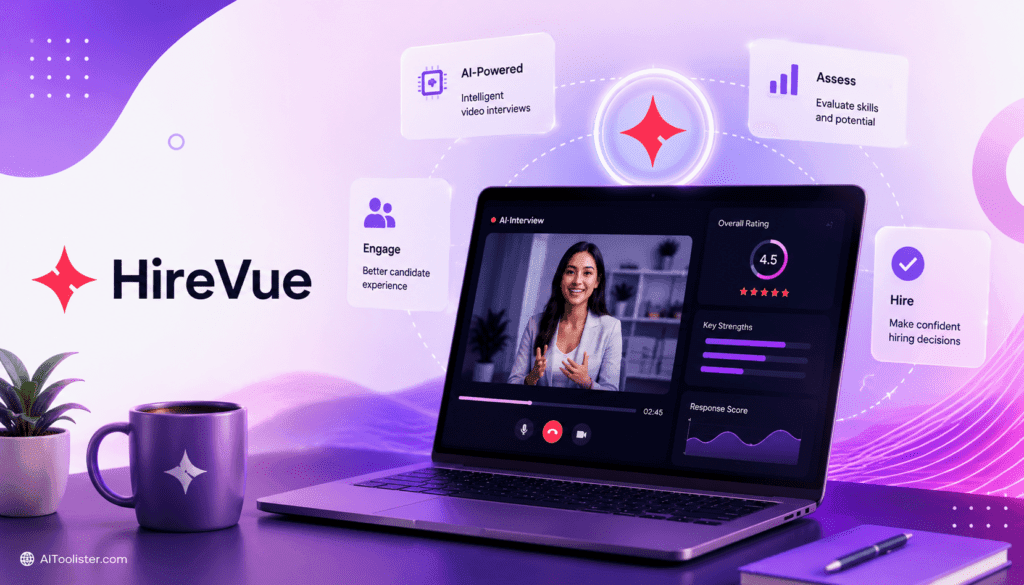
HireVue is one of the most widely recognized names in AI-powered recruiting, and its core product has been refined over many years into something genuinely useful for teams that need to screen a high volume of candidates efficiently.
The platform allows recruiters to create structured video interview questions that candidates complete asynchronously — meaning the candidate records their answers at a time convenient for them, and the recruiter reviews the responses when ready. The AI component analyzes responses for relevance and consistency against defined competencies, and surfaces scoring and insights to help recruiters prioritize which candidates to advance.
For high-volume roles — graduate programs, retail and hospitality hiring, large enterprise intake — this dramatically reduces the time between application and first human contact. Instead of scheduling and sitting through dozens of phone screens, recruiters review the most relevant candidates in a fraction of the time.
Key Features:
- Asynchronous AI video interviews
- Structured competency-based scoring
- Candidate ranking and prioritization
- Integration with major ATS platforms
- Game-based assessments available as an add-on
- Mobile-friendly candidate experience
Who It Is Best For: Enterprise HR teams and large organizations running high-volume hiring programs. Less suitable for boutique agencies or roles requiring deep relationship-building in the early stages.
Pricing:
- Free Plan: No
- Starting Price: Custom pricing — typically starts around $35,000/year for enterprise contracts
- Best Value: Enterprise plan with full ATS integration and analytics
Pros:
- Significantly reduces phone screen volume
- Consistent, structured candidate evaluation
- Strong ATS integration options
- Established platform with proven track record
Cons:
- Expensive — not accessible for small teams or agencies
- Candidate experience can feel impersonal for senior roles
- AI scoring has faced scrutiny around potential bias
2. Phenom — Best for Talent Experience and CRM
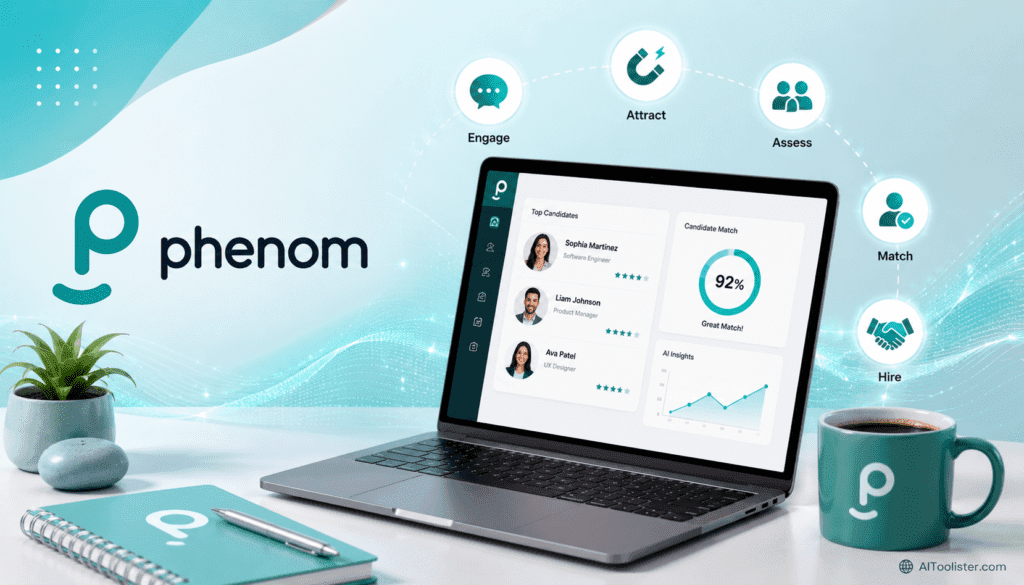
Phenom takes a different approach from most recruiting tools. Rather than focusing purely on screening efficiency, it focuses on the entire talent experience — how candidates find you, how they engage with your brand, how they move through the process, and how you keep them warm in a talent pipeline for future roles.
The platform includes an AI-powered career site builder, a candidate relationship management system (CRM), an internal mobility tool for existing employees, and a recruiting automation layer that ties it all together. For companies that care about employer brand and want to build a lasting talent pipeline rather than filling roles reactively, Phenom is one of the most complete platforms available.
The AI features are woven throughout rather than bolted on — the career site personalizes job recommendations based on a visitor’s browsing behavior and profile, the CRM suggests the right outreach timing and message based on candidate engagement signals, and the analytics dashboard shows where candidates are dropping off in the funnel.
Key Features:
- AI-powered career site with personalized job recommendations
- Talent CRM with automated nurture sequences
- Internal mobility and employee development tools
- Recruiter productivity analytics
- Chatbot for candidate engagement
- Integration with major HRIS and ATS platforms
Who It Is Best For: Mid-size to large companies with dedicated talent acquisition teams that want to build a proactive talent pipeline and improve employer brand. Not the right fit for small agencies or one-person recruiting operations.
Pricing:
- Free Plan: No
- Starting Price: Custom — typically mid-market plans start around $20,000/year
- Best Value: Full platform with CRM, career site, and analytics
Pros:
- One of the most complete talent experience platforms available
- Genuinely useful CRM for pipeline management
- Strong employer brand and career site tools
- AI recommendations improve over time
Cons:
- High cost — enterprise-focused pricing
- Implementation requires significant time investment
- Overkill for teams hiring fewer than 50 people per year
3. Fetcher — Best for Automated Candidate Sourcing
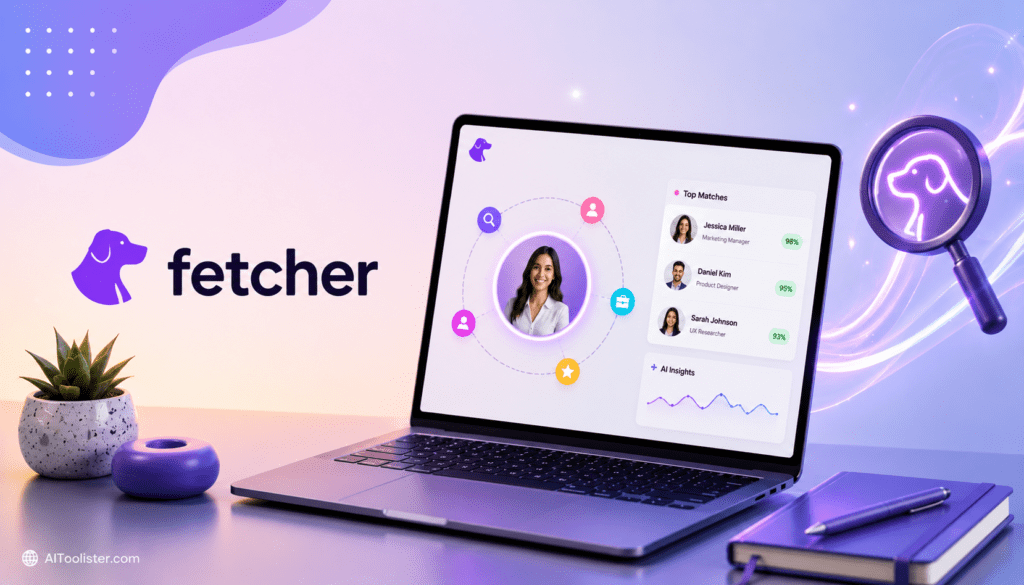
Sourcing is one of the most time-consuming parts of recruiting, particularly for roles where the right candidates are not actively looking and won’t show up in your inbound applications. Fetcher automates the sourcing process by searching across multiple talent databases and the open web, identifying candidates that match your defined criteria, and delivering them directly into your workflow.
What makes Fetcher stand out from basic sourcing tools is the combination of automation and human curation. The platform learns from your feedback — when you mark a candidate as a good fit or a poor fit, it adjusts its sourcing criteria accordingly and improves the quality of future batches. Over time, it gets meaningfully better at understanding what you’re actually looking for rather than just matching keywords.
It also handles the initial outreach. Fetcher can send personalized email sequences to sourced candidates, track opens and replies, and flag warm responses for recruiter follow-up — so you’re only getting involved when a candidate has already shown interest.
Key Features:
- Automated multi-source candidate discovery
- AI-powered matching that learns from your feedback
- Automated personalized email outreach sequences
- Response tracking and warm lead notifications
- ATS sync and workflow integration
- Diversity sourcing filters
Who It Is Best For: In-house recruiting teams and agencies that spend significant time on outbound sourcing for hard-to-fill or specialist roles. Particularly valuable for tech, engineering, and executive recruiting where passive candidate sourcing is essential.
Pricing:
- Free Plan: No
- Starting Price: $549/month (Starter plan)
- Best Value: Growth plan at approximately $1,099/month for teams with higher volume
Pros:
- Genuinely reduces sourcing time by a significant margin
- Learns and improves from recruiter feedback
- Outreach automation built in — not a separate tool
- Useful diversity sourcing features
Cons:
- Significant monthly cost for small teams
- Quality of sourcing varies by role type and location
- Best results take a few weeks to develop as the AI calibrates
4. Paradox (Olivia) — Best for AI Recruiting Chatbot
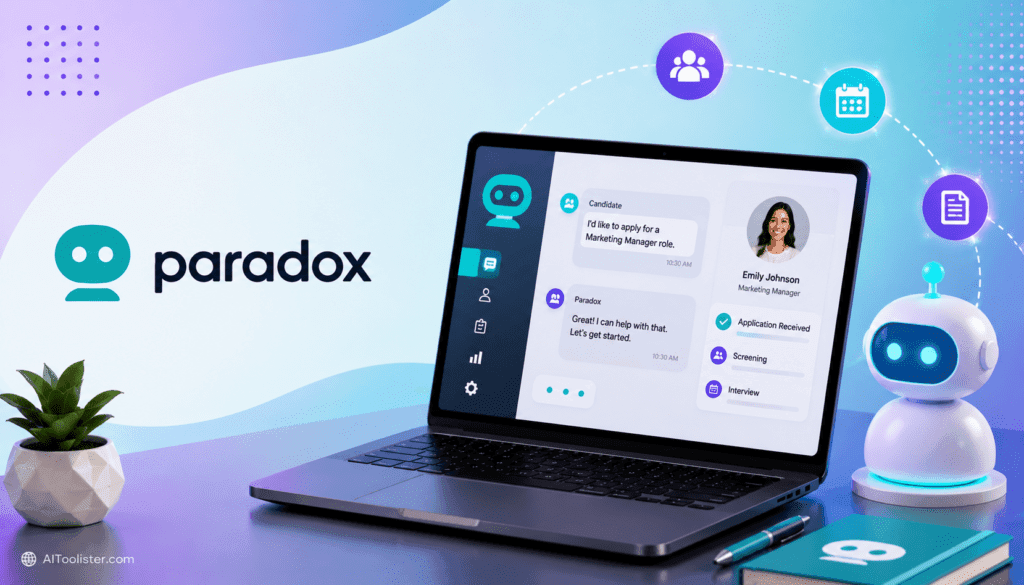
Paradox built its reputation on one thing: Olivia, an AI recruiting assistant that handles candidate communication through conversational chat. What started as a screening chatbot has evolved into a surprisingly capable end-to-end automation layer for high-volume hiring.
Olivia can engage candidates the moment they apply — answering questions about the role, completing a structured screening conversation, assessing basic qualifications, and scheduling an interview, all without any human involvement. For a candidate applying at 11pm on a Sunday, the experience is fast and responsive in a way that most recruiting processes simply aren’t.
For companies running high-volume hiring — retail, hospitality, logistics, healthcare — the impact can be dramatic. Olivia handles the entire top-of-funnel process, and recruiters only engage with candidates who have already been screened and have a scheduled interview on the calendar.
Key Features:
- Conversational AI for candidate screening and engagement
- Automated interview scheduling with calendar integration
- Multilingual support for diverse candidate pools
- Application status updates via chat
- Integration with all major ATS platforms
- Text-based engagement via SMS as well as web chat
Who It Is Best For: Companies running high-volume hiring programs — retail, warehouse, hospitality, healthcare, and any role with significant applicant volume where speed of engagement matters. Less useful for niche or senior-level roles.
Pricing:
- Free Plan: No
- Starting Price: Custom pricing — mid-market entry typically around $24,000/year
- Best Value: Full platform with scheduling, screening, and ATS integration
Pros:
- Dramatically speeds up top-of-funnel processing
- Candidate experience is genuinely conversational and responsive
- Operates 24/7 without human involvement
- Multilingual capability is a real differentiator
Cons:
- Custom pricing makes budgeting difficult upfront
- Not suitable for senior or complex role hiring
- Some candidates find chatbot screening impersonal
5. SeekOut — Best for Diversity and Talent Intelligence
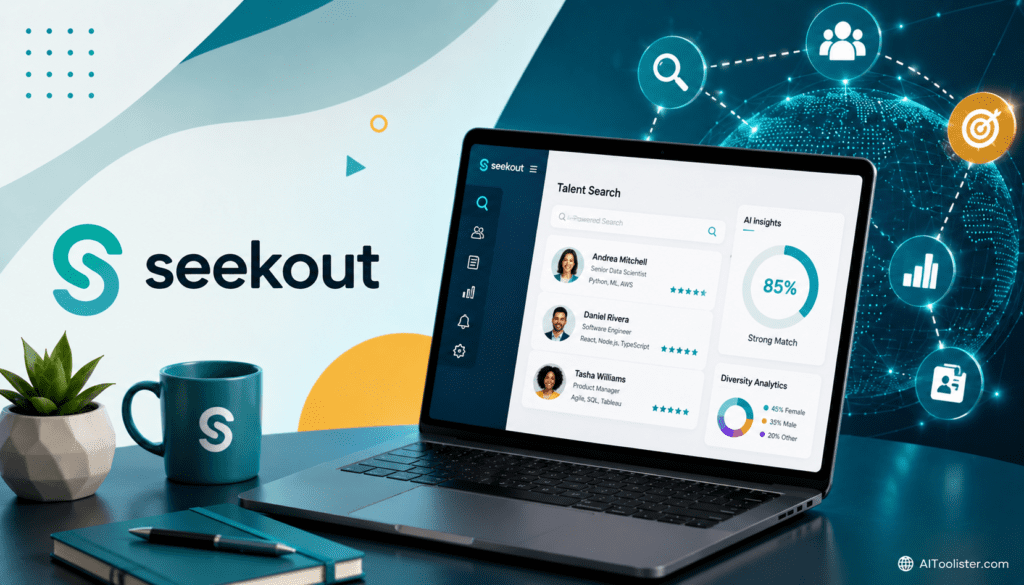
SeekOut is a talent intelligence platform built primarily for sourcing, but with a strong focus on diversity hiring and workforce analytics that sets it apart from standard sourcing tools.
The platform aggregates data from public profiles across GitHub, LinkedIn, research publications, patents, and other sources to build comprehensive candidate profiles. Its search capabilities are more granular than most sourcing tools — you can filter by highly specific technical skills, publications, certifications, career trajectory, and a range of diversity attributes including gender, ethnicity, and veteran status.
For organizations with explicit diversity hiring goals, SeekOut provides a way to build diverse candidate slates without relying purely on referral networks or inbound applications, which tend to reproduce existing demographic patterns. The talent analytics layer also helps recruiting teams understand workforce gaps and plan hiring strategy more proactively.
Key Features:
- Multi-source talent database with 800+ million profiles
- Advanced diversity sourcing and filtering
- Skills-based search across technical and non-technical roles
- Talent analytics and workforce intelligence
- ATS and HRIS integration
- Market data and competitive talent insights
Who It Is Best For: In-house recruiting teams with diversity hiring objectives, technical recruiting teams, and HR leaders who want workforce analytics alongside sourcing capability.
Pricing:
- Free Plan: No
- Starting Price: Approximately $1,200/month for small teams
- Best Value: Enterprise plan with full analytics and ATS integration
Pros:
- Exceptional diversity sourcing capabilities
- Highly detailed candidate profiles
- Strong technical talent sourcing for engineering roles
- Useful workforce analytics beyond just sourcing
Cons:
- Expensive for smaller teams
- Data accuracy varies by region and role type
- Requires time investment to use the advanced features effectively
6. Eightfold.ai — Best for AI-Powered Talent Matching
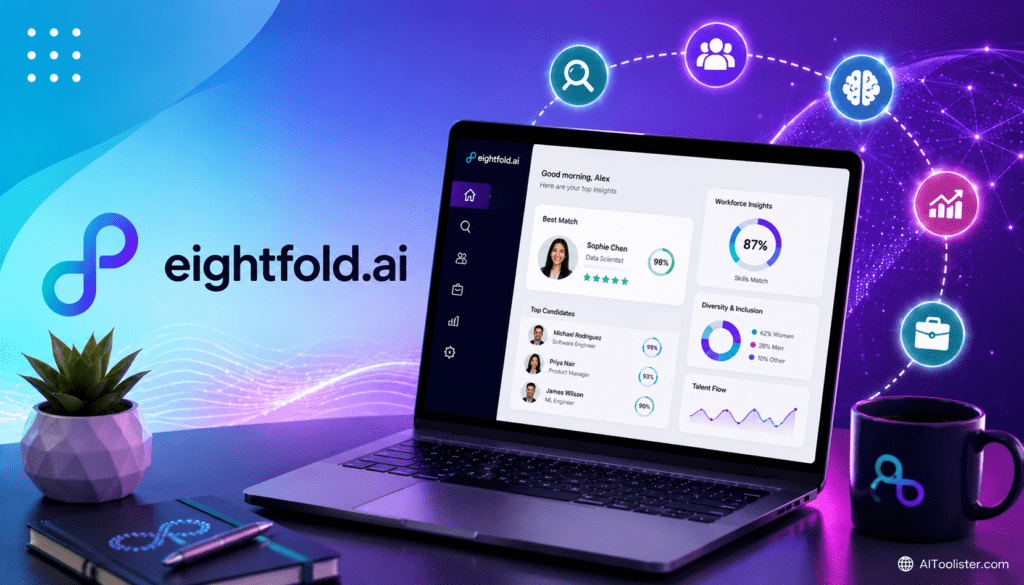
Eightfold.ai operates on a fundamentally different philosophy from most recruiting tools. Rather than matching candidates to jobs based on keywords and job titles, Eightfold uses deep learning to understand skills, potential, and career trajectory — and matches candidates to roles based on what they are capable of, not just what their resume literally says.
This matters because job titles are inconsistent across companies and industries. A “Senior Engineer” at one company may have a completely different skill set than a “Senior Engineer” at another. Eightfold looks past the labels to understand actual capability, which produces more relevant matches and surfaces candidates who might be overlooked by traditional keyword-based filtering.
The platform covers the full talent lifecycle — external hiring, internal mobility, workforce planning, and talent development — which makes it more of a strategic HR platform than a standalone recruiting tool. For large organizations that want to build skills-based hiring practices and reduce reliance on degree requirements and pedigree, Eightfold is one of the most sophisticated options available.
Key Features:
- Skills-based AI matching beyond keywords and titles
- Internal mobility and talent redeployment
- Diversity and bias reduction built into matching
- Workforce planning and skills gap analysis
- Candidate rediscovery from existing ATS database
- Deep integration with major HR platforms
Who It Is Best For: Large enterprises committed to skills-based hiring, organizations with high internal mobility needs, and HR leaders focused on long-term workforce planning.
Pricing:
- Free Plan: No
- Starting Price: Custom enterprise pricing — typically $100,000+ annually for full platform
- Best Value: Full talent lifecycle platform with workforce planning
Pros:
- Most sophisticated AI matching available in the market
- Skills-based approach reduces bias from traditional filtering
- Covers full talent lifecycle not just recruiting
- Strong rediscovery of existing candidate database
Cons:
- Very expensive — only realistic for large enterprises
- Significant implementation complexity
- ROI takes time to materialize — not a quick win
7. Manatal — Best for Affordable AI ATS
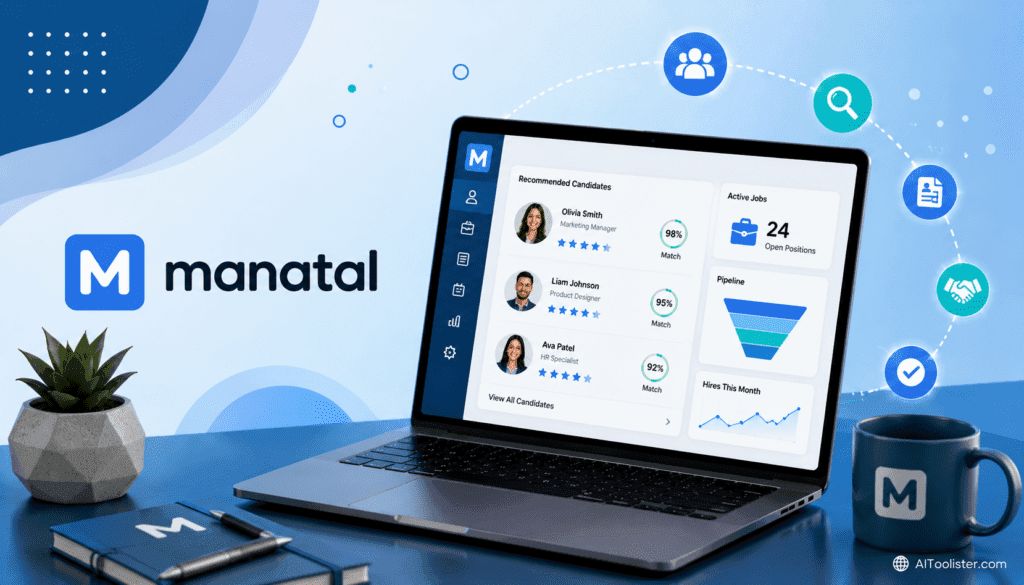
Most of the tools covered so far are enterprise products with enterprise price tags. Manatal is the exception — it is a full-featured AI-powered ATS built specifically for small recruiting teams, staffing agencies, and HR departments that need genuine AI capability without a five-figure annual contract.
The platform combines standard ATS functionality — job posting, pipeline management, candidate tracking — with AI-powered features that genuinely add value at a price point that individual recruiters and small agencies can actually afford. The AI scoring feature analyzes resumes against job descriptions and scores candidates automatically. The sourcing extension pulls candidate data from LinkedIn and other sources directly into the platform. The reporting dashboard gives clear visibility into pipeline health and team performance.
For a solo recruiter or small agency that currently uses spreadsheets or a basic free ATS, Manatal represents a significant upgrade at a very manageable cost.
Key Features:
- AI-powered candidate scoring and ranking
- Full ATS pipeline and candidate management
- LinkedIn and social media sourcing extension
- Job board posting to 2,500+ platforms
- Customizable recruitment pipeline stages
- Reporting and analytics dashboard
- GDPR compliance tools
Who It Is Best For: Solo recruiters, small staffing agencies, and SME HR teams that want AI-powered recruiting without enterprise pricing. Excellent starting point for teams currently relying on spreadsheets or basic free tools.
Pricing:
- Free Plan: 14-day free trial
- Starting Price: $19/user/month (Professional plan)
- Best Value: Enterprise plan at $39/user/month with advanced features
Pros:
- Most affordable AI-powered ATS available
- Quick to set up — genuinely usable within a day
- Covers both ATS and sourcing in one platform
- Excellent value for small teams
Cons:
- Less powerful than enterprise tools for complex workflows
- Integration library smaller than larger platforms
- AI features are simpler than dedicated AI sourcing tools
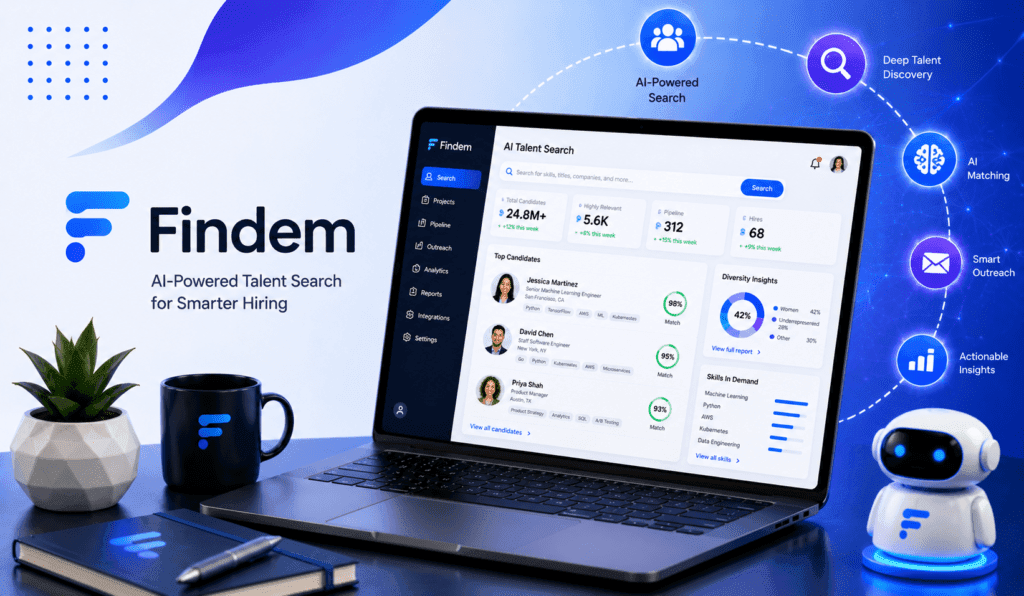
8. Findem — Best for People Data and Talent Sourcing
Findem approaches talent sourcing differently from most tools. Instead of searching across job profiles and resumes, it uses what it calls “attribute-based search” — it indexes people data across hundreds of sources and lets you search by attributes that don’t appear on a standard resume, such as specific company growth experience, particular technologies worked on, or career patterns that indicate a certain type of professional.
This makes Findem particularly powerful for finding candidates with very specific backgrounds that are hard to identify through keyword search. You’re not searching for someone who listed a particular skill on their profile — you’re searching for someone whose career history demonstrates the attribute you care about, whether or not they ever wrote it down explicitly.
The platform also includes talent market analytics, which shows hiring teams the size and location of talent pools for specific profiles, average compensation ranges, and competitive intelligence on where target candidates are currently employed.
Key Features:
- Attribute-based people search across 750+ million profiles
- AI-powered candidate discovery beyond keyword matching
- Talent market analytics and pool sizing
- Compensation data and competitive talent intelligence
- Automated outreach sequences
- ATS integration
Who It Is Best For: Technical recruiting teams, executive search firms, and organizations hiring for specialized roles where standard keyword search produces poor results.
Pricing:
- Free Plan: No
- Starting Price: Custom pricing — contact for quote
- Best Value: Team plan with analytics and outreach included
Pros:
- Attribute-based search surfaces candidates others miss
- Talent market analytics are genuinely useful for planning
- Strong for niche and specialist role sourcing
- More precise than keyword-based sourcing tools
Cons:
- No transparent pricing — requires a sales conversation
- Learning curve to use attribute search effectively
- May be overkill for generalist or high-volume roles
9. ChatGPT — Best for Writing Job Descriptions, Emails, and Outreach
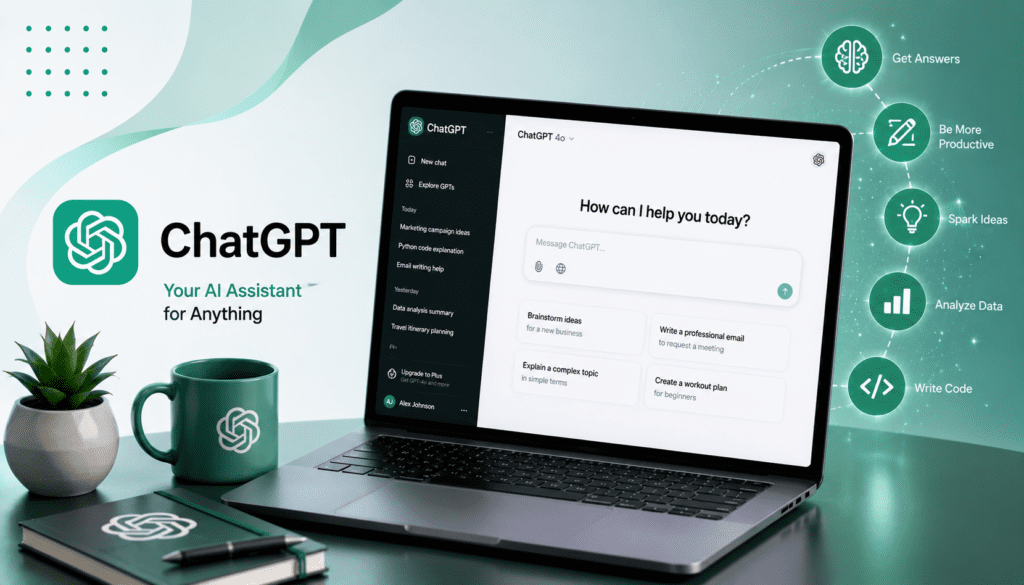
ChatGPT appears on this list not as a recruiting-specific platform, but because it is genuinely one of the most useful tools a recruiter can have in their daily workflow — and it costs almost nothing compared to everything else here.
The use cases in recruiting are extensive and immediate. Writing job descriptions that are clear, compelling, and free of jargon takes most recruiters far longer than it should. ChatGPT produces a strong first draft in under a minute from a simple brief. Cold outreach messages to passive candidates — one of the hardest things to write in a way that doesn’t sound like a template — can be drafted, varied, and refined quickly. Rejection emails, interview confirmation messages, hiring manager updates, offer letter frameworks, interview question banks — all of it is faster with ChatGPT than from scratch.
The limitation is that ChatGPT has no context about your specific role, your company culture, or your candidates. Every output is a starting point that requires your own knowledge and voice to become genuinely effective. Used well, it cuts writing time by 60 to 70 percent. Used lazily, it produces content that sounds exactly like every other AI-written email in a candidate’s inbox.
Key Features:
- Job description drafting and refinement
- Candidate outreach message creation
- Interview question generation by competency
- Rejection and status update email templates
- Offer letter and contract language assistance
- Market research and role benchmarking summaries
Who It Is Best For: Every recruiter, regardless of team size or specialty. The free plan alone is valuable; the Plus plan at $20/month adds capabilities that make it even more useful for daily writing tasks.
Pricing:
- Free Plan: Yes
- Starting Price: $20/month (Plus plan)
- Best Value: Plus plan at $20/month
Pros:
- Saves significant time on writing tasks
- Extremely versatile across all recruiting content types
- Free plan is genuinely useful
- No onboarding required — productive from minute one
Cons:
- No recruiting-specific knowledge or context
- All outputs require human review and editing
- Generic without specific, detailed prompting
10. Textio — Best for Bias-Free Job Description Writing
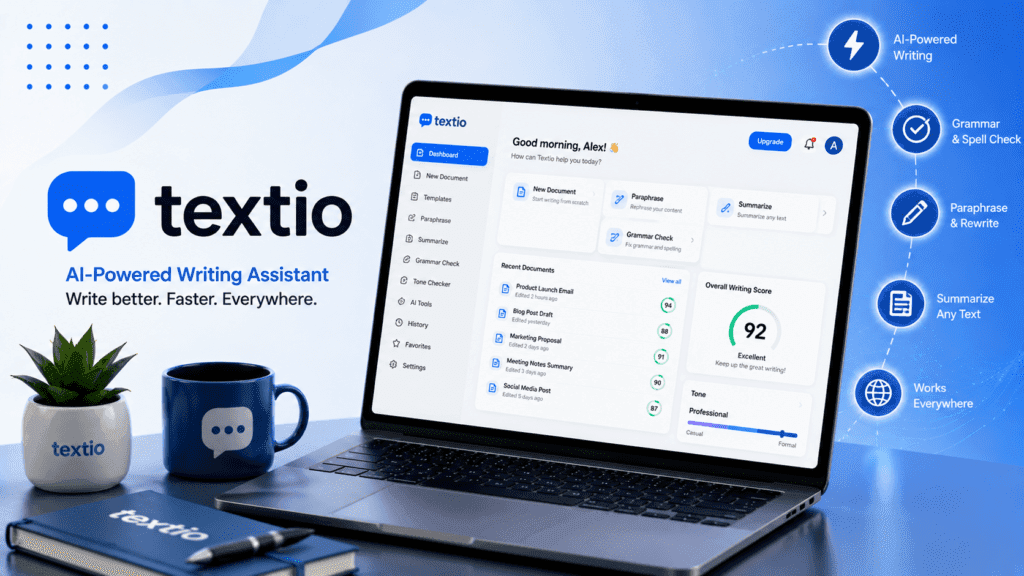
Textio is a specialized writing tool built specifically to help organizations write job descriptions, performance reviews, and recruiting communications that are free from language that unintentionally discourages diverse candidates from applying.
The research behind Textio is substantial: specific words and phrases in job descriptions have measurable effects on who applies. Language that skews masculine — words like “dominate,” “aggressive,” or “ninja” — significantly reduces applications from women. Phrases that imply a specific cultural background or age profile reduce candidate diversity in ways that hiring managers rarely intend. Textio’s AI identifies these patterns in real time as you write and suggests replacements that produce more inclusive, effective job postings.
Beyond bias reduction, Textio also scores job descriptions for overall effectiveness — predicting application rates, identifying phrases that top candidates respond poorly to, and benchmarking your language against what is performing well in your industry. For teams that are serious about inclusive hiring, this is not a nice-to-have — it is one of the highest-impact tools available.
Key Features:
- Real-time language bias detection and suggestions
- Job description effectiveness scoring
- Performance review writing guidance
- Recruiting email language analysis
- Industry benchmarking against high-performing postings
- Team collaboration and content library
Who It Is Best For: In-house HR and talent acquisition teams with explicit diversity hiring objectives. Also valuable for any organization that wants to improve application rates by writing more effective job descriptions.
Pricing:
- Free Plan: No
- Starting Price: Approximately $549/month for small teams
- Best Value: Team plan — contact for custom pricing based on headcount
Pros:
- Research-backed approach to bias reduction
- Measurable improvement in application rates
- Useful beyond job descriptions — covers all recruiting communications
- Strong team collaboration features
Cons:
- Expensive for what is essentially a writing tool
- Focused on a specific use case — not a full recruiting platform
- Some suggestions can feel overly cautious
Pricing Comparison Table
| Tool | Free Plan | Starting Price | Best Value Plan | Best For | Difficulty |
| HireVue | No | ~$35,000/year | Enterprise | High-volume interviews | Medium |
| Phenom | No | ~$20,000/year | Full platform | Talent experience & CRM | Medium |
| Fetcher | No | $549/month | Growth plan | Automated sourcing | Easy |
| Paradox (Olivia) | No | ~$24,000/year | Full platform | High-volume chatbot | Easy |
| SeekOut | No | ~$1,200/month | Enterprise | Diversity sourcing | Medium |
| Eightfold.ai | No | $100,000+/year | Full lifecycle | Enterprise talent matching | Hard |
| Manatal | 14-day trial | $19/user/month | $39/user/month | Small teams & agencies | Easy |
| Findem | No | Custom pricing | Team plan | Specialist sourcing | Medium |
| ChatGPT | Yes | $20/month | Plus plan | Writing & communication | Easy |
| Textio | No | ~$549/month | Team plan | Bias-free job descriptions | Easy |
AI Tools by Recruiter Type — Which One Is Right for You?
Best AI Tools for In-House HR Teams
In-house teams typically need tools that integrate with existing HRIS and ATS systems, support multiple hiring managers across departments, and provide analytics that help justify headcount and demonstrate recruiting ROI to leadership.
The strongest combination for most in-house teams is Phenom for talent pipeline and employer brand, SeekOut or Fetcher for outbound sourcing, Textio for job description quality, and ChatGPT for day-to-day writing efficiency. For teams with significant volume, adding Paradox for top-of-funnel automation reduces screen time substantially.
Best AI Tools for Staffing and Recruiting Agencies
Agencies need tools that are fast to deploy across multiple client mandates, support high candidate volumes, and keep costs manageable per placement. Enterprise pricing models that charge per seat or per year can become expensive when margins are tight.
Manatal is the standout recommendation for agencies — it provides genuine AI capability at a price that works per recruiter. Fetcher adds strong automated sourcing for hard-to-fill roles. ChatGPT handles the constant writing demands of agency work without adding per-seat costs.
Best AI Tools for Freelance and Solo Recruiters
Solo recruiters need maximum output from minimum tools and minimum spend. The priority is removing the tasks that eat time without adding operational complexity.
Start with ChatGPT for all writing tasks — job descriptions, outreach, follow-ups, and interview preparation. Add Manatal as your ATS and AI screening layer. These two tools alone transform what a solo recruiter can handle in a week.
Best AI Tools for High-Volume Hiring Operations
High-volume hiring — retail, logistics, healthcare, hospitality — is where AI recruiting tools deliver their most dramatic ROI. The combination of application volume and speed-of-engagement requirements makes manual processes genuinely unworkable at scale.
HireVue for video screening and Paradox for conversational AI and scheduling are the two platforms built most specifically for this use case. Together, they can take a candidate from application to scheduled interview without any human involvement — which is exactly what high-volume hiring requires.
Key Features to Look For in an AI Recruiting Tool
Resume Parsing and Candidate Screening
The most basic and universal AI recruiting feature is the ability to read and understand a resume without human involvement — extracting relevant information, comparing it against job requirements, and producing a relevance score or ranking. The quality of parsing varies significantly between platforms. Look for tools that handle varied resume formats well, understand context rather than just keyword matching, and allow you to customize the criteria being evaluated.
Automated Outreach and Candidate Engagement
Automated outreach that feels personalized is difficult to get right, but when it works it meaningfully improves response rates from passive candidates. Look for tools that allow message personalization at scale, support multi-touch sequences, track engagement signals, and flag warm responses for human follow-up rather than continuing to automate indefinitely.
Interview Scheduling and Coordination
Interview scheduling is one of the most universally disliked administrative tasks in recruiting — the back-and-forth to find a mutual time wastes hours every week. AI scheduling tools integrate with calendar systems to offer candidates real availability and confirm interviews without human involvement. This is a high-impact, low-complexity feature that delivers immediate time savings.
Bias Reduction and Diversity Hiring Support
AI tools can either reduce or amplify bias in hiring depending on how they are built and what data they were trained on. When evaluating tools, look specifically for bias auditing, diverse training data, the ability to remove demographic information from early screening stages, and transparent documentation of how the AI makes its decisions. Tools that cannot explain their scoring or matching logic should be approached with caution.
ATS Integration and Workflow Compatibility
A recruiting tool that doesn’t connect with your existing ATS creates more work than it saves. Before committing to any platform, verify that it integrates with the ATS your team already uses, that the integration is bidirectional, and that candidate data flows cleanly between systems. Poor integration is one of the most common reasons AI recruiting tools fail to deliver on their promise.
Real Benefits of Using AI in Recruitment
Faster Time-to-Hire
The most direct and measurable impact of AI in recruiting is speed. Automated screening, instant candidate engagement, and AI-powered scheduling compress the timeline between application and offer in ways that manual processes cannot match. For roles with high competition for talent, this speed advantage directly affects quality-of-hire — the best candidates are often off the market within days.
Reduced Cost Per Hire
When recruiters spend less time on low-value administrative work, they can handle more roles simultaneously without increasing headcount. Automated sourcing and screening reduce the hours spent per hire, which reduces cost per hire in a measurable and repeatable way. For agencies, this directly improves margin. For in-house teams, it means hiring targets can be met with existing resources.
Improved Candidate Experience
Candidates who receive fast, responsive communication — even if that communication is automated — have a better experience than candidates who wait days for a response. AI-powered chatbots and scheduling tools ensure that no candidate falls through the cracks and that every applicant receives timely updates. This matters for employer brand as much as it matters for individual hiring outcomes.
Better Quality of Hire Through Data and Matching
AI tools that analyze candidate data at scale can identify patterns that predict job performance — patterns that are too subtle for humans to detect when reviewing resumes individually. Over time, this produces better matches between candidates and roles, which reduces early turnover and improves hiring outcomes. This is one of the more long-term benefits that requires consistent data and thoughtful implementation to realize.
Risks and Limitations of AI Recruiting Tools
Algorithmic Bias and Fairness Concerns
This is the most serious risk associated with AI in recruiting, and it deserves honest discussion rather than a footnote. AI systems trained on historical hiring data can perpetuate the biases present in that data. If a company historically hired a particular demographic profile for a role, an AI trained on that hiring history may favor similar profiles going forward — even if those biases are exactly what the organization is trying to move away from.
Responsible AI recruiting vendors conduct regular bias audits and publish their results. When evaluating any AI screening or matching tool, ask specifically about their bias testing methodology, what demographic groups they test across, and what mitigation steps they have taken.
The Danger of Over-Relying on Automation
There is a version of AI-powered recruiting that removes human judgment so completely that candidates feel processed rather than considered. Fully automated screening, chatbot-only communication, and AI-generated rejection emails with no human review can produce an experience that damages employer brand and loses strong candidates who don’t perform well in automated formats.
AI should accelerate human judgment, not replace it. Maintain human review at meaningful decision points — particularly at any stage where a candidate’s opportunity to advance in the process is being determined.
Data Privacy and Legal Compliance
Recruiting involves collecting and processing significant amounts of personal data. AI tools that aggregate candidate information from multiple sources, retain application data, or use behavioral signals in scoring decisions have significant compliance implications under GDPR in Europe, state-level privacy laws in the United States, and EEOC guidelines on employment discrimination.
Before deploying any AI recruiting tool, involve legal and compliance teams. Ensure the vendor can demonstrate compliance with the regulations applicable to your hiring geographies, that data retention policies are clearly defined, and that candidates are informed about how their data is being used in the screening process.
When Human Judgment Still Wins
There are specific recruiting situations where AI adds little value and may actively detract from outcomes. Senior leadership hiring, roles requiring cultural judgment, positions in organizations with unique values or working styles, and any hire where the relationship between the candidate and the hiring manager is itself a key determinant of success — these are all situations where human judgment should lead from the start and AI should play a supporting role at most.
How to Implement AI Tools in Your Recruiting Workflow
Step 1 — Identify Your Biggest Time Drain First
Before choosing any tool, spend one week tracking where your recruiting time actually goes. The answer is often surprising — and it determines everything about which tool will deliver the highest return. If sourcing is consuming half your week, a sourcing automation tool like Fetcher is the right starting point. If you’re drowning in scheduling coordination, an AI scheduling tool delivers faster ROI. If writing job descriptions takes three hours per role, ChatGPT changes your day immediately. Match the tool to the problem, not to what sounds most impressive.
Step 2 — Start With One Tool, Not Five
The most common mistake when adopting AI recruiting tools is selecting a suite of platforms simultaneously and failing to integrate any of them properly into daily workflow. One tool used consistently and well delivers far more value than five tools used sporadically. Choose the single tool that addresses your most painful daily problem, use it every day for thirty days, and let the results determine whether you need to expand.
Step 3 — Measure Results After 30 Days
AI recruiting tools should produce measurable outcomes. After thirty days of consistent use, you should be able to answer: Has my time-to-fill improved? Has my sourcing volume increased? Has the quality of candidates reaching the interview stage improved? If you cannot measure an improvement, either the tool is not the right fit, or it is not being used in the right way. Both of those are solvable problems — but only if you are tracking the data.
Step 4 — Scale What Works and Drop What Doesn’t
Once a tool is delivering measurable value, that is the signal to scale — whether by using it more extensively, adding team members to the platform, or expanding its use to additional roles or stages of the process. Tools that are not delivering after a fair evaluation period should be cut without sentiment. The goal is not to use AI tools — the goal is to hire better, faster, and at lower cost. Keep only what contributes to that outcome.
Frequently Asked Questions
What is the best AI tool for recruiting in 2026?
There is no single best tool because the answer depends entirely on your recruiting context. For small teams and agencies, Manatal offers the best combination of AI capability and accessible pricing. For sourcing automation, Fetcher is a strong choice. For high-volume hiring, HireVue and Paradox address the specific challenges of that environment. For any recruiter regardless of team size, ChatGPT is immediately useful for writing and communication tasks and costs almost nothing. Start with the tool that addresses your most pressing daily problem.
Can AI completely replace human recruiters?
No, and it is unlikely to do so for the foreseeable future. AI is highly effective at processing high volumes of structured data — scanning resumes, matching criteria, scheduling interviews, and managing communication workflows. It is not effective at the judgment-intensive work that determines whether a person will succeed in a specific role and organization — assessing personality, motivation, cultural fit, and leadership potential. Those assessments require human experience, intuition, and relationship-building that current AI tools do not replicate. The more realistic and useful framing is that AI removes the administrative burden so recruiters can spend more time on the work that actually requires human capability.
Are AI recruiting tools expensive?
The range is significant. At the enterprise end, platforms like Eightfold.ai, HireVue, and Phenom operate on annual contracts in the tens to hundreds of thousands of dollars. At the accessible end, Manatal starts at $19 per user per month, and ChatGPT is free for basic use. For most individual recruiters and small agencies, the combination of Manatal and ChatGPT delivers substantial AI capability at a total cost under $60 per month. The expensive enterprise tools are built for organizations with complex, high-volume hiring needs — they are not the right starting point for most teams.
How do AI tools help reduce hiring bias?
AI tools address bias in several specific ways. Tools like Textio identify language in job descriptions that is statistically shown to discourage diverse candidates from applying and suggest more neutral alternatives. Screening tools that evaluate candidates against objective skill criteria reduce the influence of subjective assessments that can reflect unconscious bias. Anonymized resume review features remove names, educational institutions, and other demographic signals from early screening stages. However, AI can also amplify existing bias if the models are trained on historical data that reflects past discriminatory patterns. Bias reduction in AI recruiting requires both thoughtful tool selection and regular auditing of outcomes.
Which AI tool is best for small recruiting teams?
Manatal is the clearest recommendation for small teams. It provides genuine AI-powered candidate scoring, a full ATS, job board integrations, and sourcing capability at a price point — starting at $19 per user per month — that is accessible for teams of any size. Pair it with ChatGPT for writing and outreach, and a small team of two or three recruiters has a complete AI-powered workflow for under $100 per month total.
Is ChatGPT useful for recruitment tasks?
Yes, and more so than many recruiters realize until they start using it consistently. The most impactful use cases are writing job descriptions quickly and in a compelling voice, drafting personalized outreach messages to passive candidates, creating structured interview question banks for specific competencies, generating rejection email templates that are professional and respectful, and summarizing large amounts of market research for hiring manager briefings. The key to getting value from ChatGPT in recruiting is specific, detailed prompting — the more context you give it about the role, the company, and the candidate profile, the more useful the output.
What is an ATS and do AI tools integrate with it?
An ATS — Applicant Tracking System — is the software platform that manages the recruiting workflow from job posting to offer. It tracks applications, manages candidate pipelines, stores candidate records, and provides a central system of record for recruiting activity. Most organizations of any size use one, whether a basic free tool or an enterprise platform. AI recruiting tools vary significantly in their ATS integration capability. The best tools offer bidirectional integration with all major ATS platforms — meaning data flows in and out automatically. Always verify specific ATS compatibility before committing to any AI recruiting tool, and test the integration before signing a contract.
Are AI recruiting tools legally compliant?
This depends entirely on the specific tool, how it is configured, and the jurisdictions in which you are hiring. In the United States, the EEOC has published guidance on the use of AI in employment decisions, and several states — including New York City — have specific laws requiring audits of AI tools used in hiring. In Europe, GDPR governs how candidate data can be collected, stored, and processed. A responsible AI recruiting vendor will provide clear documentation of their compliance posture, conduct regular bias audits, support data deletion requests, and provide transparency into how AI-based decisions are made. Any vendor that cannot clearly answer compliance questions should not be given access to your candidate data.
Conclusion
The tools covered in this article represent the most useful and credible AI options available to recruiters in 2026 — from accessible entry points like Manatal and ChatGPT to enterprise platforms like Eightfold.ai and HireVue that are transforming how large organizations manage their talent pipelines.
The right starting point depends on where the friction is in your current process. If writing is eating your time, start with ChatGPT today — it costs nothing and delivers results immediately. If you need a complete AI-powered ATS at an accessible price, Manatal is the clearest recommendation for small teams and agencies. If sourcing is the bottleneck, Fetcher automates the work that currently takes your best hours. If you are running high-volume hiring at scale, the combination of HireVue and Paradox is built specifically for that environment.
What matters most is starting. Recruiters who are still evaluating AI tools while their competitors are already using them are falling behind in a way that is measurable in time-to-fill, cost-per-hire, and quality of talent pipeline. The barrier to entry has never been lower — meaningful AI recruiting capability is now available at price points that work for individual practitioners, not just enterprise HR departments.
Pick the tool that solves your most immediate problem. Use it consistently. Measure the result. Build from there.
About the AIToolister Editorial Team
This article was researched, reviewed, and published by the AIToolister Editorial Team.
Our team evaluates every AI tool based on practical use cases, features, pricing, ease of use, integrations, customer value, and overall performance. We regularly review and update our content to ensure readers receive accurate, unbiased, and up-to-date information.
Our goal is to help professionals, businesses, and creators discover the best AI tools with honest reviews, detailed comparisons, and expert buying guides.
For more in-depth reviews of AI tools across different business categories, explore the full library at aitoolister.com.
AI Tool Discovery


